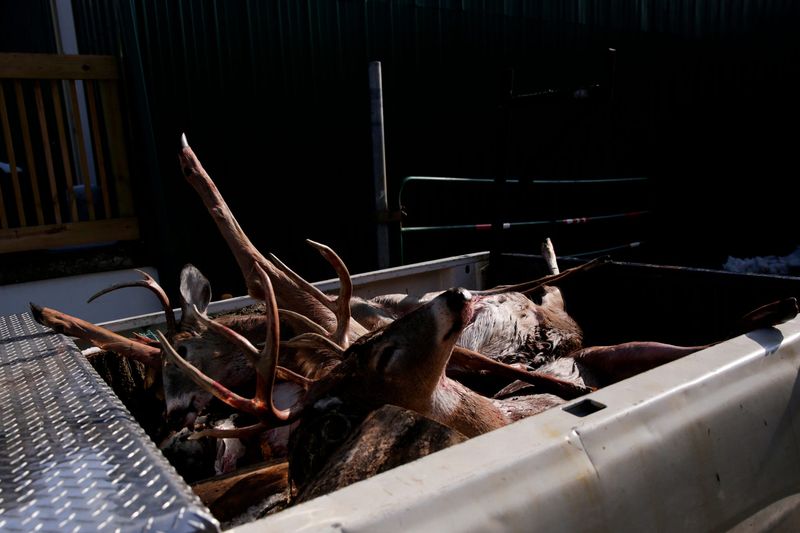
The day Derrick Haas first encountered epizootic hemorrhagic disease (EHD) started like many others: he headed out into the woods to go hunting.
It was the first day of squirrel season in mid-August, and Haas, an avid outdoorsman, drove from his home in Orange County in southern Indiana to Pakota Lake. He parked his truck and started walking, following the ridgeline about a mile back into the woods where he spied a sliver of the lake through the forest. Then he saw a flurry of wings.

Dozens of turkey vultures were swarming through the air down by a creek in a scene reminiscent of Alfred Hitchcock’s horror film “The Birds.”
“I walked over there to see what was going on, and the closer I got, the more nervous I got. I was so far out, and you never know what you’re gonna find,” Haas said.
As Haas walked down the hill, the horde of vultures flew up into the trees, waiting. Then he noticed a pair of antlers and the carcass of a white-tailed buck sticking up out of the creek. The animal’s massive 10-point rack was still covered in velvet, the fuzzy skin that envelops antler bone as it grows. Haas wasn’t sure what disease could have felled a buck so clearly in its prime.
“I would think that maybe [disease] might kill an older deer or a younger deer,” he said. “For it to kill a beautiful buck like that?… It was depressing.”
Only after encountering a game warden did Haas learn that the disease was most likely EHD, a virus that can whip through formerly healthy deer herds. However, the state typically does little to intervene against the effects of EHD unless an outbreak reaches a dangerous threshold; that approach has left some hunters questioning whether more should be done to offset the impact of so many dead deer.
But that wasn’t on Haas’s head as he stared at the imposing buck. He reached down to touch its rack and immediately regretted it. Worried that whatever killed the deer was contagious, Haas hightailed it out of the woods where he eventually met the game warden. Luckily for him, the disease does not affect humans, but almost 90% of deer that develop symptoms will die.
Seeing EHD kill deer can be traumatic for hunters, said Brian Stone, a hunter from Vigo County and the chair of Indiana’s chapter of Backcountry Hunters and Anglers.
“Ultimately, our goal is to go out and harvest these animals, right? But you develop a relationship with them, and you want to see them thriving,” Stone said. “You can understand why they’re concerned about it and frustrated and want to see something done.”
The state’s Department of Natural Resources has struggled to effectively communicate the rationale behind what some see as a laissez faire approach to EHD management. Studies suggest that EHD poses little risk to the long-term health of deer herds. If the disease is managed, like through the slightly reduced bag limits the state issued this past fall after an EHD outbreak, biologists expect deer populations to rebound after several years.
Still, the sentiment “everything will be okay eventually” isn’t always an easy pill for hunters to swallow in the midst of what feels like calamity.
Now the agency is trying a new approach to rebuild trust by engaging hunters as citizen scientists and increasing transparency. And according to a study published last month in the journal Proceedings of the ACM on Human-Computer Interaction, the state’s push to connect with hunters seems to be working — just slowly.
Flimsy trust and a lack of clarity
Although EHD has been circulating in deer herds in Indiana since at least 1955, some outdoorsmen still see outbreaks as a call for action.
The DNR says EHD is naturally occurring and almost always persistent on the landscape in small amounts, but significant outbreaks, like the one Indiana saw this year, tend to occur every few years after long stretches of warm, dry weather. As water bodies dry up, deer tend to congregate in larger groups at the remaining drinking holes, where tiny midges carrying the EHD virus can infect more deer at once.
Despite EHD’s status as almost a fact-of-life now in Indiana, Facebook groups and online forums still light up with concern and debate over management policies when an outbreak does occur.
DNR deer biologist Joe Caudell understands why this can lead to an outcry.
“Hunters are experiencing what I described as essentially a traumatic event,” Caudell said.
In the past, the DNR offered irregular updates and little information about disease outbreaks. DNR officials conceded that the agency lacked a “convenient, efficient or precise” tool that allowed the public to monitor EHD before 2019. Some cases of EHD reported by hunters fell through the cracks, according to a 2023 report written by Caudell and Emily McCallen published in the magazine Wildlife Professional. Some calls about sick or dead deer were dismissed and communication with the public about EHD was irregular.
With no infrastructure to track EHD, the DNR had no way to easily identify emerging patterns about disease spread.
Further complicating matters, severe outbreaks can be highly localized. For instance, Jennings County in southeast Indiana had 327 suspected EHD cases this year, but Ripley County, just next door, had 14. A hunting regulation that might seem like good management to one hunter could upset another a few miles away. And due to the agency’s focus on only the largest EHD outbreaks prior to 2019, smaller, hyperlocal EHD events weren’t always adequately addressed, eroding public trust, which Caudell and McCallen acknowledged in the article.
Managing deer, managing people
Hunters complained that the DNR was either ignoring their concerns or simply incompetent.
Caudell wanted to change that. The state deer biologist has spent the last several years trying to foster trust with hunters by involving them in data collection, getting direct input through annual surveys and making the DNR’s deer program more transparent.
“I was listening to [hunters], and what I was hearing is they wanted more transparency. They wanted to be involved in the discussions about deer management,” he said. “They wanted to see how we were making our decisions.”
And, he explained, he needs their help, too.
“There are very few people actually dedicated to working with deer in the state,” said Caudell, who has a handful of experts on his team. “And we have 92 counties. We just don’t have the eyeballs to see what’s going on when it comes to something like a disease outbreak.”
So the DNR is now relying heavily on the public, especially hunters who are expert citizen scientists with years of expertise, to collect data. Today almost all of the information gathered about EHD outbreaks is compiled by the state through submissions from the public.
The information is then shared with hunters through online dashboards. The DNR uses the same data to make EHD management decisions.
According to the study published last month analyzing the outcome of Indiana’s approach, Caudell’s work is effectively engaging the public with state wildlife management — and fostering a little bit of trust.
The study interviewed 14 rural hunters from across Indiana about how they viewed their role in the DNR’s data ecosystem, which collects information from hunters about their experience on the hunt, harvest totals, wildlife distribution and disease surveillance.
One hunter described feeling like he was the “eyes and ears” of the DNR. Others described feeling like the expanded tools the DNR was using to collect data showed that the agency was genuinely investing in its relationship with deer hunters.
In years past, the DNR relied on staff to collect information by chatting with hunters at physical check stations, asking that hunters only submit information about deer they killed, according to the study. Now, hunters can share their experience, opinions and suggestions for future management policies in detail through multiple surveys.
“It sounds like changes are made based on some information that is collected by the general public from these surveys,” said Will Judson, a hunter from Marion County and the vice-chair of Indiana’s chapter of Backcountry Hunters and Anglers. “The changes that might occur from some of those questions, they don’t come up in the next season, but they might be a season or two down the road.”
But rebuilding trust can take years and some hunters remain skeptical about how seriously the DNR takes the threat of EHD.
Claude Reynolds, a hunter from Wayne County, said he thinks EHD is a far more pressing concern than Chronic Wasting Disease, an ailment that state governments and universities have focused on partly due to its ability to spread between animals (unlike EHD). But Chronic Wasting Disease, first found in Indiana in 2024, could have severe long-term impacts if it spreads.
It’s not uncommon for hunters, like Reynolds, to have questions and concerns. Caudell often spends an hour or more with a hunter on the phone, wading through datasets and explaining how the agency makes decisions.
It may be tedious, but in his opinion, it’s worth it.
“We’re managing this for the public,” he said. “The only way you can do that is to bring the public into that process.”
Despite some of Haas’s reservations about some DNR practices, he participates actively in the state’s wildlife data ecosystem. He uses the state’s data to prepare for hunting season, and when he’s out wandering on state properties, he records how much wildlife he sees and dutifully reports back to the DNR without begrudging the time that might take.
“That way they can get a better, accurate read on what’s going on,” Haas said. “You know, the hunter has an important role to play.”
IndyStar’s environmental reporting is made possible through the generous support of the nonprofit Nina Mason Pulliam Charitable Trust.
Sophie Hartley is an IndyStar environment reporter. You can reach her at sophie.hartley@indystar.com or on X at @sophienhartley.
This article originally appeared on Indianapolis Star: This nasty virus kills healthy deer. Hunters want state to act but DNR says not so fast
Reporting by Sophie Hartley, Indianapolis Star / Indianapolis Star
USA TODAY Network via Reuters Connect