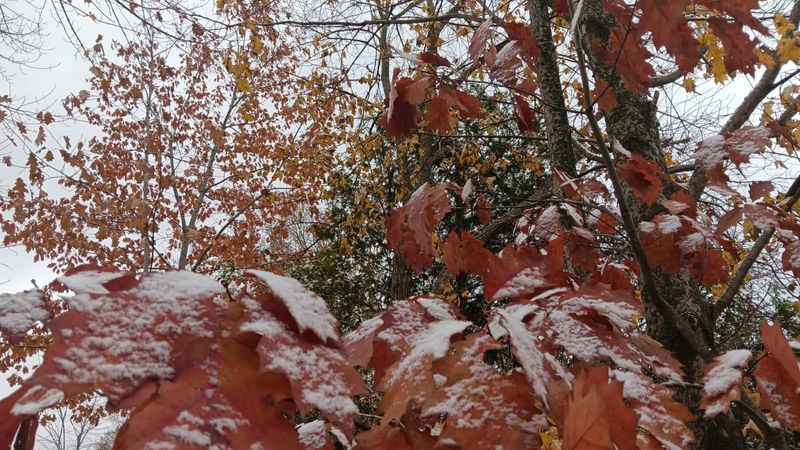
The National Weather Service has issued its first winter weather advisory for lake-effect snow this fall for Oneida, Madison and Onondaga counties from 6 p.m. on Monday, Nov. 10 until 6 p.m. on Tuesday, Nov. 11.
The advisory warns of accumulations between three and six inches across the three counties, with wind gusts of up to 35 miles per hours. Travel could become difficult and conditions may affect the morning and evening commute on Veteran’s Day, it warned.

“What most of the snowfall is or will be up in your area is just lake effect,” said meteorologist Ben Lott, of the National Weather Service in Binghamton. “So the winds upon the surface are northwesterly off of Lake Ontario. And because of the temperature difference between the air and the lake, then you get the snow that developed off of the lake.
“All this really is favorable conditions for lake effect snow.”
The cooler temperatures in place on Nov. 10 and predicted for Nov. 11 are what brings the lake effect snow, he added.
Some of the lake effect snow is predicted to hit Herkimer County as well, Lott said. And a number of counties along Lake Ontario and in western New York are also under winter weather advisories.
Other areas may see a bit of snow, but not as much, he said.
Here’s what you need to know.
The NWS forecast for the Utica area
The evening of Nov. 10: It will be cloudy with a chance of snow showers and a high near 38 degrees. There will be little or no snow accumulation.
Overnight from Nov. 10 to Nov. 11: Snow is likely, mainly after 4 a.m. with as much as an inch of accumulation possible. The low will be 25 degrees.
Tuesday, Nov. 11: Snow showers are likely during the day and overnight with a high of 37 degrees and a low of 29 degrees. Total accumulation will be around two inches during the day and less than another inch overnight. Wind gusts could reach speeds of up to 31 miles per hour.
“And then because the winds are going to be gusty, you should know wind chills are going to be in the teens in the morning and in the 20s in the afternoon,” Lott said. “So even though it’s in the 30s, it’s probably going to feel a lot colder than the thermometer’s reading.”
Wednesday, Nov. 12: With warmer temperatures — a high of 41 degrees and a low of 33 degree overnight — rain and snow are likely to mix during the day, turning to showers overnight.
Thursday, Nov. 13: Showers are likely during the day with the possibility of snow mixing with the rain overnight. The high will be 43 degrees and the low of 31 degrees.
Friday, Nov. 14: The high will be 43 degrees with a chance of showers.
What does a winter weather advisory mean?
The National Weather Service puts out these advisories whenever hazardous weather with a snowfall of between four and seven inches is predicted, Lott said.
What do I need to know about potential hazards?
“We’ve been driving on dry roads so we probably advise people to take thing easy given that this is the first snowfall,” Lott said. “If they are out on the road during heavier snowfall periods, there could be some reduced visibility as well.”
Those wind gusts could also blow more snow into the air, making it even harder to see when it’s already snowing hard, he said.
Is it early or late for the first significant snowfall?
Although flakes may fall in October, sometime in November seems to generally be right for the season’s first significant snowfall and hazardous weather, Lott said.
The Syracuse area, the site of the closest official weather station, typically gets just under 10 inches of snow in November, with only a few tenths of an inch falling in October, he said.
Data from the 17 active Global Historical Climatology Network stations located in Oneida County shows that none of them received more than a dusting last October, according to the National Centers for Environmental Information. And none of them had measurable snow last year until Nov. 21, when 0.4 inches was measured at the Point Rock station, 0.2 inches in Westmoreland and 0.1 inches in New Hartford.
The first significant snowfall came on Nov. 22 when Boonville got 6 inches. And Jordanville in Herkimer County got 7.5 inches. Several other stations in Oneida and Herkimer County (where there are seven stations) also got measurable snow that day, but an inch or less.
How much snow has New York already gotten this year?
The National Centers for Environmental Information data, which only runs through Nov. 8, shows snow fell, showed the first recorded snowfall in the state in East Aurora and Elma Center in Erie County on Oct. 23. But not enough snow fell to be measured.
Binghamton and Oswego also had dustings on Oct. 24.
The first measurable snowfall came on Nov. 1 with 2.5 inches falling Lake Placid, 1.4 inches at Saranac Lake and less than an inch measured at Highmarket and Harrisville in Lewis County, Long Lake and Tupper Lake.
Morrisville got a dusting on Nov. 2 and 4, and Boonville saw a dusting on Nov. 6.
The North County saw more snow on Nov. 6 with 2.7 inches falling in Wilmington, 1.5 inches on Lake Place, one inch at Saranac Lake and smaller amounts in Hamilton and Lewis counties, according to National Centers data.
This article originally appeared on Observer-Dispatch: Chilling effect: What to know about this seasons’ first big snowfall
Reporting by Amy Neff Roth, Utica Observer Dispatch / Observer-Dispatch
USA TODAY Network via Reuters Connect