She was stranded between paradise and a nightmare. For Kara Palmer Smith, her beloved Jamaica, where she’d grown up and returned to nearly every year for family reunions and girls’ trips, was unrecognizable.
Hurricane Melissa, a Category 5 storm that unleashed 185 mph wind and five unforgiving days of torrential rain, was a beast and dumped 30 inches of rain across the island.

Palmer Smith, a Floridian for all her adult life, was no stranger to hurricanes. But this … this monster unleashed a fury that made it one of the strongest storms ever recorded in the Atlantic Ocean.
She’s thankful to be alive, considering she took shelter with family in Trelawny, one of the most damaged parishes and the last bit of the island hammered before Melissa finally moved on.
Homes buckled under Melissa’s deadly grip, which peeled roofs off buildings like lids on tin cans. Every fruit and vegetable tree in her family’s yard was uprooted. Battered coconuts littered the saturated ground.
Palmer Smith, COO of the Early Learning Coalition of the Big Bend, and her family were fortunate, considering the house held up. Many neighbors were not so lucky.
“I just remember that I was like, ‘Wow, I don’t want to go through that again,'” she said, adding she barely could sleep between the angst and Melissa’s constant pounding. “It was like (the rain) was never going to stop. Even when Melissa left, it was still raining.”
As she talked, it was evident how the scars of Melissa are still searing in her memory. She said, “You’ve never experienced anything like it. In Florida, hurricanes come and in a couple of hours, they’re gone. This was like a whole day and a half.”
Now, she’s back in Tallahassee, after her one-week trip was stretched to two weeks beyond her control. She recounted her harrowing experience — hunkering down with family members, praying for protection and hearing the haunting howls of powerful winds and thundering sheets of monsoon rain.
Palmer Smith is still in disbelief.
“How could one storm do all of this?”
Survival after the storm
Tourists and visitors forced to ride out the storm began returning home this week from Jamaica, where more than 70 percent of the island lost power during the storm’s peak. Homes, businesses and buildings were leveled and reduced to rubble. The entire island was deemed a disaster area.
In a Nov. 6 statement to Jamaica’s Parliament, Prime Minister Andrew Holness said some of the most devastating areas were St. Elizabeth, Westmoreland, Hanover, Manchester, St. James, Trelawny, and St. Ann.
“We mourn lives lost, and we stand with the thousands of Jamaicans who have lost their homes, farms, businesses, and livelihoods,” he said, in the statement.
It will likely be years before the island, home to 2.8 million residents, can be made whole following Melissa’s destruction.
The storm’s power was unthinkable.
When it was somewhat safe to remerge from their home-turned-bunker, Palmer Smith, her mother, her husband and three other family members saw sheer devastation around them.
Some areas in Trelawny, still recovering from last year’s brush with Hurricane Beryl, were reduced to a war zone at every turn.
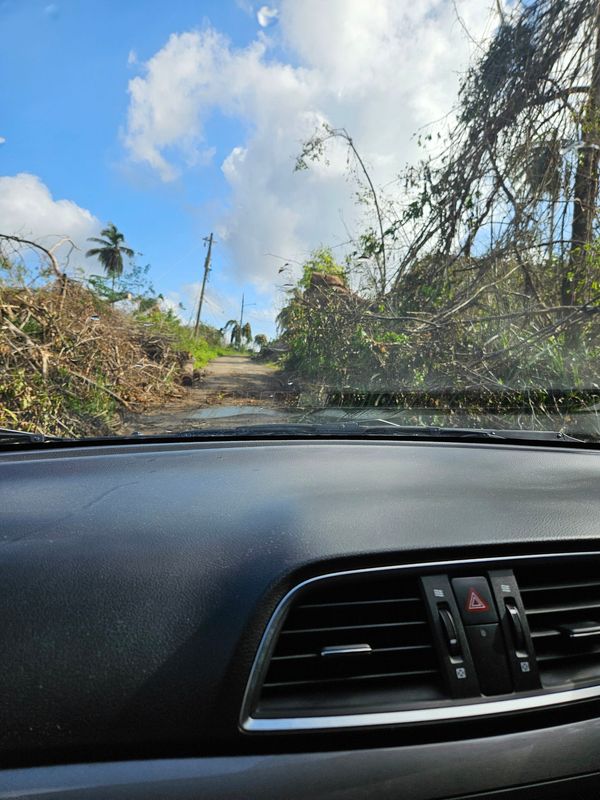
Upon Melissa’s landfall, it rained for two straight days — nonstop. Landslides and flooding in some areas only compounded what felt like something out of a movie. Debris made driving impossible. Men in the community came to assist with chainsaws to slice through the fallen thick-trunk trees.
“People would take like branches and sticks and they would try to move stuff out of the way so that people could get through and out of the neighborhood,” she said.
Families with children, the elderly and others, all lost power where Palmer Smith had taken refuge. They depended on each other and word of mouth for information as they were seemingly cut off from the world — except for a battery-powered radio as their lifeline.
‘We cannot stay in this area’
Survival was the priority.
With utilities cut off, access to water was limited and came mostly from rain collected in a large tank.
Upon Palmer Smith’s return to Tallahassee, power still hadn’t been restored to the Trelawny area. News reports online indicate that’s still the case, although the Jamaica Public Service (JPS) Company is reporting power has been restored to 55 percent of customers as of Nov. 7.
“The phones don’t work. You have access to nothing,” Palmer Smith said.
She said the Trelawny area isn’t considered a priority area for restoration since it’s not populated by tourists, and no major roads serve the area. So, it was critical that she and her family venture out and make their way to where power may be available.
By Thursday, after the rain stopped, they loaded into their car (a much-needed asset during the storm considering many people in her area didn’t have one) and traveled as far as they could before running into blocked roads. That thwarted their attempts to reach a cousin in a neighboring parish.
“When we came back, I had a conversation with my mom,” Palmer Smith said. “I said, ‘Mom, they’re probably going to try to clear some of the roads. We have got to get to another area so that we can get connectivity. Because, otherwise, I don’t know when we’re going to get connectivity back.’ “
Staying put without power, water and food was not an option.
‘We’re going to get through this’
By Friday, flying out of Sangster International Airport in Montego Bay still wasn’t an option considering the airport sustained major damage and had limited access for emergency flights. Their plan was to try and reach Kingston’s airport — three hours away.
Palmer Smith said a neighbor visited and provided needed intel after her daughter spirited her away to Kingston in the storm’s aftermath. She shared which roads were safe to drive.
That was enough for Palmer Smith and her family.
“You had to rely on people just showing up at your house to say ‘Hey, here’s what’s going on’,” she said, regarding how information spread in the aftermath.
It was en route to Kingston, that Palmer Smith’s phone first made a sound. Text message alerts started pouring in. Countless people had been texting and hoping, just needing to hear she was okay.
She seized the moment of connectivity to draft a short message she sent to everyone, letting them know she was alive and well. In that moment, with destruction at every turn, hurled into a situation she’d never experienced, she was simply thankful.
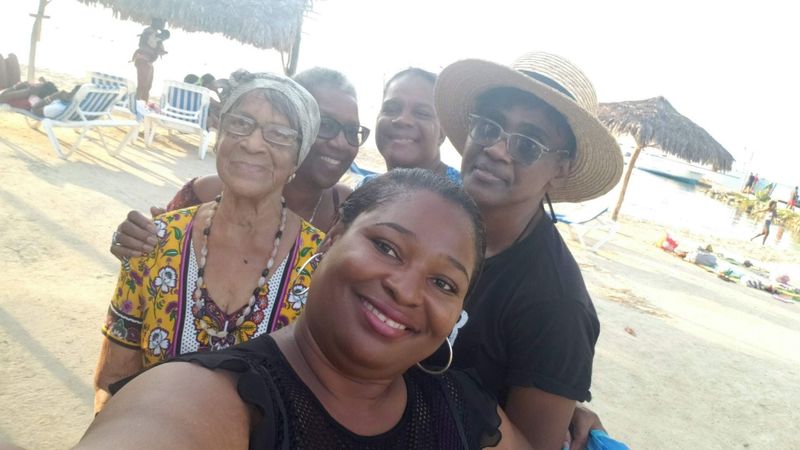
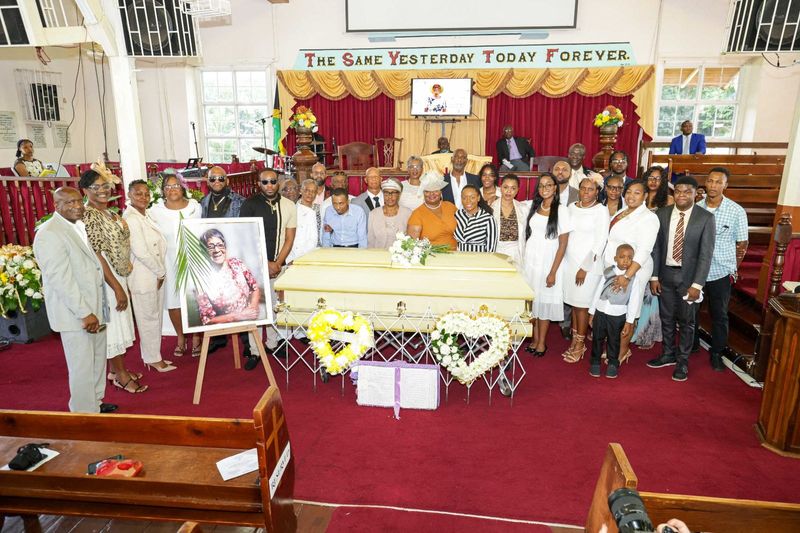
In many ways, the trip had become a family tradition — where loved ones from all over the world Canada, England and the United States — would meet in Jamaica and honor Palmer Smith’s grandmother, Beryl Ricketts. The tradition started for her 90th birthday and, even though she’s been gone for two years, the family still gathers in her name.
This year would have been her 100th birthday. The family usually gathers around mid-October, closer to her grandmother’s birthday and Hero’s Holiday, when many Jamaicans are typically off work as the country celebrates some of the island’s noted trailblazers, including Marcus Garvey, an activist known for his Black pride legacy.
However, this year, the family arrived a little later to accommodate schedules. They’d plan to knock out needed renovations at property owned by the family.
Melissa changed their family’s plans — and the island.
Holness said, in his statement to Parliament, that the storm has had a “profound economic impact on our country.”
“The storm struck the heart of Jamaica’s productive belt. It tore through our breadbasket parish of St. Elizabeth; it disrupted our tourism corridor stretching from Westmoreland through St. James and into Trelawny and St. Ann; and it inflicted heavy damage on housing, community infrastructure, commercial operations, and public utilities across multiple parishes,” he said.
“Thousands of households now face the loss of homes, crops, equipment, and small enterprises,” he continued. “This is not only a humanitarian crisis — it is a shock to livelihoods, incomes, and local economies.”
Palmer Smith knows the road ahead will be yearslong before her home country stands as it once did. But she feels hope amid deep concern. She’s grateful for aid that’s coming to the country now but worries about the weeks and months ahead.
As she prepared to leave, Palmer Smith would hear people encourage one another and say, ‘We’ll build back.'”
“We often say the (Patois) phrase, ‘Wi likkle but wi tallawah,” she said, adding the phrase means even though Jamaica is a small island, “We’re really big. We’re big hearted. We’re a big people.”
“We get it done like we’re a big nation,” Palmer Smith said. “And that’s one thing people still say … Jamaica is home to a resilient people and we’re going to get through this.”
How to help: Local residents helping Jamaica relief efforts
Reggae Rail, a Jamaican cuisine restaurant in Railroad Square, is collecting items to be sent in large barrels to aid in the island’s relief efforts. Some of the requested items include toothbrushes, toothpaste, clothes other essentials.
The restaurant plans to ship two barrels on Nov. 10 and has an ultimate goal of sending 10 barrels by the end of the month, according to is Facebook post. The restaurant’s address is 653 Railroad Square.
Another effort, organized by Gift International Inc., is raising money and collecting items, including hygiene supplies, baby products and cleaning items. For more information, contact 850-325-0444 or email giftint15@gmail.com.
The Florida State University, Florida A&M University, University of Florida, University of South Florida and University of Central Florida Jamaican American Student Associations are collaborating to in a GoFundMe at www.gofundme.com/f/jamsas-hurricane-melissa-relief. All proceeds will go directly to Jamaicans impacted by Hurricane Melissa.
The best way to help quicky is to support on the ground operations through donations to aid groups like the Red Cross and United Way.
Donations can also be sent to https://supportjamaica.gov.jm/, a site created by the Government of Jamaica.
Contact Economic Development Reporter TaMaryn Waters at tlwaters@tallahassee.com and follow @TaMarynWaters on X.
This article originally appeared on Tallahassee Democrat: Paradise to peril: A Tallahassee woman’s story of survival in Hurricane Melissa
Reporting by TaMaryn Waters, Tallahassee Democrat / Tallahassee Democrat
USA TODAY Network via Reuters Connect