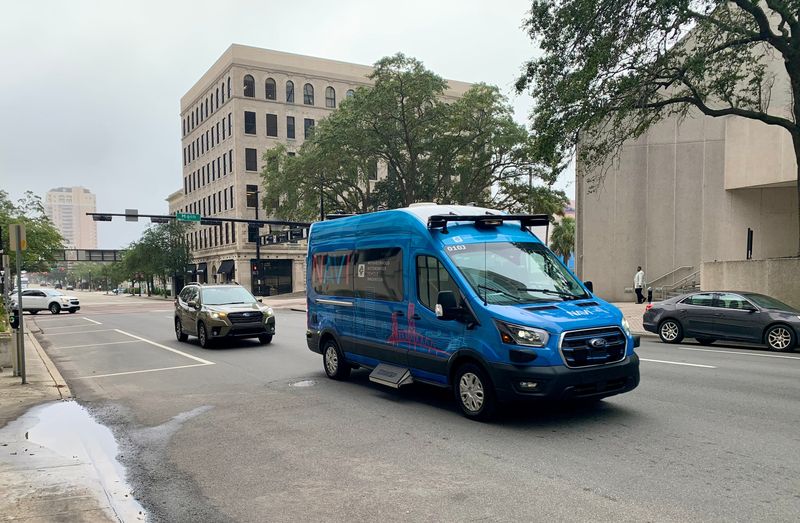
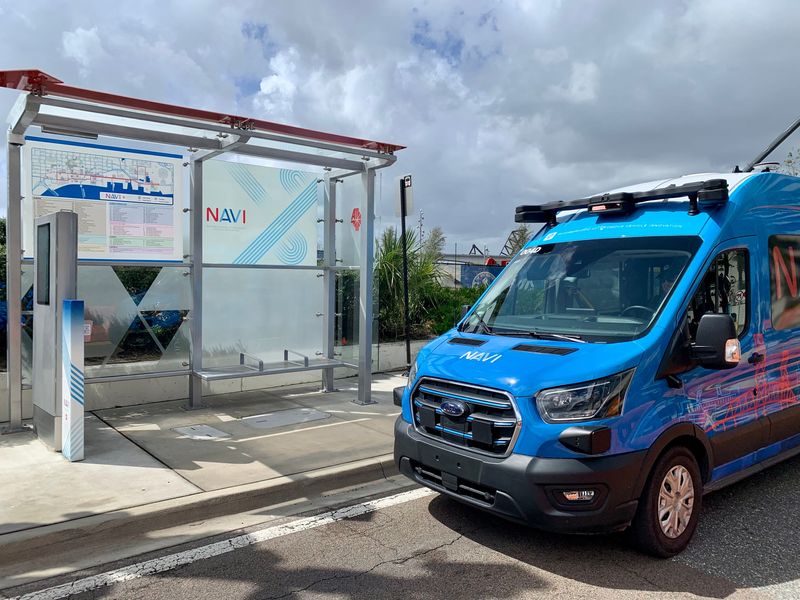
The Jacksonville Transportation Authority’s cost of providing rides on its new autonomous shuttles is about $370 for each passenger who boards the shuttles that operate between the heart of downtown and the sports complex, according to a Times-Union analysis.
The high per-passenger cost would be less if the service could attract more riders, but that could take years to happen.

A JTA presentation during a Nov. 4 meeting of City Council’s Duval DOGE Committee indicated future ridership will depend on the pace of downtown development and the future construction of a much bigger network costing several hundred million dollars so the shuttles can take passengers on longer trips.
Duval DOGE Committee members grilled JTA’s top executive for an hour and 15 minutes. They did not take any formal action in response to the presentation that was billed as an information item but could continue to monitor it as JTA moves toward the next phase of construction.
City Council member Rory Diamond, who advocates pulling the plug on the system, called it a “$400 million gamble” that would be better spent on roads and sidewalks.
Mayor Donna Deegan’s deputy chief of staff told the committee that Deegan supports construction of the autonomous vehicle system.
JTA is an independent authority overseen by an appointed board that ultimately wields the decision-making power over the autonomous shuttles.
JTA says current NAVI ridership doesn’t predict future use
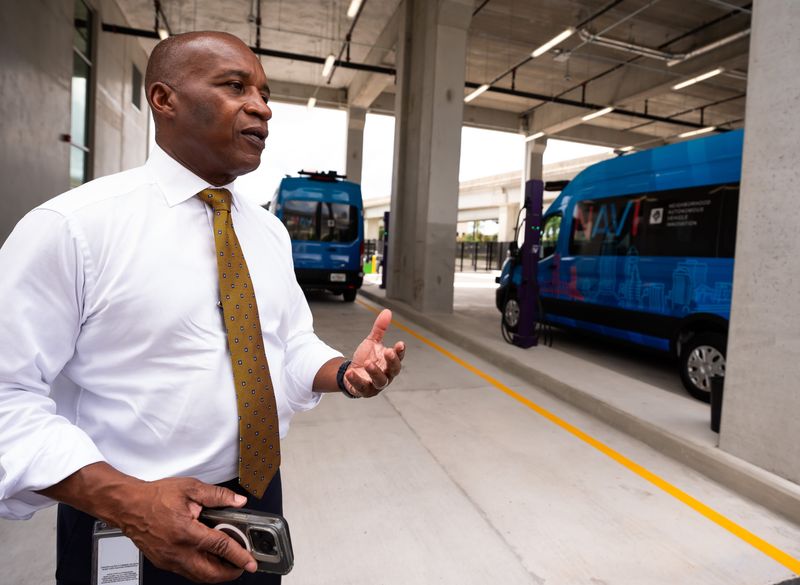
In a presentation to the DOGE Committee, JTA CEO Nat Ford said it’s premature to use current ridership figures for an assessment of the system, which is the first of its kind in the nation operated by a public transit agency as part of its regular fare-paying service.
He said JTA is using a forward-thinking strategy to put the transit system in place ahead of upcoming development such as the RISE Doro apartments, the Four Seasons Hotel, the relocated Museum of Science and History, the Shipyards West Park and Riverfront Plaza.
Ford said a snapshot for 100 days of a new service “is not an indication of the actual success this program may have in five, 10, 15 to 20 years.”
The Neighborhood Autonomous Vehicle Innovation service — NAVI for short — operates from 7 a.m. to 7 p.m. Monday through Friday.
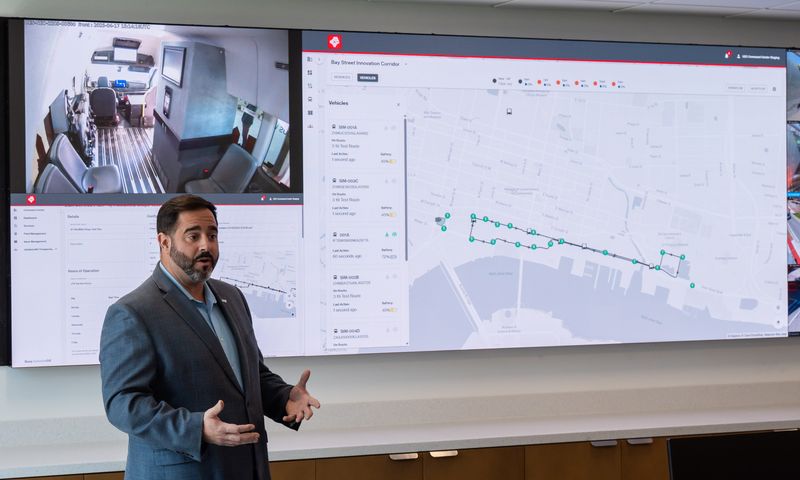
The shuttles are stocked with technology that communicates with other technology along the route and at a command center enabling them to operate autonomously. But in the opening months of the service, an onboard driver takes control of the wheel at times so it’s a mix of autonomous and human operation.
JTA launched the service without charging a fare from June 30 through the end of September. On Oct. 1, JTA began charging a $1.75 fare.
JTA paying millions a year for service with declining ridership
The $7.3 million per year expense for operations and maintenance of the NAVI service is on top of the $65 million cost of building the 3.5 mile long Bay Street loop and the command center. JTA used a mix of federal, state and agency funds for the construction.
The ongoing $7.3 million annual cost for NAVI equates to about $608,333 million per month. Through the first four months of service, NAVI has picked up 6,578 passengers or an average of 1,644 passengers per month.
An average month of 1,644 passengers with an operations and maintenance cost of $608,333 per month equates to a cost of $370 per passenger.
JTA says ridership numbers will rise when the NAVI service is connected to the larger Ultimate Urban Circulator system that’s still to be built.
Conversion of Skyway is next for autonomous shuttle system
The next phase of expanding the use of autonomous shuttles would convert the elevated Skyway system in downtown so the rubber-tired, all-electric shuttles can operate on it.
JTA has said that would involve removing the upper portions of the elevated structure and replacing them with platforms designed for the shuttles. JTA also would build ramps connecting the elevated structure to ground-level streets so the shuttles can switch between them.
City Council agreed in 2021 to earmark $247 million for the Skyway conversion when council doubled the local gas tax to 12 cents per gallon to finance a long list of transportation projects.
The city entered into an interlocal agreement with JTA for it to get half the additional 6-cents per gallon tax for the Skway conversion and other JTA-managed projects so any change in that agreement would require approval by both City Council and JTA.
When City Council was debating the gas tax, JTA said in 2021 that a Transit Concept and Alternative Review Plan projected the daily ridership on the Bay Street corridor would be an average of 1,000 to 3,500 per day by 2035 and then 1,200 to 4,400 riders by 2045.
For the first four months of service, daily ridership has averaged 76 passengers and it’s been on the decline since the grand opening.
In its presentation to the Duval DOGE Committee, JTA used projections by the state Department of Transportation and the First Coast Transportation Planning Organization that forecast 280 riders per day in 2035 on the Bay Street loop.
JTA currently estimates it will cost $240 million for converting the Skyway and then another $95 million extending routes into neighborhoods surrounding downtown. Combined with the $65 million for the Bay Street leg, the total cost would be $400 million for a full 10-mile system, though the price could be higher as JTA gets deeper into design and engineering.
JTA and Deegan point to impact of Holon plant
Diamond, who initiated the review by the DOGE Committee, asked Ford if he would “fight us” if City Council asked JTA to modify the transportation list financed by the gas tax to remove the Skyway conversion from it.
Ford said JTA’s position as an industry leader in the field of autonomous transit helped convince Holon to pick Jacksonville for a $100 million manufacturing plant for autonomous shuttles. About 200 people will work at the plant when it starts production in 2027. Holon, which is based in Germany, also moved its U.S. headquarters to Jacksonville.
“I serve at the pleasure of the JTA board of directors, but I wouldn’t be doing my job as your CEO to not state the economic impact of the Holon plant,” Ford said. ” … They saw this project as a lighthouse project for the United States.”
Deegan also points to Holon as a reason for continuing construction of the U2C.
“What you’re seeing with this project is ripple effects across the city,” Deputy Chief of Staff Joe Inderhees told the DOGE Committee.
In response to DOGE Committee Chairman Ron Salem asking if JTA could hit the pause button on running the Bay Street service until more development fills in that corridor, Ford said if JTA did that, the agency would have to reimburse the state Department of Transportation and the federal government, which each provided $12.5 million grants for the construction.
Councilman say city cannot “point the figure” at JTA
City Council member Raul Arias said JTA deserves credit for being “ahead of the curve” on having a transit system in place for upcoming development and it’s wrong to “point the finger” at JTA for the lower ridership figures.
He said the city and Downtown Investment Authority are responsible for the speed of downtown development, not JTA.
“So to question the ridership problem, guys, look at yourself,” Arias told fellow council members. “Let’s look at DIA. Let’s talk to them to see why we don’t have enough people in downtown so that JTA could do their job properly.”
Salem said he supports the city having independent authorities such as JTA but that only works if board members are engaged and ready to ask pointed questions. He said the city “went through hell” in 2019 during the attempted sale of JEA when board members for the city-owned utility didn’t provide adequate oversight.
He said JTA board members should not “go along to get along as what happened in 2019.”
“I just can’t emphasize that enough,” Salem said.
City Council member Chris Miller added those questions by the JTA board should be asked and answered during public meetings, not in private sessions “behind closed doors” where individual board members speak to JTA management.
(This story was updated to add headlines.)
This article originally appeared on Florida Times-Union: Duval DOGE members grill JTA on low ridership for autonomous shuttles
Reporting by David Bauerlein, Jacksonville Florida Times-Union / Florida Times-Union
USA TODAY Network via Reuters Connect