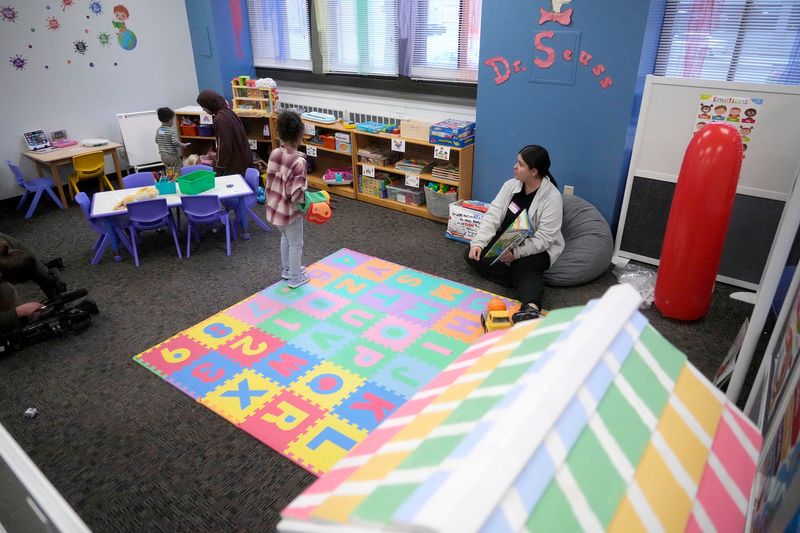
Child care providers and advocates across Wisconsin are urging lawmakers to advance a bill that would again extend funding for the state’s Child Care Counts program.
Corrine Hendrickson, a founder of the advocacy group Wisconsin Early Childhood Action Needed, said the new Bridge Payments program is a temporary fix that falls short of what’s needed to stabilize the industry and prevent program closures.

The Bridge Payments program replaced the pandemic-era Child Care Counts program, which offered providers monthly stabilization payments to help cover staff wages and other operating costs. Child Care Counts was initially funded through federal pandemic relief dollars and later kept afloat with emergency funding, which expired in June.
The program distributed more than $650 million in payments to about 5,000 Wisconsin childcare providers, according to the Wisconsin Department of Children and Families. Many used the money to raise staff wages, avoid closures and maintain affordable rates for families, said Renae Henning, who runs Community Care Preschool and Child Care in Beaver Dam.
“The benefits that it had through these years are numerous,” she said. “I’ve been able to give bonuses to staff to retain them. When they didn’t renew (Child Care Counts) in the budget, it was just heartbreaking.”
In place of Child Care Counts, Gov. Tony Evers and Republican lawmakers agreed in the 2025-27 biennial budget to create the $110 million Child Care Bridge Payments program as part of a larger $360 million investment in the sector. The new program allows the state to continue sending providers monthly payments through June 2026, but some say the payments aren’t enough.
So far, over 3,850 providers have received about $26.7 million in Bridget Payments since the program began in July, according to the Department of Children and Families.
However, Hendrickson said the Bridge program covers only about 80% of what providers previously received under Child Care Counts. Theresa Fredericks, who owns Tree Top Child Development Center and Preschool in Ashland, said she raised her school’s tuition to make up for the gap.
“What these Bridge Payments are supposed to do is keep child care affordable, but there’s nothing about it that has done that,” Fredericks said. “Programs have closed, and the ones that are open have had to raise rates.”
Democratic lawmakers have introduced a bill to bring back Child Care Counts and fund the program through the end of the current budget cycle in 2027. State Sen. Chris Larson, D-Milwaukee, said the proposal would increase monthly payments to providers and maintain funding for another year beyond the Bridge program’s expiration, but the bill has yet to receive a public hearing in the Republican-controlled Legislature.
The legislation would provide more than $442 million in state general purpose revenue for the program over the next two years, according to a representative from Larson’s office. The ask is similar to what Evers initially requested in his state budget proposal to keep Child Care Counts running. He previously threatened to veto a state budget that excluded stabilization payments to providers.
Hendrickson, who closed her child care business this summer, said she likely would have been able to keep her business open if the state budget had included the higher payments.
Republicans, meanwhile, have introduced bills they say would better address issues with child care, including one that would offer business tax credits to employers who provide child care services to their staff. An Assembly hearing for the bill, co-authored by state Rep. Karen Hurd, R-Withee, is scheduled for Nov. 5.
Hurd said the proposed tax credit would be more realistic than offering more stabilization payments and would be a win on top of the investments already made to child care in the current state budget.
“It’s not feasible. It’s a nice dream,” Hurd said of the bill to extend Child Care Counts. “It’s better to give a hand-up, not a handout. Nobody can just do subsidies constantly.”
Assembly Speaker Robin Vos, R-Rochester, previously told reporters that Democrats’ preferred policy is “just basically writing out checks to childcare providers, hoping they charge less to parents.”
“I don’t think that their model is one that we would ever support,” he said. “Ours is really to make sure that the parents have access to the resources, and hopefully incentives to be able to get the best quality care.”
Even so, Fredericks worries what will happen to her business if Child Care Counts isn’t reinstated or the Bridge program ends. She said the loss of such payments could force providers to lower wages and hike tuition rates. Some might close altogether, which could worsen the child care shortage and particularly hit families in rural areas, Fredericks said.
A 2024 Wisconsin Department of Children and Families survey found that one in four child care providers could close without ongoing stabilization funding.
“It’s scary,” Henning said. “We use those payments to pay the bills here, to keep the program afloat.”
At a media event Oct. 29, Josh Pertl, secretary of the Department of Children and Families, said he supports the continuation of stabilization payments to providers.
“It’s a critical part of solving the child care challenge,” Pertl said. “Whether it’s Child Care Counts or some future version of the program, those payments to providers help stabilize the sector. I think that’s going to be part of the long-term solution.”
Kayla Huynh covers K-12 education, teachers and solutions at the Journal Sentinel. Reach her at khuynh@gannett.com and follow her on X at @_kaylahuynh. All of her work and coverage decisions are overseen solely by Journal Sentinel editors. Kayla’s position receives support from Herb Kohl Philanthropies and contributions to the Journal Sentinel Community-Funded Journalism Project. Help continue this reporting with a tax-deductible donation at jsonline.com/support.
This article originally appeared on Milwaukee Journal Sentinel: Advocates call to revive Child Care Counts, warning current child care funding falls short
Reporting by Kayla Huynh, Milwaukee Journal Sentinel / Milwaukee Journal Sentinel
USA TODAY Network via Reuters Connect