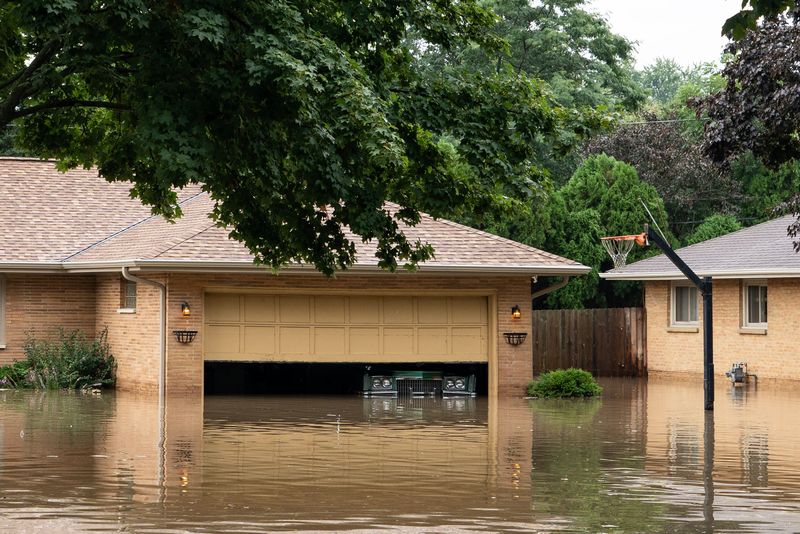
While the 1,000-year flood that swept through southeast Wisconsin in early August was a rare event, climate change is fueling more extreme rainfall across the state.
It was one of many reminders this summer that the Midwest isn’t the climate haven many perceive it to be.

That may have homebuyers — or homeowners planning to sell their house — wondering about Wisconsin’s requirements for disclosing flood damage or other weather-related risks.
Many properties in southeastern Wisconsin have never had this kind of flooding, said Cori Lamont, the vice president of legal and public affairs at the Wisconsin Realtors Association.
“This is kind of a new space for everybody,” Lamont said in an interview with the Milwaukee Journal Sentinel.
Here’s what you should know about Wisconsin’s real estate disclosure laws and what information must be shared about previous flooding:
Does Wisconsin have a flood disclosure law?
Wisconsin’s real estate disclosure laws are found in Chapter 709 of the state statutes. The law requires the seller to provide a Real Estate Condition Report to the buyer, otherwise the buyer has a time window in which they can decide not to move forward.
The form asks about defects in the electrical, plumbing, septic or HVAC systems, for example, or the presence of asbestos or lead paint. Sellers might use third parties, like foundation experts, to help them complete the form.
Out of the 60-some questions on the form, these five most directly relate to flooding and water damage:
How much detail does a seller have to provide about past floods?
If any of the above questions are marked “yes,” there’s a space on the form where the seller must provide an explanation.
But state law doesn’t outline what information must be provided in the explanation, or how long it should be. A seller might speak to their attorney about how much detail to provide, Lamont said.
“If the seller has not given a full representation of the risk that the buyer might be taking on, then the buyer could certainly try to take legal action against them,” she added.
The form only asks what sellers are aware of. The average person moves every decade, Lamont said, and even if the current owner didn’t experience flooding, they wouldn’t know if previous owners before them have.
“I think sometimes there’s a need to want to hold someone accountable,” she said. “And yet while they lived there, it never occurred, and they weren’t aware of it.”
What other information should homebuyers seek out?
An ethical realtor will help homebuyers dig deeper than the Real Estate Condition Report, said Republican state Rep. Scott Krug, who also works as a realtor in central Wisconsin.
That could involve going to a home inspector who could recommend follow-ups with a structural engineer or basement specialist, for example.
There have been times when Krug took the buyer out to the property for a visual inspection after receiving the report, and they suspect the grading of the driveway could contribute to water in the basement. They might go back to the seller, who didn’t realize the issue, and they work it out together.
“(It’s) probably a very rare circumstance where you find that they’re trying to hide it,” Krug said.
What is a floodplain? And do I live in one?
Floodplains are areas of land where water naturally flows when water levels rise. They’re often found near rivers or lakes, but many of Wisconsin’s flood-prone areas are simply low-lying areas where water collects after a rainstorm, according to the Wisconsin Realtors Association’s information page.
Realtors will help buyers find out if the property is in a floodplain, either by referencing county-level data or FEMA maps. You can enter an address into FEMA’s website to see nearby waterways and flooding risks.
If the buyer does learn the property is in a floodplain, they can work with their insurer to figure out the cost of flood insurance, Lamont said.
Could Wisconsin’s real estate disclosure laws change in the future?
Lawmakers already review the form about every two years in collaboration with the Wisconsin Realtors Association, adding questions to address new issues affecting real estate.
State lawmakers could introduce more questions to the form, such as specific details on past flooding events. Still, making the already six-page report longer might not be helpful, Krug said.
“Now that you see more circumstances where (flooding is) starting to occur on a more widespread basis, that will start driving conversations about policy changes,” Krug said.
How does Wisconsin’s flood disclosure laws compare to other states?
The Natural Resources Defense Council, a liberal-leaning environmental advocacy group, commissioned a report to compare flood disclosure laws by state.
Wisconsin received a “D” grade, or “inadequate.” That category of states requires disclosing floodplain status but doesn’t require disclosing whether the property must have flood insurance. Very few Wisconsin households have flood insurance to begin with.
“As far as any gaps in the law may go, there are so many other layers that protect (Wisconsin) consumers,” Krug said. “A good realtor, if you’re going by the code of ethics, you’re looking out for your customer’s best interests.”
Other Midwestern states scored a “C” grade, including Iowa, which asks if the seller knows if the property is in a floodplain, and if so, the floodplain designation. Iowa’s form also asks about known flooding problems, requires an explanation for a “yes” response, and directs sellers to use extra sheets of paper to write the explanations if necessary.
Gulf Coast states prone to hurricanes like Texas, Louisiana and Mississippi have some of the strongest laws, according to the NRDC. Texas, for example, requires sellers to say whether they’ve ever filed an insurance claim for flood damage or received aid from FEMA or the U.S. Small Business Administration.
This article originally appeared on Milwaukee Journal Sentinel: Are you buying a home that’s been flooded? What to know about Wisconsin disclosure laws
Reporting by Hope Karnopp, Milwaukee Journal Sentinel / Milwaukee Journal Sentinel
USA TODAY Network via Reuters Connect