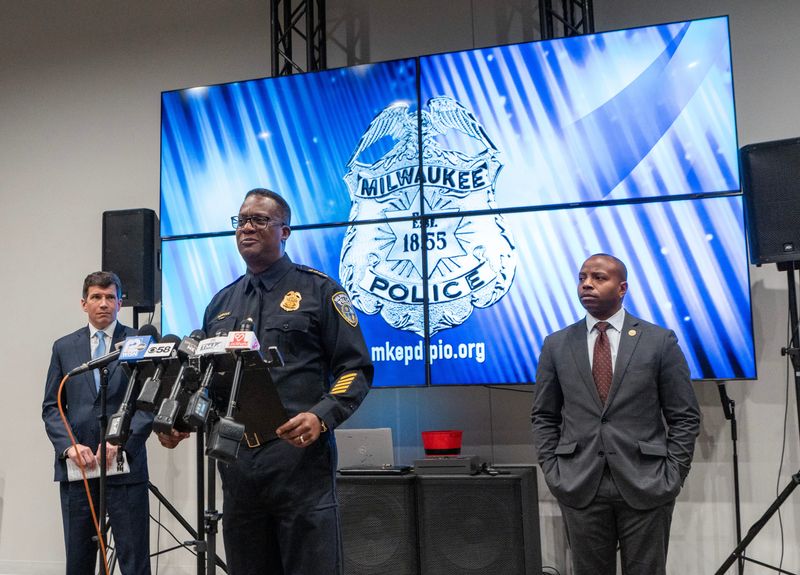
In the four months since the Milwaukee Police Department announced its hopes to acquire facial recognition technology, it’s been met with almost uniform pushback.
The public and activists pushed back at a debut public hearing before the city’s Fire and Police Commission in April. The next month, two-thirds of the Common Council signed a letter in opposition. By July, the city’s Equal Rights Commission followed suit, passing a resolution against it.

Despite this, Milwaukee Police Chief Jeffrey Norman told the Journal Sentinel editorial board he was emphatically still in support of it. He called concerns over its misuse “speculative” and cited instances of the police’s usage of it through surrounding departments as evidence of its effectiveness.
“What’s speculative is ‘will it be abused?'” Norman said. “But what’s known is sexual assaults are out there in our community. Homicides out there in our community. Robberies out there in our community. I don’t know how many examples we have to show to our public in regards to, what is your level of tolerance?”
The city’s top cop said the key to its use is establishing rules around its use. At public meetings where the technology has been discussed, officials have said they would not use it solely to make an arrest and that it would only be used for violent crime.
“We’re not talking about facial recognition to go after somebody who stole a bike,” he said. “We’re talking about real, serious, tangible crime.”
Consistently, the department has framed it as a neutral tool and showed how its been used to assist in solving crimes in the past.
“It is only a tool. The disparity comes from the misuse of the technology,” said Heather Hough, the department’s chief of staff, at a previous meeting on the technology.
But since its announcement, opposition to the technology has persisted.
Concerns from activists, residents and others range from fears of access by the Trump administration for immigration enforcement; studies showing bias in technology; and infringement on civil liberties. Some have noted that cities like Madison have banned facial recognition’s use entirely.
Many have also cited concerns with the department’s proposal for acquiring it: trading 2.5 million mugshots for free access to licenses from the company Biometrica.
Some of those opposed are calling for creating a public body called citizen control over police surveillance, or CCOPS for short.
Facial recognition has long been controversial as well, with cities like Detroit facing legal action over its usage.
“We are already seeing how surveillance technology is being weaponized in real time,” said an April statement from the ACLU of Wisconsin, which has opposed the department acquiring the technology. “While we trust that our local leaders and police officers may have good intentions, history reminds us how quickly larger systems can override those intentions.”
Norman welcomes the feedback, he said, but takes issue with those who may default to being opposed.
“Tell that to the next victim then,” he said. “They’re going to have to be able to give an explanation of why, when we have the ability to interrupt, impact violent crime.”
“If there is a tool that we can use to interrupt so that my daughter who lives in this city drives a car, my wife who lives in this city and drives a car, doesn’t have to be the second victim, I absolutely unapologetically will use it,” Norman added.
David Clarey is a public safety reporter at the Milwaukee Journal Sentinel. He can be reached at dclarey@gannett.com.
This article originally appeared on Milwaukee Journal Sentinel: Milwaukee Police Chief Jeffrey Norman still wants facial recognition tech, despite opposition
Reporting by David Clarey, Milwaukee Journal Sentinel / Milwaukee Journal Sentinel
USA TODAY Network via Reuters Connect