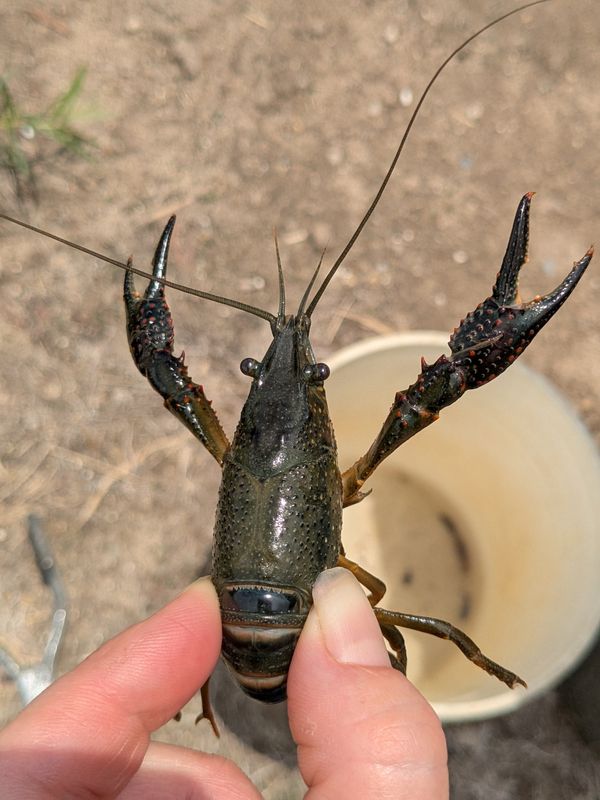
State officials on July 24 said an invasive crayfish species that has been found in several Michigan counties was discovered in a rearing pond at Wolf Lake State Fish Hatchery.
The Michigan Department of Natural Resources recently confirmed the presence red swamp crayfish in an outdoor muskellunge rearing pond at the hatchery in Mattawan, west of Kalamazoo, after the pond was drained following a fish stocking operation.

Populations of red swamp crayfish were first detected in Michigan in 2017, with simultaneous discoveries in Sunset Lake in Kalamazoo and a drainage pond in Pontiac, the DNR said.
Isolated infestations since have been confirmed in Kalamazoo, Livingston, Macomb, Oakland, Van Buren and Wayne counties.
The DNR said the infestations are believed to have resulted from the release or escape of aquarium pets, live bait or live crayfish brought to Michigan for crawfish boils.
While the source of the hatchery infestation remains unknown, Michigan’s Invasive Species Program staff is exploring several possibilities, including a known population 15 miles away, bait or aquarium release into the pond or nearby Wolf Lake, or accidental transport through forage fish used to feed the fish reared in the pond, but sourced from other states.
The red swamp crayfish is native to the southern U.S., but has been prohibited in Michigan since 2014. The crayfish aggressively outcompete native crayfish for food and habitat. They have a high reproductive rate and cause destructive burrowing along shorelines that can destabilize banks and infrastructure.
How the crayfish infestation was discovered
When collecting fish from ponds for stocking, the ponds are drained into a kettle, or collection box. Fish are netted from the collection box and loaded onto stocking units while staff attempt to remove as much bycatch, or undesired species, as possible.
After stocking muskellunge in Thornapple Lake, in Barry County, and Lake Hudson, in Lenawee County, hatchery staff drained the rearing pond and found the carcasses of two unusual crayfish in the collection basket of Wolf Lake Hatchery Pond 20, the DNR said in a release.
Staff then set crayfish traps in Pond 20, and two adjacent ponds, and caught one live, positively identified red swamp crayfish.
Lake infestation unlikely, officials say
Most fish stocked from Michigan’s state hatcheries are raised in tanks within hatchery buildings, inaccessible to outside species. Some fish, like muskellunge and walleye, are moved to outdoor rearing ponds to grow and improve survivability before being released, the DNR said.
The muskie sent to Thornapple Lake and Lake Hudson from Wolf Lake Hatchery in July were 12 to 13 inches in length, and each was individually handled and tagged before release, significantly reducing the likelihood that red swamp crayfish were transferred with them to the receiving waters, the DNR said.
The DNR is developing a monitoring plan for both lakes and will alert lake users to report any sightings of the invasive crayfish.
What is the DNR doing to combat the infestation?
The outdoor ponds at Wolf Lake State Fish Hatchery are sourced from well water, along with natural spring water that circulates through the ponds and is then released into a drain that eventually connects to the Paw Paw River.
According to Joe Mickevich, DNR southern area hatcheries manager, an open system can’t easily prevent undesired species — including crayfish, tadpoles and even some small fish — from finding their way into the ponds, either over land or from bird and waterfowl movement.
When needed, ponds are treated with rotenone, an aquatic pesticide, before the next use.
The DNR and MISP, in the last week, set 165 traps among all 11 earthen bottom ponds at Wolf Lake Hatchery.
The DNR is considering using environmental DNA, or eDNA, to help determine the potential source of the crayfish, spread and presence of red swamp crayfish in the hatchery and surrounding waters.
Suppliers and officials from states where minnows were sourced are cooperating with efforts to trace shipments and verify quality control measures to prevent contamination, the DNR said.
What are red swamp crayfish like?
Red swamp crayfish live in a variety of permanent freshwater habitats. Crayfish are crustaceans that burrow deep into the substrate of their habitat and create large mounds of sand and soil called chimneys with a relatively large hole in the center.
The crayfish are prohibited in Michigan, but can be identified by:
What you should do if you find a red swamp crayfish
To report sightings of red swamp crayfish, collect and freeze a sample or take photos, note the location, and email information to Kathleen Quebedeaux, DNR Fisheries Division, QuebedeauxK@Michigan.gov.
For more information on invasive red swamp crayfish, including identifying characteristics, visit Michigan.gov/Invasives.
This article originally appeared on Lansing State Journal: DNR staff found a red swamp crayfish in a fish rearing pond. Why that’s a problem
Reporting by Dan Basso, Lansing State Journal / Lansing State Journal
USA TODAY Network via Reuters Connect