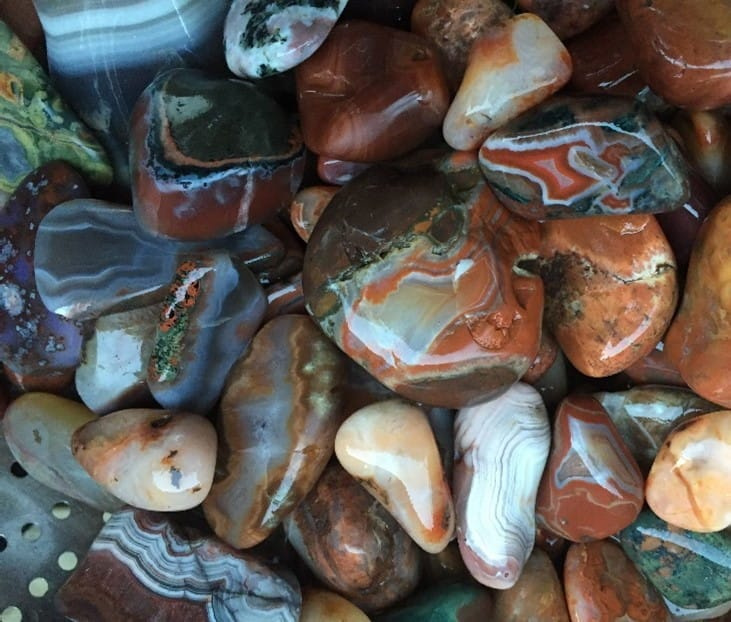
Known for their colors and patterns, collectors are often amazed at agates that turn up on Upper Peninsula lakeshores, with some known to be up to 20 pounds, according to the Michigan Department of Natural Resources.
Known for their diversity and beauty, agates are a form of quartz and can be translucent — and in some cases completely transparent.

Rockhounding, otherwise known as rock collecting, is a favorite pastime for visitors and residents who live in Michigan or simply visit its U.P. beaches.
Here’s what to know about agates and where you can find them in Michigan:
How are agates formed?
Agates are formed when gas bubbles in lava leave a hole in the “vesicle” in the rock, according to the Michigan Department of Environment, Great Lakes, and Energy.
Silica (silicon dioxide) solutions flow into the holes in the host rock and fill them up over time, creating colored bands.
Different chemicals in the solution cause the bands to be different colors.
How do I know my stone is an agate?
“Agates are sometimes hard to identify, even for the experts,” Mary Ann St. Antoine, a senior environmental quality analyst in the Marquette District Office of EGLE, said in a news release.
Antoine, who said she found her favorite agate near Grand Marais, encourages collectors not to get discouraged when the outside of the rock has a dull, waxy luster.
Agates are often translucent, so collectors should hold them up to the light to see if they transmit some light.
When is the best time to look for an agate?
EGLE says the best time for Michiganders to look for agates is after a storm, when the waves have washed up new rocks along the coastline.
Where can I find agates in Michigan?
The stones can be found across multiple locations in Michigan’s Upper Peninsula, including:
Techniques for identifying rocks
These identification techniques, according to the EGLE, can help rock hunters determine the type of rocks they have:
Appearance
Unique properties
Unique properties
Is there a limit on how many rocks a person can collect?
According to the EGLE, one person can not exceed 25 pounds total per year on state-owned and public trust lands.
This story was updated to add a gallery.
This article originally appeared on Detroit Free Press: Michigan’s agates can be hard to find: Where to look this summer in the Upper Peninsula
Reporting by Jalen Williams, Detroit Free Press / Detroit Free Press
USA TODAY Network via Reuters Connect