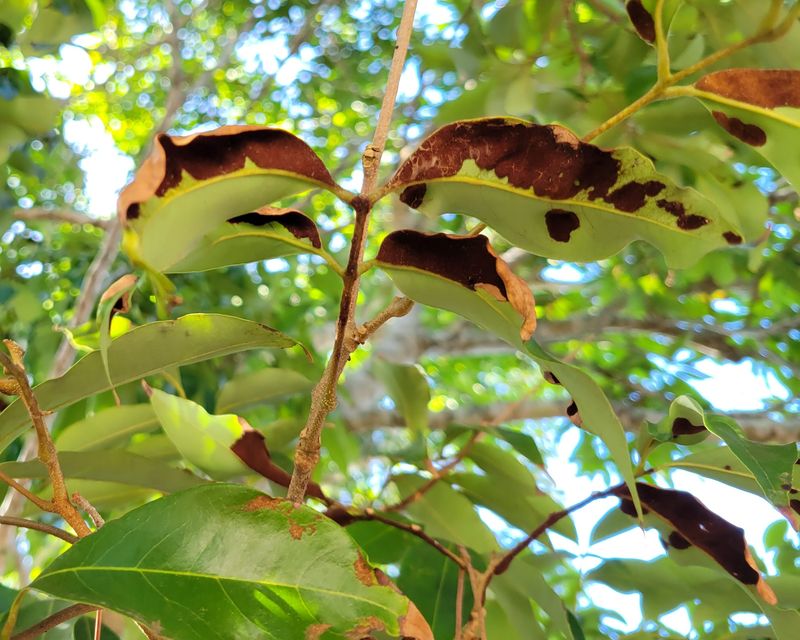
This article is for everyone who is growing a lychee tree, knows someone who is growing one, or wants to plant one. There is a pest in the state that is a serious threat to lychee trees, so everyone growing a lychee tree will want to learn how to protect their tree. This insect is the Lychee Erinose Mite (LEM) and goes by the scientific name Aceria litchii.
LEM is a native of Asia, where it is considered a major pest of lychee (Litchi chinensis) trees. It is a world traveler and has made its way to Hawaii, Australia, Brazil, and the continental United States. LEM was first discovered in Florida in a lychee grove in Sarasota County in 1955, and again in 1995 in Miami-Dade County on imported plants from China. In both of those cases, they were eradicated and never became established in the state, but that is not the case anymore!

Florida produces more lychee and longan in the United States than both Hawaii and California, with approximately 90% of the commercial production concentrated in Miami-Dade County. LEM has been discovered not only in Brevard County, but also in Martin, Palm Beach, Broward, Miami-Dade, Collier, Hendry, Lee, Charlotte, Sarasota, Manatee and Pinellas counties.
LEM are microscopic but can be detected by the symptoms that first appear on the newest leaves. Immature foliage will have small blisters with silver-white hairs that are visible with a hand lens or eye-loupe. As their feeding damage continues, it causes the leaf epidermal cells to become a reddish-brown hairy mass that becomes very visible on the entire underside of the leaf, causing the leaf to become distorted and curled. Sometimes the undersides of the leaves can even turn almost black. As the mite population grows and their feeding spreads, these symptoms can also occur on the stems, petioles, panicles, flower buds, and fruit. LEM infestations can result in an 80% reduction in the trees fruit production. Follow this link for the Florida Department of Agriculture and Consumer Services (FDACS) LEM information: https://www.fdacs.gov/Agriculture-Industry/Pests-and-Diseases/Plant-Pests-and-Diseases/Lychee-Erinose-Mite.
Because of their extremely small size, LEM can be spread by air currents, honeybees, tools, humans (who touched symptomatic leaves), and the movement of infested plants. Cleaning your tools after pruning infested branches and changing your clothes before moving to another area of lychee trees will help stop their spread. All tools and equipment used on lychee trees, including clippers, loppers, hand saws, chain saws, and hedgers, should be washed with a 10% bleach solution (one part bleach to nine parts water) before using them on another tree.
You can also protect your tree from this potentially devastating pest by helping your tree grow as healthy as possible. A good start would be to test the soil, if you have not done so in the last year. Send the soil sample to the UF/IFAS Soil Testing Lab and pay for the $10 Test B. The test results will include the soil pH and the levels of water-soluble phosphorus, potassium, magnesium, copper, manganese, zinc, and boron. The first three nutrients are macronutrients, which plants require in higher amounts. Deficient levels of any of these nutrients can be a stressor for plants and make them more susceptible to insect infestations and diseases. The soil testing form can be found at this link: https://edis.ifas.ufl.edu/pdffiles/SS/SS18700.pdf. It is not uncommon for soils to test low, or even very low, in potassium, which is important for both the plant’s root system and water regulation.
Local master gardeners are ready to help you
For general information on growing lychee trees, check out our bulletin, Lychee Growing in the Florida Home Landscape at https://edis.ifas.ufl.edu/pdffiles/MG/MG05100.pdf. This bulletin will cover numerous topics, ranging from planting, watering, fertilizing, and more. After several years of fruit production, it is recommended that the tree be pruned back to a height of 10 to 15 feet. That should be done by selectively removing a few upper limbs, back to where they branch off a lower limb. Doing this yearly will allow sunlight to reach the lower canopy for better fruit production. Nineteen cultivars of lychee trees grown in Florida are also discussed in the bulletin. If you would like to learn additional recommendations to help your tree ward off insects and diseases, email the UF/IFAS Brevard County Master Gardeners at brevard-mg1@ifas.ufl.edu so they can send you a copy of Easy Directions for Improving Soil Health and Recommendations for Growing Fruit Trees and Other Edible Plants.
If you have a lychee tree, check out photos of LEM by doing a Google Images search for “LEM on lychee ifas” to learn what to look for when scouting for this new pest. If you don’t already own at least a 10-power eye-loupe to look for evidence of LEM or check out a 40-power jeweler’s eye-loupe with LED lights to see which one you would prefer. Once you have your eye loupe in hand, spend time looking at the new growth of your lychee tree(s) and look for blisters covered with silver-white hairs.
Hopefully, you won’t find any abnormal new growth, but if you are going to discover evidence of LEM, it’s much better to find them at the very beginning of an infestation, because your trees will fare much better. If you have any family or friends who are growing lychee trees, share this information with them also. For anyone growing lychees, now is the time to begin giving your trees some tender loving care, because they need it!
Sally Scalera is an urban horticulture agent and master gardener coordinator for the University of Florida’s Institute of Food and Agriculture Science.
This article originally appeared on Florida Today: There’s a pest that can harm your lychee trees: Here’s how to battle LEM | Scalera
Reporting by Sally Scalera / Florida Today
USA TODAY Network via Reuters Connect