

By Panu Wongcha-um
BANGKOK, June 5 (Reuters) – Thailand said on Friday it will join a U.N. arbitration process chosen by Cambodia to resolve a festering maritime boundary dispute, but put on hold for now other two-way efforts to settle their contested borders.

This week Cambodia launched a compulsory conciliation process under the United Nations Convention on the Law of the Sea (UNCLOS), after Bangkok decided last month to unilaterally end a 2001 framework pact for talks on a disputed maritime belt.
For more than 25 years, both have claimed about 26,000 sq km (10,000 sq miles) of sea in the Gulf of Thailand, estimated to hold nearly 12 trillion cubic feet of natural gas and large volumes of oil, for a total value of $300 billion.
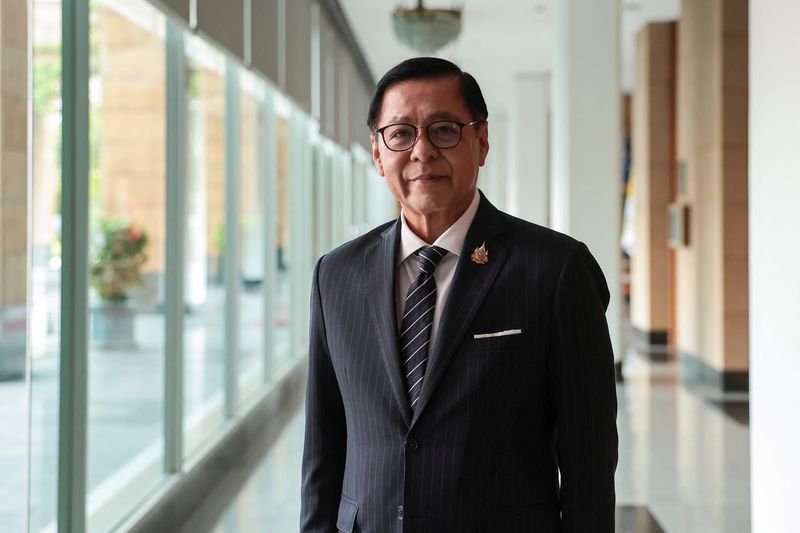
Thailand will send two representatives to the U.N.-backed negotiations, Foreign Minister Sihasak Phuangketkeow said on Friday, but expressed dismay at Cambodia’s move to also use the talks to tackle questions of resource sharing.
“I told my Cambodian colleagues, ‘Why don’t we give talks a chance? Six months or something,'” he told Reuters in an interview.
“‘If we cannot make progress, then we can agree on the next step, which of course includes compulsory conciliation, but it also includes voluntary conciliation.'”
Sihasak said Cambodia made public its decision to use the compulsory conciliation process on Tuesday, before officially notifying Thailand.
“And since June 2, we’ve not had any discussion informally, formally with the Cambodian side.”
A spokesperson for the Cambodian government denied Sihasak’s assertion that Thailand had not been notified ahead of the announcement. They shared images of a timestamped email and paper copy of the notification that they said had been delivered on Tuesday morning.
Reuters could not immediately independently verify the notices.
In response to Reuters queries, Cambodian Foreign Minister Prak Sokhonn said two-way efforts to resolve the dispute had been exhausted, prompting Cambodia’s choice.
“Cambodia hopes that the Thai government will engage with this process in good faith,” he said.
NO OTHER BILATERAL TALKS WITH CAMBODIA, THAI PM SAYS
Despite joining the mediation, Thai Prime Minister Anutin Charnvirakul said Bangkok would not hold any other two-way talks, including those to manage and resolve land border issues.
“We will use UNCLOS, which means from now on there will be no more talks … or other forms of cooperation,” he added. “We will not discuss the restoration of relations yet.”
All border gates between Thailand and Cambodia would stay closed, he said.
Ties have been on edge after two rounds of intense border clashes last year killed nearly 150 people and displaced at least 300,000 on both sides, but a December ceasefire still holds.
Cambodia’s choice of compulsory conciliation, in which a five-member panel makes non-binding recommendations, will not improve overall ties between the two countries, said Sihasak, who is also Thai deputy prime minister.
“We simply don’t agree with how they approached this,” he said.
So far, only East Timor, also known as Timor Leste, has used the U.N.-backed process to successfully resolve a decades-long maritime dispute with Australia, taking just under two years.
“If we do this through bilateral talk in a friendly way, it may take a shorter time to reach an amicable solution,” Sihasak said. “Now, we don’t know how long this will take.”
(Reporting by Panu Wongcha-um, Additional reporting by Panarat Thepgumpanat, Writing by Devjyot Ghoshal; Editing by Martin Petty, David Stanway and Clarence Fernandez)
By Panu Wongcha-um | Reuters | © Copyright Thomson Reuters 2026.
