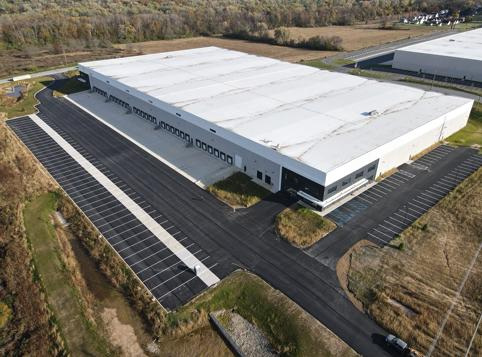
WISCONSIN RAPIDS – Wisconsin Rapids residents are asking a lot of questions about data centers after a recent proposal for a 209-acre data center in the city.
What are data centers? What do they do? How are they related to artificial intelligence? How would a data center impact the community?

Initial plans in Wisconsin Rapids call for building on 1.2 million square feet of a 208.95-acre piece of former paper mill industrial land where the local pulp mill had been demolished. Construction plans include converting an existing 143,000-square-foot building and constructing four new data center buildings on site, for a total of five buildings.
PNK Group recently told a Daily Tribune reporter it is still exploring the possible purchase of the former industrial property in Wisconsin Rapids and is evaluating the property’s suitability for a data center redevelopment at the site. The group has also not determined who would own and operate the potential data center in the long term. No final decisions have been made, the developer said.
As conversations continue about a potential data center project in Wisconsin Rapids, the Daily Tribune is stepping back to provide more information about what data centers are, what artificial intelligence is and how the two are related.
A Daily Tribune reporter collected information from the University of Wisconsin-Madison and other sources and compared specific concerns to what PNK Group noted in the developer’s conditional use permit application submitted to the city.
Here’s what we learned.
What is a data center?
Anna Haensch, a research associate professor with the Data Science Institute and an associate director of the Digital Scholarship Hub, published a presentation March 26, 2026, titled “Data Centers in 2026” through the University of Wisconsin-Madison.
A data center is a group of computers in a building. Those computers could be holding data, computing figures and containing cloud resources for people in other locations. These setups vary in size and could operate in colocation or shared facilities, enterprise data centers or hyperscale data centers, according to Haensch’s presentation.
According to IBM, a hyperscale data center is a massive center engineered for large-scale workloads. They’re larger than typical data centers, requiring enough space for at least 5,000 servers, taking up millions of square feet of space. IBM sited International Data Corporation’s definition as at least 5,000 servers and occupying at least 10,000 square feet of physical space. Most hyperscale data centers use between 100 megawatts and 300 megawatts, according to IBM.
According to the PNK Group’s conditional use permit application for the proposed Wisconsin Rapids project, the total building area is estimated to be 1,206,280 and use 150 megawatts after the project’s three full phases have been completed, estimated by 2030. The first phase is estimated to use 40 megawatts in the first half of 2027, then 100 megawatts by 2028, contingent on applicable engineering studies and regulatory approvals.
The Wisconsin Economic Development Corporation calls data centers buildings that are “constructed or rehabilitated to house a group of networked computer servers to centralize the processing, storage, management, retrieval, communication, or dissemination of data and information.”
It’s a rapidly growing industry, according to the WEDC. The organization is working to attract more data centers to Wisconsin, stating there are fewer data centers in Wisconsin when you look at percentage of total businesses compared to other states.
How many data centers are there in Wisconsin?
According to a Milwaukee Journal Sentinel report, DC Byte, a firm tracking data center developments, counts 21 locations in Wisconsin, including 12 projects that aren’t live yet as of May 13.
A tracking website, datacentermap.com, counts 53 individual data centers listed in Wisconsin from 10 markets across the state. This count, however, includes two data centers in Wisconsin Rapids from a project that never materialized.
Digital Power Optimization Inc. announced its plans to build an artificial intelligence computing facility in Wisconsin Rapids and shared more details with a Daily Tribune reporter in January 2025. The company planned to lease a 6-acre parcel of land owned by Consolidated Water Power Company and develop a $200 million facility. By July 2025, the project was scrapped. The DPO project that was originally planned is not on the same parcels as the current PNK Group project.
What is AI?
According to the United States Military Academy Library, there are three levels of artificial intelligence.
A document describing generative artificial intelligence on the academy’s library website says we are currently operating in a Narrow AI, or “Weak AI” era. AI-powered tools are designed to perform very specific tasks and can be useful and faster than humans in speed and efficiency. Examples of this type of AI are manufacturing robots, self-driving cars and personal assistants like Alexa and Siri. These tools are being used in almost every field like education, health care, government, manufacturing, engineering, construction, business, military and computer science.
The Department of Veterans Affairs, for example, is working to leverage AI to improve care for veterans and to meet the VA’s mission more efficiently and effectively, according to a USA TODAY report from November 2025. In this application of AI, the technology has helped doctors identify possibly concerning polyps in colonoscopies and has helped improve detection rates by 20%. Artificial intelligence has also helped VA employees summarize long documents or helped them research various topics.
Artificial general intelligence is more advanced and includes AI that can learn, understand and apply knowledge to a broad range of tasks. General AI can be designed to play chess or apply facial recognition, answers questions and works through complex problem solving, according to the document. This type of AI has potential to change many industries and sectors, but a lot of that potential is theoretical.
Generative AI is one of many ways to use AI, like ChatGPT. A human could use GenAI by giving it a prompt, instructions or a question. GenAI then runs those prompts through an algorithm and generates text, images, videos and 3D models. Humans should always fact check for accuracy, as hallucinations and bias are considerable problems, according to the generative artificial intelligence document. Generative AI can hallucinate, producing false events, stories or nonsense as fact.
Artificial super intelligence is hypothetical at this point. The concept aims to create an AI system that is smarter than humans and would be capable of comprehending and interpreting human emotions and experiences and could develop its own emotional understanding and beliefs, creating its own ideas. While many scientists don’t believe this type of AI is possible or achievable, some believe it is with the right technologies.
What does artificial intelligence have to do with data centers?
The existing amount of data centers and their capacity cannot meet the needs of the forecasted AI growth, according to Haensch’s UW-Madison presentation.
What powers a data center?
Data centers are powered by central processing units and graphical processing units.
Central processing units are the brains of a computer. A CPU uses between 125 and 190 watts of electricity. Haensch compares this much power as slightly less than a rice cooker uses. Computing here happens by passing electrical currents through the integrated circuit.
Graphical processing units are fast brains of a computer that are good at images. Most GPUs in the U.S. are made by Nvidia, and a single Nvidia Blackwell GPU uses between 700 and 1,200 watts of energy. Haensch compares this much power as between a refrigerator and window air conditioning unit.
All of that computing generates heat, requiring cooling systems that take energy to operate.
According to PNK Group’s letter to the city, it intends to use hydroelectric power. Initial plans say the data center would use power provided through a coordinated arrangement between Consolidated Water Power Company at the local distribution and substation level and the American Transmission Company at the regional bulk transmission level.
According to that letter, the data center project would not degrade electric services for homes, schools, hospitals and existing businesses in the city. The Daily Tribune has reached out to Billerud, the owner of subsidiary Consolidated Water Power Company, with questions about the amount of power the project could use, how it compares to powering the paper mill at full operations and any impact to other users. At the time of publication, Billerud had not responded.
There are many more questions people have about data centers, risks and benefits and more about the proposed Wisconsin Rapids project. The Daily Tribune will continue covering those topics in further detail.
What’s next?
The city originally planned to hold a public hearing May 4 about the conditional use permit, however because of the project’s specific industry, size and location, the city announced it would defer the public hearing and would be scheduling a listening session to provide more information about the project and respond to questions.
The date and time of that listening session has not been scheduled as of May 22.
Rescheduled public hearings will be held in front of the Planning Commission to discuss a conditional use permit for the project.
City staff would work to create a list of conditions specific to the project and property. The city’s Planning Commission would review and vote to share their recommendations with the Wisconsin Rapids Common Council. The Common Council would have authority to approve the conditional use permit.
Contact Caitlin at cshuda@usatodayco.com or follow her on Twitter @CaitlinShuda.
This article originally appeared on Wisconsin Rapids Daily Tribune: We answer your questions about what a data center is, how it powers AI
Reporting by Caitlin Shuda, Wisconsin Rapids Daily Tribune / Wisconsin Rapids Daily Tribune
USA TODAY Network via Reuters Connect