The lake sturgeon is an ancient and long-lived species.
If you live in Wisconsin, those facts are likely familiar.

We’re fortunate in the Badger State for the Winnebago System, home to one of the world’s largest and best-managed sturgeon populations, as well as strong numbers of the fish in the Chippewa, Wisconsin and other rivers and restoration efforts in sites such as the Milwaukee River.
The Department of Natural Resources and various news media put out dozens of reports and articles annually on the sturgeon, including spring spawning activities, stocking programs and spearing and hook-and-line seasons.
We even have Stockbridge, the “Sturgeon Capital of the World,” on the northeastern shore of Lake Winnebago.
Wisconsin residents likely have a higher sturgeon IQ than those of any other state in the union.
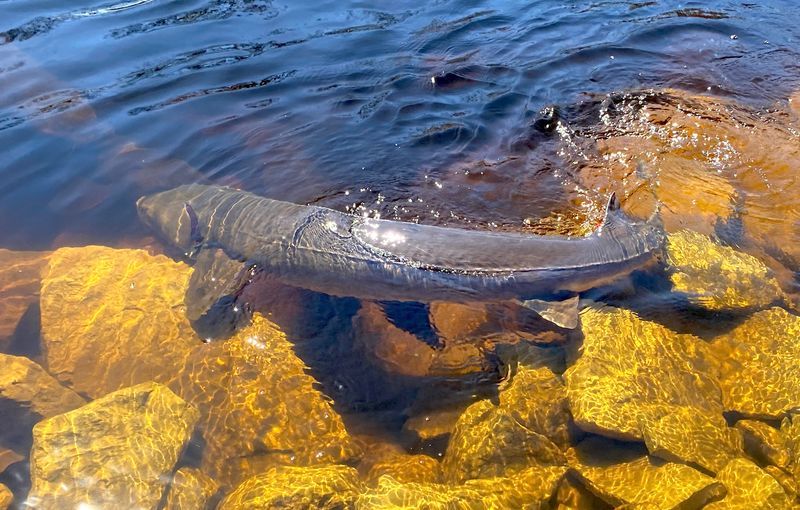
We know the “charismatic megafauna” has barbels, or whiskers, a vacuum mouth, smooth skin like a shark and is sometimes called a “living dinosaur” due to its existence in the fossil record from 100 to 136 million years ago.
We also know they are the largest fish in Wisconsin waters, with some specimens topping 200 pounds, and they can get very old.
But how old?
It’s been commonly stated in recent decades that sturgeon in Wisconsin can live more than 100 years.
But sturgeon don’t have scales, meaning a common method of aging fish by counting annual growth rings on scales can’t be used.
And the otoliths, or ear bones which also exhibit lines for each year of age, are fragile and difficult to work with, according to sturgeon experts.
Further, the rings on fins were found to underestimate the ages of sturgeon, said Ron Bruch, the retired DNR fisheries director and long-time Winnebago System sturgeon biologist who earned his doctorate in work on the species.
So the question of “how old” is still being researched.
A paper published in April 2026 in the Journal of Fish Biology highlighted a new approach to the issue and has some eye-popping conclusions.
Titled “Lake sturgeon growth and longevity estimated from adult capture–mark–recapture data,” the work leveraged information gathered from years of world-class fisheries field work done in Wisconsin and Michigan.
As you may be aware, each year DNR fisheries staff nets, measures, weighs and releases hundreds of sturgeon in Wisconsin. And critical to fisheries research and management, if the sturgeon doesn’t have a tag, the DNR marks it.
In recent years the common tagging method is implanting the fish with a passive integrated transponder, or PIT tag.
The tag carries a unique identification number similar to the chips in our pet dogs and cats.
Many of the tagged sturgeon are caught again in subsequent years, allowing scientists to record the difference in weight and length over a known time.
Another fact about sturgeon: they essentially keep growing all their life though more slowly as the years go on.
So a group of nine researchers led by Edward A. Baker of the Michigan DNR’s Marquette Fisheries Research Station set out to use this mark-recapture data to come up with a new estimate of sturgeon ages.
The paper includes three Wisconsin co-authors: Bruch; retired DNR fisheries supervisor Mike Donofrio; and current DNR sturgeon biologist Margaret Stadig.
It should come as no surprise that most of the data came from fish in the Winnebago System. The Wisconsin sturgeon program is funded by proceeds of sturgeon spearing licenses and applications. For the last several decades the revenue has allowed the DNR to dedicate staff and resources to this important species.
It’s arguably the best managed sturgeon population and the richest sturgeon data set in the world.
The research paper separates sturgeon into five cohorts, or areas where fish were sampled: Black Lake, St. Clair River and Sturgeon River in Michigan; the Menominee River in Michigan and Wisconsin; and Lake Winnebago in Wisconsin.
The sample size of the Winnebago fish dwarfs everything else. The paper shows data from 4,703 sturgeon in Lake Winnebago were used in the study, while 116 were from the Black River, 85 from the Sturgeon River, 63 from the Menominee River and 40 from the St. Clair River.
The researchers calculated sex-specific mean annual growth rates.
To give an idea of how slowly a sturgeon can grow after it reaches maturity, the paper cites a couple of examples. In one, a male lake sturgeon initially captured in the Sturgeon River in 1990 was 46.06 inches and when recaptured in 2024 (34 years between events) had only grown 2.75 inches, an average annual increase in length of 0.08 inches. In another case from the Black River, a female lake sturgeon captured in 2012 was 50.0 inches and when recaptured in 2021 was 50.78 inches, a mean annual growth rate of 0.09 inches.
Given these slow growth rates even for relatively small fish, extreme longevity for a species that routinely reaches lengths of 70 inches should be expected, according to the paper.
Indeed the age estimates produced by the capture-mark-recapture data are deserving of “all caps.”
Predicted median ages for the largest observed males ranged from 94 to 435 years among populations, the paper states. Female predicted median ages for the largest observed fish ranged from 73 to 292 years.
Specific to Lake Winnebago, the cohort with the largest sample size, the maximum age ranges were estimated to be 141 to 150 years for male sturgeon and 143 to 178 years for female sturgeon. The data are listed at the 95% confidence level.
The researchers concluded their “results show lake sturgeon longevity may be similar to other long-lived fish taxa” such as the Greenland shark, estimated at more than 400 years, as well as several species of rockfish.
The paper cites torpor, or a seasonal slowing of metabolism, as a physiological mechanism lake sturgeon may employ to increase longevity.
In their conclusion, the authors state “our results suggest lake sturgeon routinely live much longer than currently accepted and consequently must have high annual survival as well.”
Bruch, who led the Wisconsin sturgeon program during a critical period and helped establish the system of harvest caps to limit annual harvest, is confident the species has adequate protections in the Winnebago System.
“We now have a system in place that will allow the sturgeon to show us how old and how big they can get,” Bruch said. “It won’t happen in my lifetime but future generations will see it, I’m sure of it.”
This article originally appeared on Milwaukee Journal Sentinel: Smith: Researchers put new potential on how old lake sturgeon could get
Reporting by Paul A. Smith, Milwaukee Journal Sentinel / Milwaukee Journal Sentinel
USA TODAY Network via Reuters Connect
By Paul A. Smith, Milwaukee Journal Sentinel | USA TODAY Network