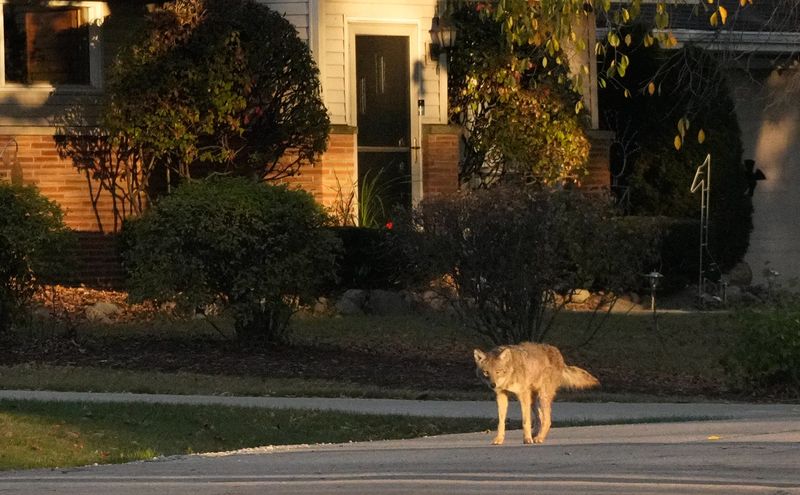
As the winter months approach, one creature may be seen more often around Wisconsin: coyotes.
While spotting a wild canid in an urban area like Milwaukee may be an unexpected sight, it’s not uncommon. Coyotes can survive well in cities, said Emilie Burmeister, a conservation biologist with Milwaukee County Parks.

“They have become really great urban adapters,” Burmeister said. “And we have more people, which means more sightings, which means more interest.”
The Milwaukee County Coyote Watch, a project run by Milwaukee County Parks in collaboration with the Wisconsin Department of Natural Resources, has provided insight into coyote whereabouts in Milwaukee County for the last 10 years. The project operates through the nonprofit social media nature site iNaturalist, and encourages Milwaukee County residents to log locations they see or encounter coyotes.
Burmeister said the coyote watch project helps Milwaukee County Parks identify “hot spots” of coyote observations and encounters, so the county and the DNR can pinpoint where to focus educational outreach efforts in the community.
These educational opportunities can be especially beneficial for people to understand what coyote behavior is normal and what’s abnormal.
“I can really say with confidence that education has been our most successful tool to help people understand and coexist peacefully with coyotes,” Burmeister said.
Coyote sightings tend to increase between November and March for a variety of reasons, experts say.
Jessica Knackert, a Milwaukee wildlife educator and biologist with the Wisconsin Department of Natural Resources, said one reason is that foliage where coyotes like to conceal themselves becomes sparse at this time of year, as trees lose their leaves and snow starts to fall. Food sources like vegetation and rodents are less bountiful in the colder months, causing many coyotes to venture out of their usual paths to find food.
Fall is also “dispersal time” for coyotes, meaning young coyotes that were born in the spring begin to explore on their own, and winter is mating season, when coyotes are preparing dens and may be traveling in pairs, Knackert said. Because coyotes can be protective of their mates, it’s especially important to give the animals space when two are together.
Cities across the United States have seen an increase in coyotes since the ’90s, Knackert said. In recent decades, it’s been difficult to determine if urban coyote populations are increasing, but anecdotal evidence suggests there has been an increase in reported coyote sightings in many areas due to home surveillance and security cameras, Knackert said.
What to do if you encounter a coyote
While coyotes have an instinctive fear of humans, longtime exposure to urban environments can reduce an animal’s innate fear, Knackert said. That can lead to problematic interactions.
People who encounter a coyote are encouraged to “haze” the animal, which entails scaring it away by making loud sounds and large gestures, Knackert said.
Because urban coyotes are exposed to lots of people and loud sounds, hazing needs to be louder and more dramatic than would likely be required for coyotes in more rural settings, she said.
“I always tell people that if they feel like they look a little ridiculous when they’re hazing a coyote, that’s probably a good level of hazing,” Knackert said. “They should be really loud, dramatic, and they should do it consistently until that coyote leaves the area.”
Knackert said she encourages people to keep their pets close to them to avoid conflicts with coyotes. Cat owners are encouraged to keep their cats indoors, and dog owners should keep their animals on a short leash next to them or closely monitored in a fenced-in yard.
Extra care should be taken with pets at night, when coyotes are the most likely to roam, according to guidelines from the Wisconsin Humane Society.
To keep coyotes out of yards, the human society advises people to secure garbage cans, and dispose of food waste that might be attractive to wild animals, like meat and cheese, with a small amount of ammonia in the garbage bag. Compost bins should be enclosed.
The DNR and Milwaukee County Parks encourage people to report sightings to the Milwaukee County Coyote Watch page.
Contact Kelli Arseneau at (920) 213-3721 or karseneau@gannett.com. Follow her on X at @ArseneauKelli.
This article originally appeared on Milwaukee Journal Sentinel: Since it’s November, you might see more coyotes in Milwaukee area. Here’s why
Reporting by Kelli Arseneau, Milwaukee Journal Sentinel / Milwaukee Journal Sentinel
USA TODAY Network via Reuters Connect