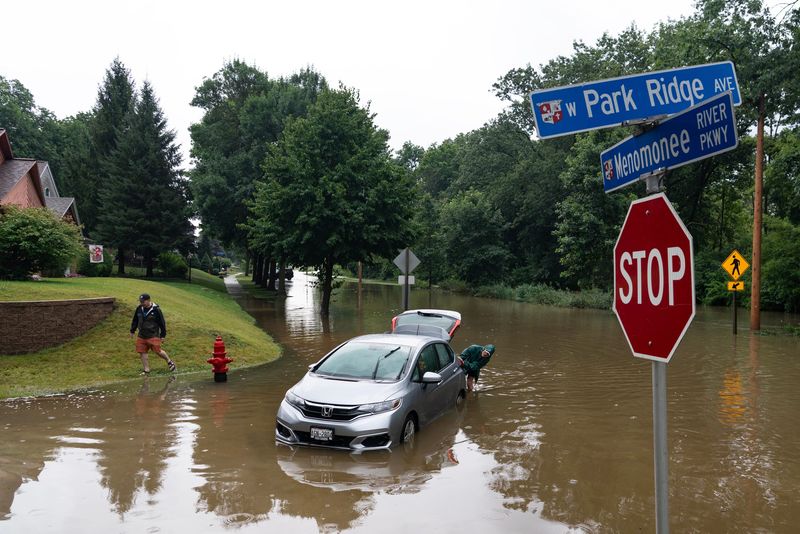
Climatologists have confirmed that the August deluge in southeastern Wisconsin was the largest rainfall event ever recorded in the state. It surpassed the previous record set nearly 80 years ago by about three inches.
Between Aug. 9 and 10, a rain gauge on top of James Madison High School in northwest Milwaukee recorded 14.55 inches of rain in under 24 hours. The gauge is maintained by the Milwaukee Metropolitan Sewerage District. The previous state record was 11.72 inches on June 24, 1946, near Mellen in Ashland County.

The 24-hour rainfall record was confirmed by scientists with the State Climate Extremes Committee, which includes representatives with the National Weather Service, the Wisconsin State Climatology Office, the Midwestern Regional Climate Center and the National Oceanic and Atmospheric Administration.
Several of these agencies have felt the impact of cuts from the Trump administration, raising the specter of whether this kind of data will be available in the future.
The disastrous August deluge was so rare that it’s classified as a thousand-year event. Thousand-year flood events don’t refer to time, as is commonly misperceived. They refer to probability, meaning there is a 1-in-1,000 chance of it occurring in any given year.
Several rounds of thunderstorms drenched southeast Wisconsin during the August flood event, leading to widespread flooding, in which at least two people died.
The Milwaukee County Office of Emergency Management estimated that damage from the flood event surpassed $50 million.
Throughout Milwaukee County, more than 2,200 homes sustained major damage or were destroyed. A significant number of those homes were concentrated in the city of Milwaukee, especially on the north and west sides, as well as in the suburban municipalities of Glendale, West Allis, Wauwatosa and Brown Deer, according to data from Milwaukee County’s Office of Emergency Management. In the city of Milwaukee, 54 homes were reported as “uninhabitable” as a result of flooding.
In Wauwatosa, first responders rescued about 70 people, including two rescues from the Menomonee River, during and in the aftermath of the storm. Flood damage to public property surpassed $4 million, including Hart Park, which lies on a floodplain and is surrounded by a flood levy.
The flood event also forced the largest combined sewer overflow since the Deep Tunnel was installed in 1993. About 5.14 billion gallons of untreated wastewater were discharged into nearby waterways and Lake Michigan.
The Trump administration granted a request for $29.8 million in FEMA Individual Assistance for Milwaukee, Washington and Waukesha counties, but later denied a $26 million request for Door, Grant, Milwaukee, Ozaukee, Washington and Waukesha counties.
Bridget Fogarty, Claudia Levens, Vanessa Swales, Alison Dirr and Gina Lee Castro contributed to reporting on this story.
Caitlin Looby covers the Great Lakes and the environment for the Milwaukee Journal Sentinel. Reach her at clooby@gannett.com and find her on X @caitlooby. All of her work and coverage decisions are overseen solely by Journal Sentinel editors.
Caitlin is an Outrider Fellow whose reporting also receives support from the Brico Fund, Fund for Lake Michigan, Barbara K. Frank, and individual contributions to the Journal Sentinel Community-Funded Journalism Project. The project is administered by Local Media Foundation, tax ID #36-4427750, a Section 501(c)(3) charitable trust affiliated with Local Media Association.
This article originally appeared on Milwaukee Journal Sentinel: Rainfall that caused August flood was largest in Wisconsin history
Reporting by Caitlin Looby, Milwaukee Journal Sentinel / Milwaukee Journal Sentinel
USA TODAY Network via Reuters Connect