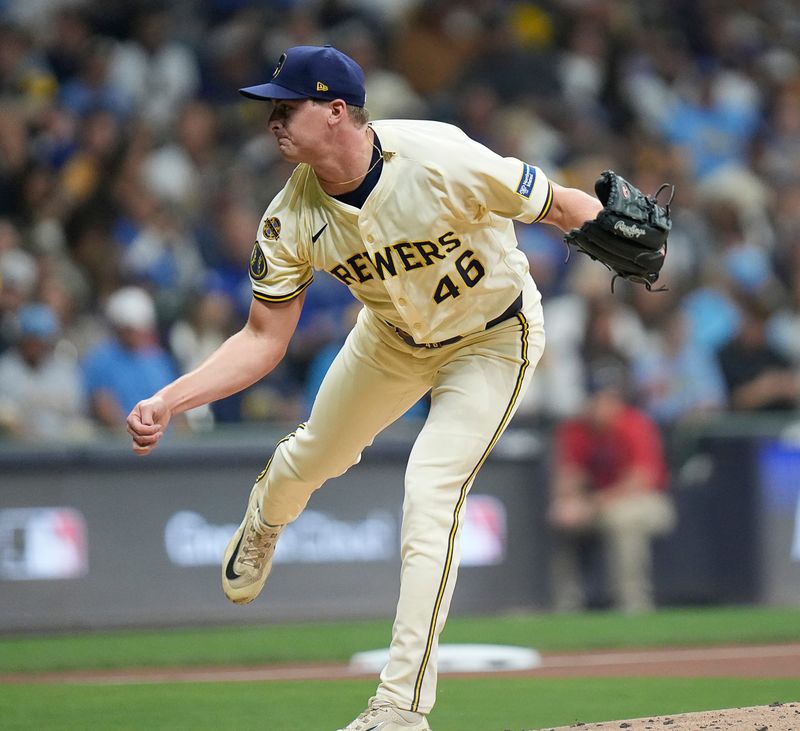
After exhausting every non-procedural avenue to deal with his thoracic outlet syndrome over the past three months, Quinn Priester has settled on having surgery.
The Milwaukee Brewers right-hander will undergo a first rib resection to remove the uppermost rib to decompress the nerves that have caused him problems on the mound this season.

When initially diagnosed with neurogenic thoracic outlet syndrome in March, the hope for Priester was that he would not have to undergo surgery. A Botox injection in the pectoralis minor in his upper chest helped alleviate the pain and Priester was able to pitch largely pain-free while attempting to rehab the injury. But the writing ultimately was on the wall as the results from his minor-league starts were jarringly poor.
“We’ve just gotten to a point where these things aren’t working so we’re going to go down on Monday [June 22] and get surgery with Dr. [Gregory] Pearl,” Priester said. “Make sure we clean this issue up so the rest of my career this isn’t an issue. Ten years ago, this was more of a question mark but now with the way things have progressed in the medical field I feel really confident we’re going to come back even better.”
While Priester wasn’t feeling pain from the compressed nerves, he clearly wasn’t right. He allowed 28 runs and walked 24 in 16 innings across eight rehab starts, twice being pulled from his rehab assignment and back to the injured list.
The explanation, according to Priester: His proprioception – the body’s “sixth sense” that controls limb movement in space without having to look at it – was off.
“That’s causing a lot of the control issues that we worked really really hard, really diligently [on] mechanically,” Priester said. “But when the brain and arm aren’t communicating the right way because of this diagnosis, because of the nerves that are pinching in there, it makes it nearly impossible to create a result that’s repeatable. It was great that we got the pain to go away with the nerve blocks, but essentially we couldn’t alleviate all the symptoms.”
Priester expects to begin a plyometric throwing program in eight to 10 weeks and should be able to play catch shortly thereafter.
Ultimately, an eight- to 10-month recovery is most common for the surgery, which would put Priester back on the mound sometime around the scheduled beginning of next season.
“I’m confident with my body and I’m still a pretty young guy that I’ll be able to make that a little bit quicker and [be] diligent with the work and be ready to compete for a spot in spring training next year,” he said.
The Brewers attacked the injury initially with a diagnosis of exclusion, ruling out every other potential cause for his symptoms.
They approached the last few months similarly, attempting myriad treatments as well as warm-up and recovery methods. But after Priester walked five in his most recent rehab outing June 8, the Brewers took him off his rehab assignment and he went to visit Pearl in Dallas.
“We’d done everything. We wanted to turn over every stone that wasn’t surgery,” Priester said. “Whether that’s scraping, needling, cupping, hot tub, warming up before or after, BFR (blood flow restriction) machines. We really tried to go down every avenue here. The nerve blocks, invasive and non.
“Ultimately we weren’t getting the results. We ended up getting to a pain-free spot, but in terms of the command, you know how important consistency is to be here and to be good for this team and an actual option. If we don’t have that, it’s not anything I can control.”
While Priester’s injury is different from that of Zack Wheeler, who was dealing with blood clots from his thoracic outlet syndrome, the recovery of the Philadelphia Phillies right-hander this season is an encouraging sign. Wheeler, at age 36, has a 2.01 earned run average in 10 starts this season immediately off the shelf from his recovery.
Whether Priester gets back to a similar level he showed last year in his first season with the Brewers, pitching to a 3.32 ERA in 157⅓ innings, remains to be seen.
This has been a challenging process for Priester, and that isn’t going to change for the next few months.
“It’s been a mental challenge,” he said. “It’s hard to go out and have the results I’ve had this year but continued to wake up and say, ‘Hey, we’re going to get through this at some point.’ I felt like that was the best to maintain just for confidence sake and getting off the mat, because some of those outings were rough ones. Not ones that I’m accustomed to – even when I have a bad game. It wasn’t like, ‘Oh, these were just bad games.’ These were uncontrollable things that were difficult to go to bed and wake up and be like, ‘Oh, I’m just going to figure it out tomorrow.’
“Obviously that didn’t really happen. Mentally, it was really difficult.”
This article originally appeared on Milwaukee Journal Sentinel: Quinn Priester to have season-ending surgery for thoracic outlet syndrome
Reporting by Curt Hogg, Milwaukee Journal Sentinel / Milwaukee Journal Sentinel
USA TODAY Network via Reuters Connect
By Curt Hogg, Milwaukee Journal Sentinel | USA TODAY Network