Mabel Lamb and Yvonne McCaskill know that in order to live healthy lives in their Milwaukee neighborhoods, knowledge is power.
Lamb, executive director of the Sherman Park Community Association, and McCaskill, who leads the Century City Triangle Neighborhood Association, live on opposite sides of the once-bustling 30th Street Industrial Corridor. Though industries helped the corridor flourish for a time, they also left behind hazardous waste when they departed.

Now, both neighborhoods will be part of an effort ultimately intended to document how the environment affects human health across Milwaukee, and to give people the knowledge they need to find solutions. The Milwaukee effort is shepherded by Clean Wisconsin and funded by a $250,000 grant from the Medical College of Wisconsin’s Advancing a Healthier Wisconsin Endowment.
Clean Wisconsin began the work in Sherman Park last year, summarizing the air quality, urban heat islands, access to green space and proximity to polluted properties in Lamb’s neighborhood. Then it shared the information with residents.
Now, the organization is expanding the work to McCaskill’s neighborhood, Garden Homes, Harambee, Silver City, Burnham Park and Muskego Way. Eventually, it hopes to cover the entire city, said Clean Wisconsin’s Resilient Communities Program Director Nancy Retana.
The profile of Sherman Park was eye-opening, Lamb said, particularly the mapping of polluted sites. Both she and McCaskill agreed that while older residents may be aware of such hazards, newer ones might not.
Hard data, lived experiences come together to tell the full story
In many cities across the country, Milwaukee included, low-income communities and communities of color are disproportionately exposed to environmental hazards, such as heat islands and air pollution.
Plenty of data exists to back up that assertion, but it can be confusing and hard to access, Retana said. The Clean Wisconsin project is meant to simplify it.
The two-page Sherman Park profile compares that neighborhood to Milwaukee County as a whole on a number of factors, including rates of certain health conditions, tree canopy cover, surface heat, lead paint, air pollution levels and traffic density. Clean Wisconsin worked with the Milwaukee-based organization Data You Can Use to pull the data from a variety of sources.
Notably, more Sherman Park residents experience asthma, chronic obstructive pulmonary disease, coronary heart disease and high blood pressure than the Milwaukee County average. Those conditions can be made worse with exposure to environmental pollutants – lending an urgency to finding solutions, Lamb said.
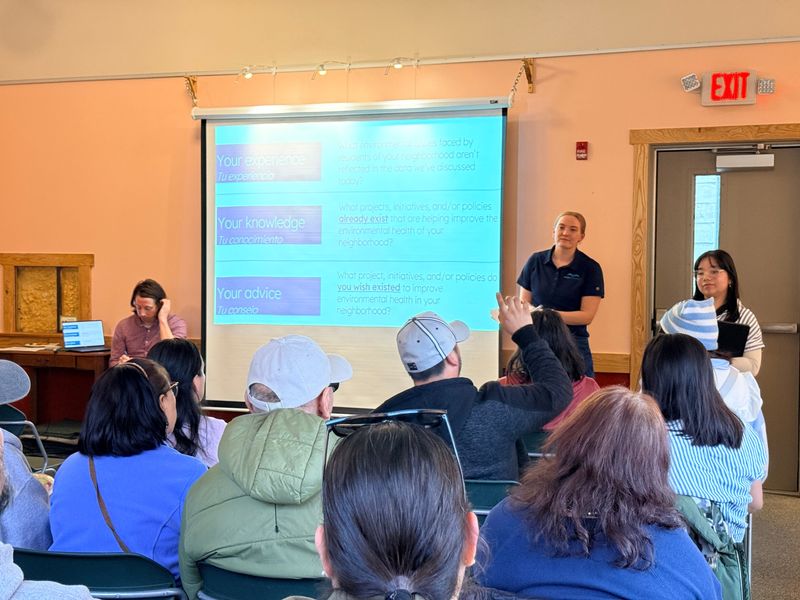
When a first draft of the profile was complete, Clean Wisconsin staff brought it to Sherman Park residents for what they’re calling a “data chat,” in partnership with the Milwaukee Health Department. The aim is to flesh out the quantitative data with residents’ lived experience to paint a fuller picture of the neighborhood’s environmental health, Retana said.
For example, the organization’s initial findings showed that all residents in the neighborhood live within one mile of a park – at first blush, a positive indicator of access to nature. But during the data chat, Retana said, residents opened up about how they might be geographically close to green space, but other factors – like pedestrian safety, dangerous driving and litter – affected how much access to parks they felt they had.
Through 2027, Clean Wisconsin will refine the neighborhood profiles based on resident feedback, and then present them to people again.
“We’re not just saying, ‘Here’s the material, we had one data chat, that’s it,'” Retana said.
Knowledge about hazardous sites could lead to change
Sherman Park’s draft profile pinpoints more than 170 sites within and directly around the neighborhood’s boundaries that are listed by the Wisconsin Department of Natural Resources as being contaminated or releasing toxic vapors.
Even if people are aware of the areas, Retana said, they may not know what type of contamination is present. That can be important. During the data chats, Clean Wisconsin staff can help residents learn about the property and what risks it might pose.
“When we become aware of something like a gas tank still buried under the ground of what looks like a nice green park, do we have information about the health impacts? Is it leaking? Is it still impacting water?” said the Rev. Tim Perkins, who has been pastor at Bethel-Bethany United Church of Christ in the neighborhood for decades. The church hosted a data chat.
Lamb and McCaskill both pointed to instances where not having such information has cost neighbors.
In the Century City Triangle Neighborhood, Melvina Park – once a parking lot for A.O. Smith Corp. – underwent a restoration a few years ago. Part of that restoration addressed “minor environmental contamination,” according to the city of Milwaukee’s Department of City Development, and some of the spoils were capped and left on-site.
“We as a community were not informed that that was going to happen,” McCaskill said. “Because we were not told that, part of the trust factor was damaged.”
Lamb recalled the discovery of a cancer-causing chemical in the east building of the affordable housing site Community within the Corridor, which sickened residents and forced evacuations of more than 150 people in 2023.
“We have to be concerned about what types of businesses are going into those sites … making sure our residents aren’t affected in some adverse way,” she said.
By having this information in hand, Retana said, she hopes residents are empowered to push for neighborhood investments from elected leaders, and to advocate for themselves at the doctor’s office, too.
Perkins said the Clean Wisconsin project also could prompt broader involvement in remedying environmental hazards.
“What are we going to do – all of us – to correct them?” he said.
Madeline Heim covers public health and environment issues for the Journal Sentinel. Contact: mheim@usatodayco.com.
Madeline’s environmental reporting is supported by Fund for Lake Michigan and reader contributions to the Journal Sentinel Community-Funded Journalism Project. Journal Sentinel editors maintain full editorial control over all content. To support this work, visit jsonline.com/support. Checks can be addressed to Local Media Foundation (memo: “JS Community Journalism”) and mailed to P.O. Box 85015, Chicago, IL 60689.
The JS Community-Funded Journalism Project is made possible through our partnership with Local Media Foundation, tax ID #36-4427750, a Section 501(c)(3) charitable trust affiliated with Local Media Association, and EnMotive, LLC, a subsidiary of USA TODAY Co., Inc. USA TODAY Co., Inc. is the parent company of this publication.
This article originally appeared on Milwaukee Journal Sentinel: Project helps Milwaukee neighborhoods learn environmental health risks
Reporting by Madeline Heim, Milwaukee Journal Sentinel / Milwaukee Journal Sentinel
USA TODAY Network via Reuters Connect