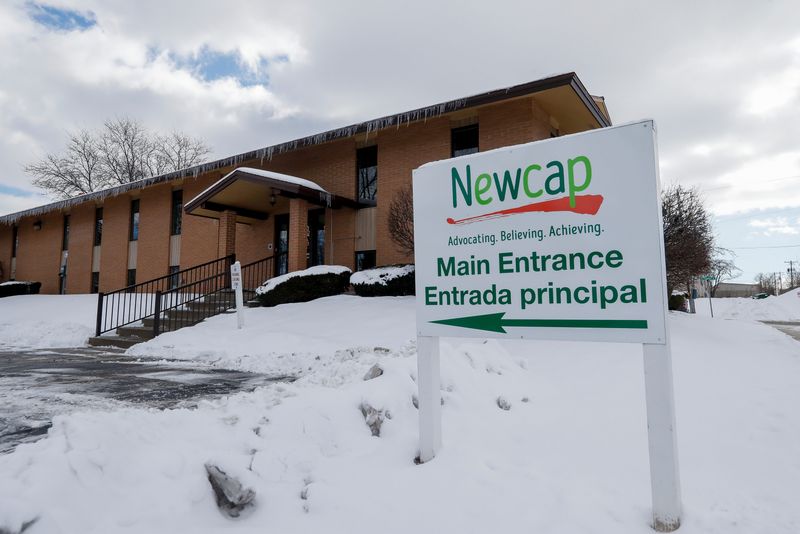
The choice to approve the highest pay of any CEO in the history of anti-poverty nonprofit Newcap was made unanimously on April 14, 2022, by 13 board members.

They were pleased with the performance of CEO Cheryl Detrick, according to meeting minutes. In the year prior, the nonprofit recorded over $33 million in revenue and $6.3 million in profit, the highest figures Newcap had seen. Net assets in 2021 were at an all-time high of about $10 million.
Their vote earned Detrick compensation of $296,800 in 2022, excluding retirement and non-taxable benefits.
Of that, $50,000 was a one-time bonus taken out of a $5 million grant meant for homeless families to find stable homes, according to meeting minutes.
Detrick’s pay was the highest of any chief executive at the 18 agencies making up the Wisconsin anti-poverty coalition WISCAP in 2022. The compensation kept up a practice at Newcap of giving 1% of all new money it received as a bonus to Detrick, a provision included in her personal services agreements since at least 2019 and an incentive that’s raised ethics concerns.
“This kind of arrangement creates an inherent conflict of interest,” said Laurie Styron, executive director at Charity Watch, the independent national charity watchdog organization.
Detrick declined multiple times to be interviewed about her compensation by the Green Bay Press-Gazette in 2025.
Tom Sieber, currently Newcap’s executive committee chairman and former chairman in 2022 of the personnel committee that had suggested Detrick’s pay contract, declined to comment on “issues recently brought to our attention,” he said in a Feb. 12 email.
Sieber was referring to WLUK-TV reports last week that raised financial concerns about the nonprofit and has prompted calls from several state legislators for an independent investigation into Newcap.
“I was deeply concerned to learn of the serious and credible allegations of the misuse of funds at Newcap,” said state Sen. Jamie Wall, D-Green Bay. “The thousands of people who rely on their services deserve better, and we all expect integrity and transparency from organizations entrusted with public and charitable dollars.”
1% of all new money as a bonus
First established in 1965, Newcap serves 10 counties from the Northwoods to the bay of Green Bay. It’s under WISCAP, the statewide network of 18 anti-poverty agencies, each running its regional programs meant to move people up the economic ladder.
In Newcap’s case, it has offered services like clinical exams, job training, fixing up homes for low-income families – all programs whose availability changes from county to county, serving tens of thousands. It reported in its 2014 tax filings that its grant-funded services helped about 90,000 individuals who accessed services like food assistance and maternal and child health care, as well as gave about 2,700 months’ worth of rent assistance. In 2025, the nonprofit served about 25,000 households, Detrick told the Press-Gazette in January.
Detrick, a Nevada-native who worked at several chambers of commerce, started at Newcap in January 2016 as the replacement to retiring CEO Robert Koller, arriving from the De Pere Area Chamber of Commerce where she was CEO since 2008.
She earned $98,876 in her first year.
Her pay grew modestly, reaching $114,498 in 2018 when the board of directors, in a Aug. 8, 2018, meeting, approved a 3% raise for Detrick, according to meeting minutes.
“Our CEO pay is comparatively a bit below mid-range, but our CEO has committed to accepting the same percentage as available to her staff,” said meeting minutes from a June 13, 2019, board meeting.
The personnel committee had reviewed a WISCAP compensation study to see if wages at Newcap were comparable to other agencies, the minutes said. Tax filings show the committee was responsible for recommending Detrick’s pay to the board based on evaluations of the CEO submitted by program directors and interviews. Pay for other executive positions was based on a 2015 WISCAP wage study, according to tax filings.
For Detrick’s 2019 pay, the personnel committee recommended and the board approved a 3% raise, as in 2018, as well as “a 1% bonus on new money,” the meeting minutes said.
Charity watchdog raises concerns on profit incentive
Nonprofit executive pay was not supposed to be based on a profit motive, which bonuses introduce, according to Styron, the Charity Watch executive. Compensation should be based on education, skills and experience to do a job efficiently, not on how much money an employee can pull in, as important as that was, she said.
In the case that executive employees make more than $150,000, the IRS requires nonprofits to fill out a Schedule J. Bonuses are to be separately reported from other kinds of compensation.
According to Styron, nonprofits are required to mark on Schedule J if the nonprofit paid or piled up any compensation for the relevant key employees based on how much money the organization got.
“While this kind of arrangement is not unheard of, these types of compensation structures are typically frowned upon for nonprofit organizations,” Styron said.
Should a nonprofit want to maintain a bonus incentive structure anyway, ethically, donors should be made aware the organization has a compensation system that incentivizes fundraising, an incentive that may pull attention away from the organization’s other activities to its detriment, Styron said.
Detrick made $130,804 in 2019 from the approved compensation terms, under the $150,000 bar.
She crossed that threshold the following year.
In 2020, Detrick made $173,799. She said in a Feb. 3, 2020, board meeting that Newcap was “Always looking for new programs/grants to apply for. A lot of opportunities in Green Bay may be opening in housing,” according to meeting minutes.
She made $157,466 in 2021, the year that the accounting firm Wipfli noted in its end-of-year audit five new federal housing grants through Green Bay’s Redevelopment Authority, among other grants.
The 1% bonus was tabled in 2021 and brought back up for board consideration the next year in its April 14, 2022, meeting, according to meeting minutes. The minutes reiterated previous notes that the CEO got a bonus based on new money coming into the nonprofit.
Each of the 13 present board members were given a copy of the personnel committee’s proposed 2022 personal services agreement for Detrick, the minutes said. A compensation study that looked at other human service agencies similar to Newcap across Wisconsin, Minnesota, Illinois and Iowa had been done that spring to determine Detrick’s salary, according to tax filings.
The meeting minutes said the average salary of 17 comparable agencies was “voted on,” and was concluded to be $217,955. The personnel committee said Detrick should receive this salary, plus a 3% raise.
As for the previously tabled bonus, “It was decided that Cheryl would receive 1% of the Bezos Family Grant, as a one-time bonus, $50,000.”
The grant reference was to the $5 million award received in November 2021 through Amazon founder Jeff Bezos’ Day 1 Families Fund. The Press-Gazette reported at the time that Newcap would use the money to expand its Whole Family Approach to move families out of homelessness.
Newcap’s tax filings said a $50,000 incentive payment was accrued in 2021, then paid out to the CEO in 2022. Tax filings show she earned $296,800 in 2022 compared with $157,466 in 2021.
Though Detrick had declined interview requests to answer questions about her compensation, she said in an email last year that the nonprofit had derived her pay from compensation studies.
She added, “I was given a bonus in recognition of our housing project in Marinette, which was completed December 2021, plus there was an error discovered in my compensation calculation and that was fixed.”
The minutes said a compensation study had been done for all employees, who received a 5% raise that year, “to ensure that we are compensating staff adequately. We plan to do that going forward.”
Newcap CEO calls audit ‘moot’
Detrick’s compensation was $218,226 in 2023 and $239,641 2024. Newcap did not report in its tax filings that there were any bonuses.
In these years, Detrick spent a third of her time talking with politicians and lobbyists “that could act on the organization’s behalf regarding current issues that need addressing,” tax filings said.
During that same time, Newcap posted its deficits of over $2 million annually, the largest in its history, partially contributing to the accounting firm Baker Tilly’s “substantial doubt” that Newcap could keep running by the end of 2025, according to Newcap’s 2024 regularly scheduled end-of-year audit.
The accounting firm also drew its conclusion after considering Newcap’s expenses that were higher than revenues and the nonprofit’s strained cash balance. It saw the checks issued above what Newcap had in the bank. And it saw the nonprofit didn’t have the assets to meet future loans.
“I’m beyond frustrated about this myself,” said Detrick of the audit opinion in a January interview with the Press-Gazette. Her roughly 140-person staff were still working, she said, “So clearly this is moot.”
Nicole Berkeland, public relations director at Baker Tilly, declined to comment, saying the firm doesn’t speak on client engagements as a matter of policy.
Detrick in January acknowledged to the Press-Gazette that the company was financially struggling and called the audit’s findings “nothing we didn’t already know.”
Detrick said the nonprofit had already put in place cost-saving measures before the audit was delivered in September.
She said contracts were renegotiated with vendors and that she would look to negotiate with national funders. Payroll costs were down about $500,000, she said.
The audit elaborated that Newcap reduced administrative staff to lower expenses and eliminated programs that didn’t have a dedicated funding source. The audit also said senior leadership had reallocated their time to focus on fundraising and was continuing to look for new grants. Newcap sold “various facilities” in 2025 to raise cash and started looking into restructuring its debt to delay upcoming payments, the audit said.
Whether the nonprofit could keep operating depended on whether Newcap could restructure its debt terms and extend its line of credit, according to the audit, a finding that Detrick said was frustrating for its circumstances.
Detrick said she was put in a catch-22 where the bank was waiting for the audit to extend Newcap’s line of credit, which renewed in the fall, all while Baker Tilly was concerned with the limited credit line. Detrick said she was confused why the auditor had been concerned with Newcap’s ability to repay several mortgages that were “way in the future.”
She attributed much of her nonprofit’s financial situation to the way nonprofits got their money from the state. To provide grant-funded services, like food pantries or shelter, Detrick said a nonprofit spends its own money, then waits to be reimbursed, a situation she described as making nonprofits “the bank of Wisconsin” and called “no way to run the taxpayer’s business.”
The audit noted that federal and state grants were typically reimbursed to Newcap within 30 days.
Newcap faces public scrutiny
Reports by WLUK-TV on Detrick’s salary and how Newcap has spent money earmarked for helping low-income families has reportedly led to Detrick being placed on administrative leave and calls for an investigation into the nonprofit from state legislators. WLUK reported that the state Department of Administration has placed Newcap under “enhanced financial monitoring,”
“We need an immediate, independent review to ensure every dollar intended to serve families in need is properly accounted for,” state Rep. Ryan Spaude, D-Ashwaubenon, said in a Feb. 13 news release.
Jesse Lin is a reporter covering the community of Green Bay and its surroundings, as well as politics in northeastern Wisconsin. He also writes a weekly column answering questions about Green Bay. Contact and send him questions at 920-834-4250 or jlin@usatodayco.com.
This article originally appeared on Green Bay Press-Gazette: Paying Newcap CEO 1% bonus for money brought in causes ethics concerns
Reporting by Jesse Lin, Green Bay Press-Gazette / Green Bay Press-Gazette
USA TODAY Network via Reuters Connect