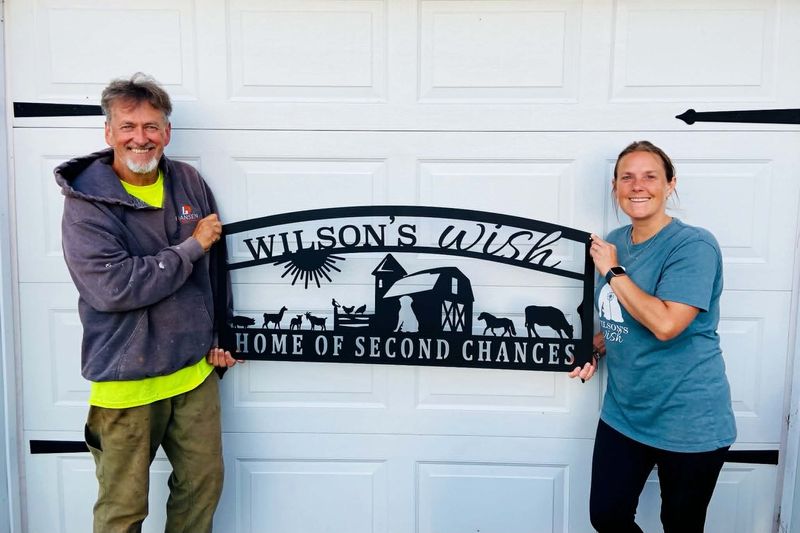
It’s not unusual to pass rural farmsteads around Luxemburg. But there is one that stands out by declaring on its sign that it is “The Home of Second Chances.”

And the couple who have been giving those second chances since 2019 are Dave and Tonya Edwards, owners of Wilson’s Wish, an animal sanctuary. The sign is a bittersweet reminder of what they will be leaving behind as they move from the area in upcoming weeks.
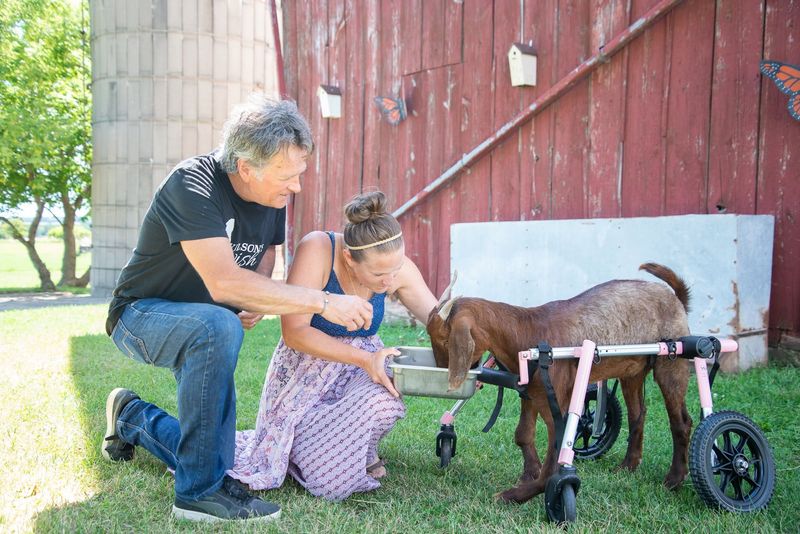
It is getting more difficult to provide for as many as 57 animals – an assortment that has included alpacas, dogs, goats, pigs, ducks, chickens, barn cats, cows, and donkeys. As age slowed down many of the animals, the Edwards also are finding it harder to handle all of the care.
Tonya said they began their journey when they were living in Appleton. “I was working for the Fox Cities Chamber. My husband, Dave, and I adopted a Great Pyrenees dog named Wilson and we took him home and had him for about two years. When he passed of cancer, I told Dave we should start fostering dogs.”
Having grown up on a farm, Tonya loved animals. Dave, a California native, didn’t have the same type of experiences, but he had been impacted by Wilson and agreed to foster.
That was the beginning of what would become a busy nonprofit named Wilson’s Wish after that first dog. Just as Wilson had suffered neglect for most of his life, there were dozens of other animals that needed a home.
To provide that home, they purchased a 3-acre farm in Seymour in 2019, and it wasn’t long before other animals were added.
“In addition to Wilson, we got another dog named Moe. Moe loves other people but he didn’t love other dogs,” Tonya said. “We decided to expand to foster other types of animals.”
As calls came in for them to adopt, they quickly realized that they needed more space. After just 13 months on the Seymour farm, they moved to a 5-acre farm in Luxemburg. The months moving from one location to the other proved interesting.
The Seymour farmette sold quickly and they needed to rent a storage unit before the Luxemburg location could be purchased. That would have been fine if it were just their own household items, but they also had to find a place for 10 chickens, three donkeys, and two pigs. The challenges continued at the new farm.
Tonya said, “It was difficult when we moved to the new property because the previous owner didn’t have any animals. That meant there was no water and limited electric to the barns. There were no pens and a bad roof. It was all hands-on deck.”
Their individual experiences came in handy as they moved forward. Dave, now a retired lawyer, and Tonya, who continues to work full time in sales and marketing, made a good team.
“Dave and I come from different backgrounds,” Tonya said. “He is a details person. When we were filing for our nonprofit, he did all of the legwork because he’s used to dealing with contracts. That is not my strong suit. His career in law helped with establishing a board, writing bylaws, and taking care of the legal matters.”
Having owned a business previously with his dad, Dave was also adept at taking care of the financial side of things. Tonya stressed that running a nonprofit should be treated just like a for-profit business. The major exception is where income comes from. In a nonprofit, there may be some merchandise sales, but the main source of income comes from fund-raising, grants, and donations.
And with so many animals to care for, Tonya utilized her experience to take care of fundraising. She raised funds to put a new roof on part of the barn by selling an assortment of items like mugs and apparel. She planned events such as an annual soup cookoff, a fall harvest event, and a comedy night.
She said, “We never wanted to be an organization that would just ask for money. We wanted people to feel like they were contributing by coming to events.”
The need for funds to run an animal sanctuary is great. Hay alone costs more than $1,000 a month. Then there is other feed, vet visits, hoof-trimming of horses, and vaccinations. They do the cleaning and feeding themselves because Tonya said you can’t find volunteers who want to muck a stall.
There also have been continuous updates to make sure the animals are in a healthy environment. They added new electrical service to the barn and a place to obtain water. Then there were other issues like the “mischievous little goats” breaking the windows in the barn. The goat fencing had to be replaced three times because they destroyed it.
“We stay in pretty decent shape doing this and work hard from sunrise to sundown. We never travel because we can’t find someone to watch the animals; so we do it all ourselves. Dave spends all day working outside and we do the chores together. We’re invited to a lot of things, but can’t really leave to go to any of them,” Tonya said.
But despite the isolation, there is the reward.
Tonya said, “We can learn a lot from animals about being resilient. We learn about love and acceptance. Some of the animals don’t get over past neglect, but for others, it is amazing to see what animals can overcome and how they help other people.”
The animals have been a comfort during personal trials. Tonya had a miscarriage and beat cancer twice. There is also the emotional toll of losing animals that they are housing; especially since about 50% are senior or retirement age, 30% are disabled, and 20% are animals that people didn’t want anymore.
She said the decision to leave the farm was made after a tough winter when they lost a number of their animals due to sickness or old age and taking care of the animals meant they were unable to go home during the holidays. At the same time, Dave started having back issues.
Through it all, she said she learned to spread positivity and encouragement. But she also learned that it might be time to take a break. She hasn’t seen her dad in a year; so they plan to rehome the animals and move closer to family. Their mission “to provide animals with a second chance” will continue with thoughtful placement at other farms.
The move won’t be made alone. They are planning on taking seven chickens, two ducks, all five of their dogs, two goats, and “maybe” a few barn cats with them. The memories will also endure with no regrets for what they accomplished.
“If you’ve got a dream, chase it,” Tonya said. “A dream isn’t going to chase you back. We took a chance and were able to accomplish something very special that will carry us through the rest of our lives. Whatever the dream, find a way to say yes. I will never look back on this as wasted time.”
Tina Dettman-Bielefeldt is a current volunteer and past district director for SCORE, Wisconsin.
This article originally appeared on Green Bay Press-Gazette: One adopted dog led to fostering, which turned into an animal sanctuary
Reporting by Tina Dettman-Bielefeldt, For Green Bay Press-Gazette / Green Bay Press-Gazette
USA TODAY Network via Reuters Connect
By Tina Dettman-Bielefeldt, For Green Bay Press-Gazette | USA TODAY Network