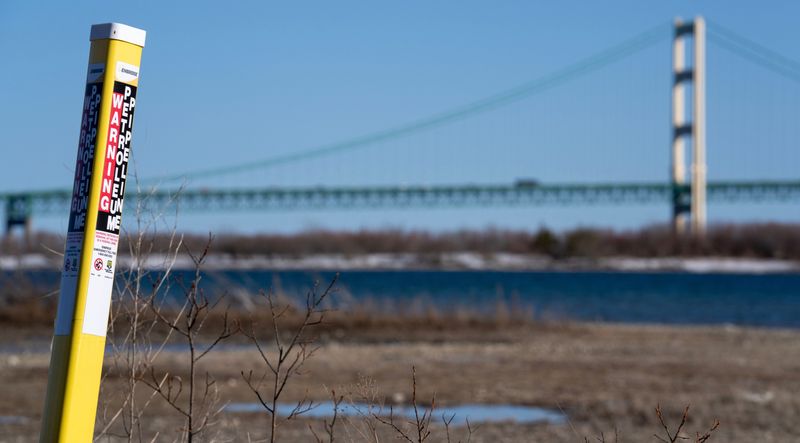
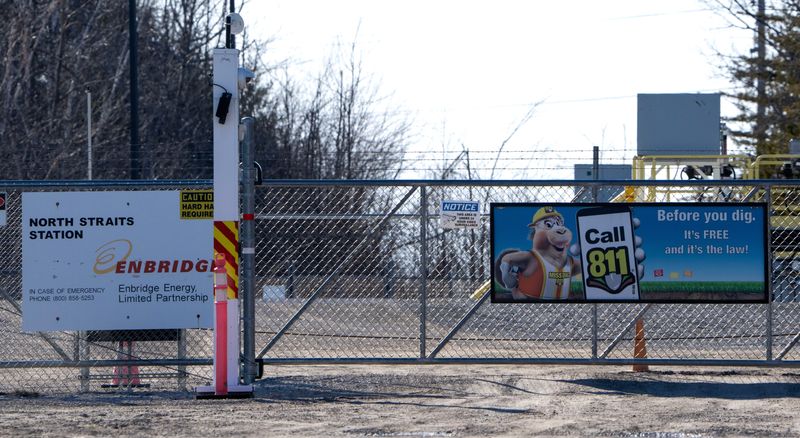
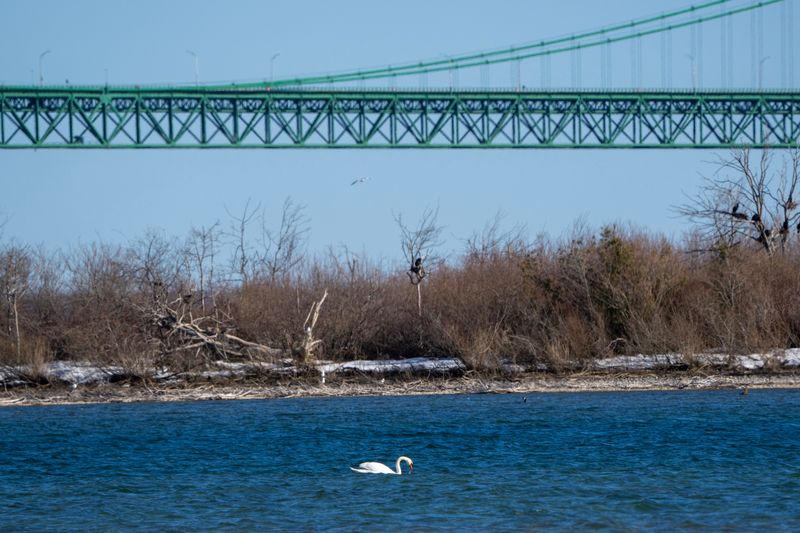
Enbridge’s controversial plan to construct a massive tunnel beneath the lakebed of the Straits of Mackinac for its Line 5 pipeline is set to face another legal challenge.
The Michigan Supreme Court has announced it will hear a challenge from Great Lakes tribes and environmental groups, who argue that the Michigan Public Service Commission broke state laws in approving permits in December 2023 for the Great Lakes Tunnel project. The Supreme Court announcement came down September 19.

The Bay Mills Indian Community, along with the Little Traverse Bay Bands of Odawa Indians, Grand Traverse Band of Ottawa and Chippewa Indians, and the Nottawaseppi Huron Band of Potawatomi, filed the legal challenge. The tribes are joined by the Michigan Climate Action Network and the Environmental Law and Policy Center.
The tribes and environmental groups contend the permit approvals failed to adequately consider the risks of potential oil spills.
“The tunnel project and the dual pipelines are just two versions of one terrible idea that threatens to destroy our clean water, our fishing, and our way of life for the sake of Canadian profits,” said Whitney Gravelle, the president of Bay Mills, in a statement. “We simply want government officials to consider the safest, cheapest, and most common-sense alternative: Decommission Line 5.”
Over the years in the Straits of Mackinac, ships’ anchors have struck the pipeline, sections have needed additional support, and protective coating has been damaged or worn away. Enbridge has said the Great Lakes Tunnel, which would house Line 5 through the 4 1/2 mile stretch separating Lakes Michigan and Huron, would nearly eliminate the chance of a pipeline incident.
The tunnel will be bored into rock 60 to 250 feet under the lakebed, using a tunnel boring machine that would progress 40 feet per day on average during construction. It will be constructed from the south side of the Straits to the northern shores, which Enbridge has said would minimize environmental impacts.
“We are confident in the Michigan Public Service Commission’s (MPSC) thorough permitting process. The February decision from the Michigan Court of Appeals affirmed the comprehensive and detailed work of the MPSC to approve the Great Lakes Tunnel Project,” Enbridge said in an emailed statement through Juli Kellner, a spokesperson.”The Michigan Court of Appeals concluded that the MPSC appropriately examined the location of the Line 5 replacement segment within the Great Lakes Tunnel, consistent with Michigan law.”The tunnel will be owned and operated by the state of Michigan, and leased to the company. It will take roughly six years to construct. The Enbridge statement said that when completed, it would make “what has always been a safe pipeline even safer.”
A complicated web of approvals and challenges
The oil giant must secure state and federal permits to construct the Great Lakes Tunnel. When tribes first challenged the public service commission’s decision it was struck down. In April, tribes and environmental groups asked the state Supreme Court to consider overturning the lower court’s decision.
And while Enbridge’s state permit from the Public Service Commission is facing a legal challenge, the company is also redoing its permit from Michigan’s Department of Environment, Great Lakes and Energy (or EGLE), which was set to expire in 2026.
In late July, EGLE launched a public comment period for the wetlands and submerged lands permit required by Enbridge. During that period, which closed Aug. 29, tribes gathered approximately 10,000 public submissions, according to EarthJustice.
Enbridge also needs a federal permit from the U.S. Army Corps of Engineers, which fast-tracked its permit review process under the Trump administration’s declaration of a national energy emergency. The Army Corps released its environmental review draft in May. The final draft is expected in October.
In July, a Journal Sentinel investigation showed how Enbridge sidelined tribal voices and how federal oversight can be used to bypass protections for Indigenous lands. For instance, a land swap between the oil company and Emmett County, may have allowed the company to circumvent a thorough historic review, even part of the land held historic cultural significance.
Before the draft was even released, Great Lakes tribes withdrew as cooperating agencies in the review process, saying that the federal agency was not acting in good faith. Tribal leaders claimed the process ignored the federal government’s responsibility to protect tribal treaty rights.
This story has been updated to add new information.
Caitlin Looby covers the Great Lakes and the environment for the Milwaukee Journal Sentinel. Reach her at clooby@gannett.com, and follow her on X @caitlooby.
Caitlin’s work is supported by the Brico Fund, Fund for Lake Michigan, Barbara K. Frank, and individual contributions. Grants and donations help make this reporting possible. The Journal Sentinel maintains full editorial control.
To learn more about our community-funded journalism initiatives, or to make a tax-deductible donation, visit https://givebutter.com/milwaukee-journal-sentinel. Checks can be addressed to Local Media Foundation with “JS Environment” in the memo, then mailed to: Local Media Foundation, P.O. Box 85015, Chicago, IL 60689.
This article originally appeared on Milwaukee Journal Sentinel: Michigan Supreme Court will hear legal challenge to Enbridge’s Great Lakes Tunnel project
Reporting by Caitlin Looby, Milwaukee Journal Sentinel / Milwaukee Journal Sentinel
USA TODAY Network via Reuters Connect