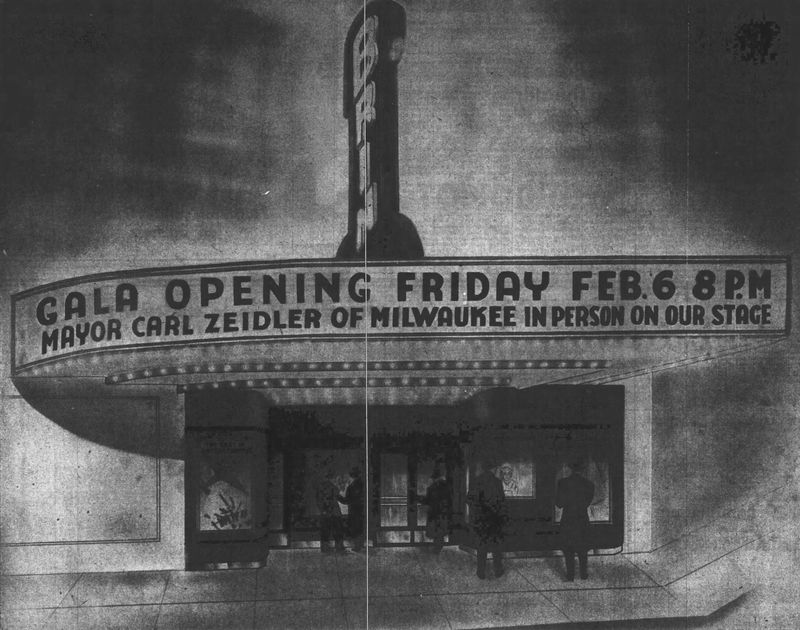
Menasha’s Brin Theater once stood at 1 Main St. The building was listed on the state and national registers of historic places.
The building was destroyed by fire on Aug. 10, 2018. We took a look through the Post-Crescent archives to find out more about this historic movie house.

A Dec. 22, 1928 article announced that the new Brin theater in Menasha would open at noon Christmas Day. The Brin, along with two Milwaukee theaters owned by the L.K. Brin Company, were the first to install talking pictures in the state.
The building also had apartments on the second floor and a bowling alley and soda fountain in the basement. It was the largest commercial building at the time, and went through several owners over the years.
In addition to the popular movies of the time, stars from the big screen also appeared on the Brin stage in person.
An article in the Dec. 7, 1935 issue stated: “Gene Autry is appearing in person at the Brin theatre immediately upon his arrival from Hollywood, upon completion of his latest motion picture, this being his first stage appearance since the completion of “The Singing Vagabond” which will also be on view soon at the Brin Theatre.” Autry, nicknamed the Singing Cowboy, was an American actor and musician, who spent more than three decades on TV, in movies and on the radio.
Singer and actor Eddie Dean also made a personal appearance in 1949.
The theater closed in September of 1941 for a $35,000 reconstruction project. It reopened Feb. 6, 1942, offering air conditioning, illumination, sound and projection. Updates to the outside included neon lights, a canopy in a unique shape dictated by its location and the ticket window strategically placed to the side to avoid congestion to the entry. The entire building was covered in color and the old screen was replaced with a silver sheet screen.
The Brin was Menasha’s premier movie house until 1969. The theater and the bowling alley in the basement were closed and dismantled. The once-popular entertainment house was then largely unused for decades.
Several articles mentioned revitalization efforts, and eventually retail spaces were created within the building.
Bob and Donna Ziesemer of Appleton purchased the building in 1985 when the building their bookstore was located in was bought out to make way for the marina. Tenants occupied the apartments and a variety of shops rotated in and out of the building.
It was listed to the national register of historic buildings in 1986, and enrolled on the state listing in 1989.
Then, in 2018 a fire destroyed the entire building. The Ziesemers sold the property to the city and the city paid for the razing.
The Brin that now stands on Main Street is a new mixed use building with residential and retail units.
In other Appleton area history
May 1, 1926: A final report will be made by the garbage committee at the next meeting of the Appleton common council. The committee went to Green Bay to study the system of garbage disposal employed by the city. Green Bay, it was learned, collects and delivers its garbage to one or two farmers who feed it to their hogs. This is a plan similar to the one employed at Madison, and is one which was considered here. The committee. appointed by former mayor John Goodland Jr.. also made trips Madison, West Allis and other cities to study various garbage disposal systems and of comparing the cost of each.
May 3, 1951: Alderman Axel Solie said several Drew street residents had told him they opposed curb and gutter, grading and graveling, turnover and seal coat. Robert Leland replied that “that street has been up for pavement for the last five years. It’s one of the oldest in the city, Something has to be done in fairness to the people who have to use it.” Harvey Priebe declared that Drew street had been put off year after year, and “it’s costing us more money daily to repair than it would to put in a curb and gutter job.” Franzke said that Reno Doerfler, Third ward alderman who preceded Solie, had fought for permanent paving, more expensive than the work now proposed. Solie then said that he had no objections to the project but felt he should report the objections he had heard. The acceptance of the committee report closed the matter.
April 28, 1976: House-attached patios, carports and canopies without foundations should be legal under certain conditions, the Appleton Welfare and Ordinance Committee recommended Tuesday. The estimated 100 owners of such units presently in the city – who could be ordered to tear them down under the present ordinance – could leave them up under the proposed amendment to the city’s building code. The amendment was proposed by Gregory Gill, an attorney representing two local establishments that make and install the foundationless patios. would allow their installation, provided they are designed to flex to accommodate frost heave and are designed to meet load bearing codes. The committee’s recommendation runs counter to a recommendation from city Inspections Director Charles Magnette that the code be left unchanged. He said that frost heaving could damage a slab that is not anchored with frost walls or footings and could damage the house it is attached to. Gill and other industry representatives have argued that new technology has developed a floating-type temporary structure that moves with frost heave to prevent damage.
May 2, 2001: It could cost more than $13 million to triple the size of the Calumet County Jail, an Illinois consulting firm estimates. Dennis Kimme, of Kimme and Associates, presented county officials Tuesday with new details about a planned jail expansion and renovation. The firm estimates the jail and sheriff’s offices will cost $12,368,410 to build, along with an 8 percent contingency fund, for a total of $13,358,000. Kimme cautioned the board that while the latest figures are based on more detailed planning work, they are still only estimates. The looming costs led County Administrator John Keuler to raise the idea of a county sales tax. He said the tax could raise $1.3 million to $1.4 million per year. The proposed expansion would relieve crowding in the jail by increasing its capacity from 54 to 156 beds. The committees decided to review the jail plans further before making any recommendation to the full County Board. The panels plan to meet May 15.
Is there a person, place or event you would like to know the history of? Contact Mara Wegner at mwegner@usatodayco.com or 920-996-7241.
This article originally appeared on Appleton Post-Crescent: Menasha’s Brin theater one of first in state to offer talking pictures
Reporting by Mara Wegner, Appleton Post-Crescent / Appleton Post-Crescent
USA TODAY Network via Reuters Connect