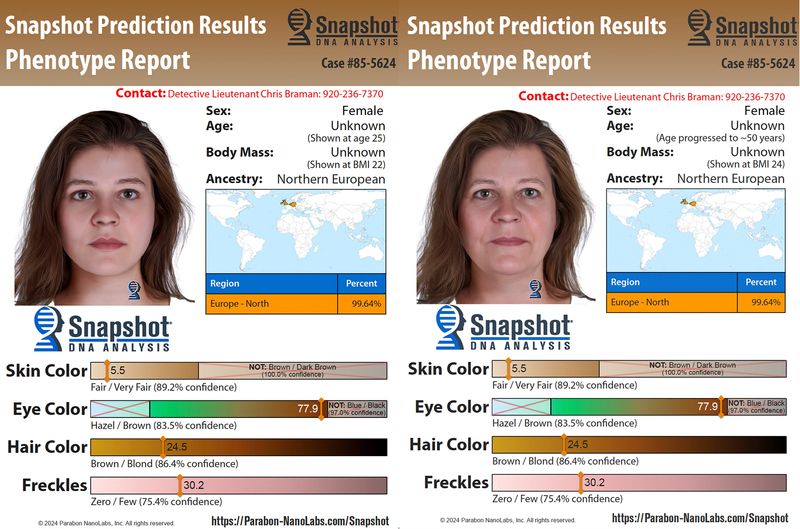
Cold-case investigators believe they are getting close to identifying a woman whose skull was found 40 years ago at the bottom of the Wolf River in Winneconne.
Lt. Chris Braman of the Winnebago County Sheriff’s Office said experts in genetic genealogy have determined the victim’s ancestry was 99% Irish or Northern English. Investigators have found familial matches, likely a second cousin on the maternal side and a couple of third cousins, but then the lineage gets lost in obscurity.

“They’re all somewhat related to our victim,” Braman told the Appleton Post-Crescent, “but no one has anybody – that they know of – that’s missing from their family. It’s somewhere in the family tree.”
Braman has been working to unravel the mystery since 2011. The case was entered into the National Missing and Unidentified Persons System in 2014.
Momentum has picked up in the past four years, thanks to technological advances in DNA extraction and analysis, but investigators still don’t know how or when the woman died, how she ended up in the river or whether her death is the result of foul play.
The priority is discovering who she was, and the rest will follow.
Braman said genetic genealogy provides the best hope for identifying the woman, whom the extended family has named “Joanne,” as it is less awkward to reference than “the skull.” Investigators now refer to the victim as “Wolf River Joanne Doe.”
Plot thickens with possible mob connection
Adding intrigue to the investigation, but perhaps merely a coincidence, is that Michael B. Spano Jr., the son of a reputed mob boss, once owned a riverfront vacation home two doors upstream of where the skull was found. Spano was convicted, along with his father and five others, of stealing more than $10 million from the Town of Cicero, Illinois, in an insurance scam.
“This was a mob house,” Braman said. “A normal driveway is 4 to 6 inches of concrete. This is 2 feet of concrete.”
The federal government seized the property as an asset in the 2000s. It subsequently was sold.
Jordan Karsten, a University of Wisconsin-Oshkosh biological anthropologist who works with law enforcement to find and identify human remains, used ground-penetrating radar to search a section of the property closest to the river for any clandestine grave that might hold human remains linked to the skull. Nothing was found.
How was ‘Joanne’ discovered in the Wolf River?
On July 26, 1985, two teenage boys were snorkeling in the Wolf River looking for old glass bottles when they found the skull in 8 feet of water north of 409 S. First St. The boys notified police.
A dive team from the sheriff’s office searched a 60-by-35-foot area of the mucky riverbed. No other human remains were found.
A woman’s wallet and a single-barrel shotgun were recovered by divers, but neither proved to be a breakthrough. The wallet was traced to a Menomonee Falls woman who recalled losing it in the Wolf River in 1952 or 1953. Braman said the case file contains no further mention of the shotgun.
“All we’ve ever had in evidence is the skull,” he said.
In June 2023, the dive team re-searched the riverbed where the skull was found to look for additional evidence. Divers uncovered barrels containing trash from the late 1960s or early 1970s but no human remains or other clues to advance the case.
More recently, the sheriff’s office has been working with the University of Wisconsin Missing in Action Recovery and Identification Project to analyze the riverbed for DNA evidence. UW MIA RIP tests DNA density in core samples to determine if human remains are nearby.
“It’s a new approach for scouting for human remains,” team lead Charles Konsitzke said. “This is research being developed as we speak.”
UW MIA RIP extracted nine core samples of sediment from the Wolf River near where the skull was found. The samples are waiting to be processed. If human DNA is detected, the locations will be plotted “to give us a good visual for where possible human remains are,” Konsitzke said.
What can be deciphered from the skull?
The skull is technically a cranium because it was found without its mandible, or lower jaw, but it otherwise is intact. Two upper molars are in place, and two teeth were missing before death, which suggests they might have been removed by an orthodontist.
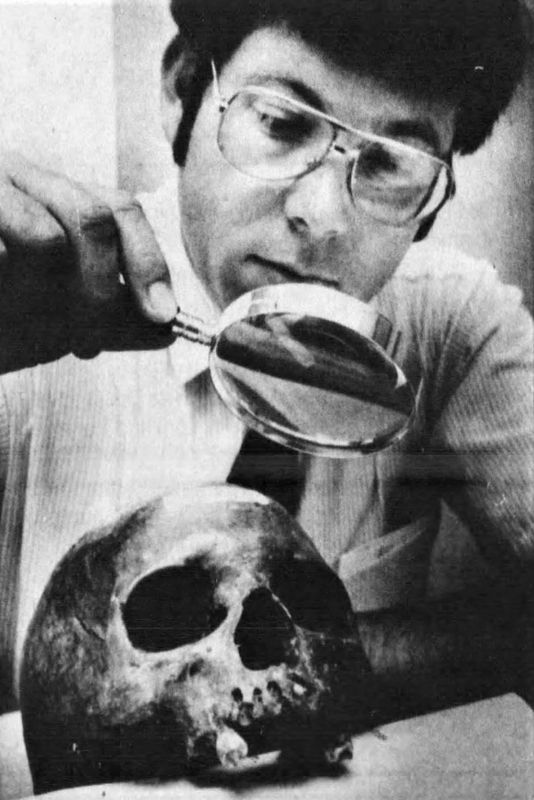
In 1985, James Provinzano, an associate professor of anthropology at UW-Oshkosh, examined the cranium. He hypothesized it was a woman who was about 30 years old and who had been dead for 15 to 40 years. His findings were based on the condition of the cranium and the nature of the water in which it was found.
Another review in 1985, done by Grover Krantz, an anthropology professor at Washington State University, concluded that the cranium belonged to an adult Caucasian woman.
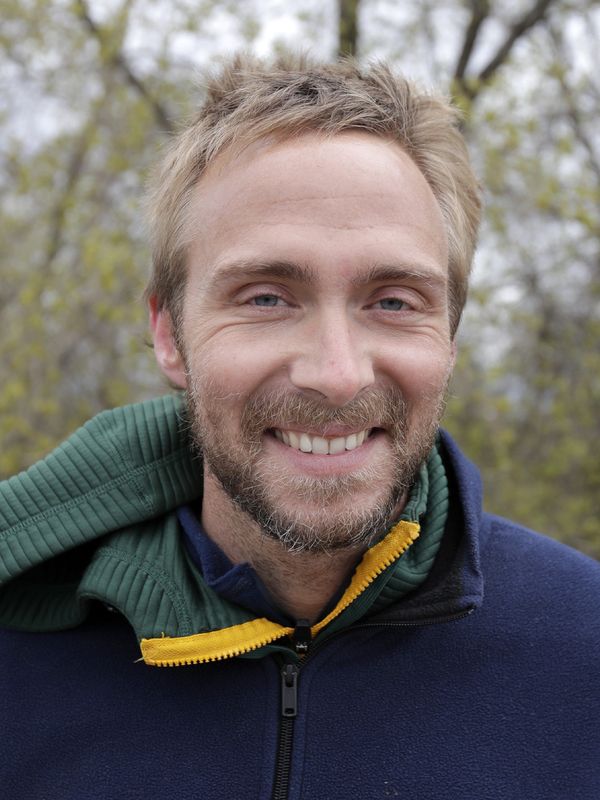
More recently, Karsten inspected the cranium. Through measurements, visual observations and statistical analysis, he deduced that “Joanne” was a Caucasian woman from the modern era who was between 30 and 50 years old. He estimated the cranium had been in the water for 20 years or less.
With that information, Braman is operating under the theory that “Joanne” was born between 1915 and 1955.
Forensics exclude three missing women
Braman hasn’t developed a theory of how “Joanne” died and ended up in the river.
“As law enforcement and as somebody who’s been in investigations for a long time, I immediately think something nefarious,” Braman said. “Then you find information about the Chicago mob, but really it could be anything. Maybe there was a drowning in the ’40s or ’50s or ’60s and that information just somehow didn’t get relayed.”
A comparison of dental records excluded “Joanne” from being Bonnie Repinski of Sheboygan or Dona Bayerl of Muskego.
Repinski was 33 when she went missing from the Town of Menasha (now Fox Crossing) in 1975. Bayerl was 38 when she went missing in 1979.
Another missing woman, Carol Wells of Oshkosh, was excluded by comparing the DNA of a family member. Wells was 28 when she disappeared in 1973.
What might have happened to the rest of ‘Joanne’?
Karsten said it isn’t unusual to find a cranium without other parts of the skeleton.
The cranium could have been separated by human activity, such as dismemberment, or by animal activity, with scavengers pulling the skeleton apart.
Natural forces, such as the movement of water, also could have played a role.
“There’s a reasonable chance the rest of the skeleton is just also in the Wolf River,” Karsten said. “Finding all parts of a skeleton in a moving body of water like that can be very, very difficult.”
Advances in DNA technology lead to distant relatives
In traditional DNA forensics, investigators compare an STR sample to evidence from a crime scene. STR stands for short tandem repeat, and the sequences are unique to each person, making them ideal for direct comparisons.
In the case of “Joanne,” the skull was in the water for so long that there wasn’t enough DNA to get an STR sample, though UW MIA RIP is developing technology that soon might make that possible.
Instead, investigators are working with Othram, a private forensics company based in Texas, to develop an SNP profile for “Joanne.”
SNP stands for single nucleotide polymorphism. SNPs (pronounced “snips”) are biological markers that can yield a genetic roadmap to identify distant relatives, allowing investigators to build family trees. SNPs can be obtained from a smaller amount of DNA.
In 2021, the Winnebago County Sheriff’s Office used SNP genealogy to identify Roland Klug of Oshkosh. His remains were found in 2015 along a railroad in Vinland.
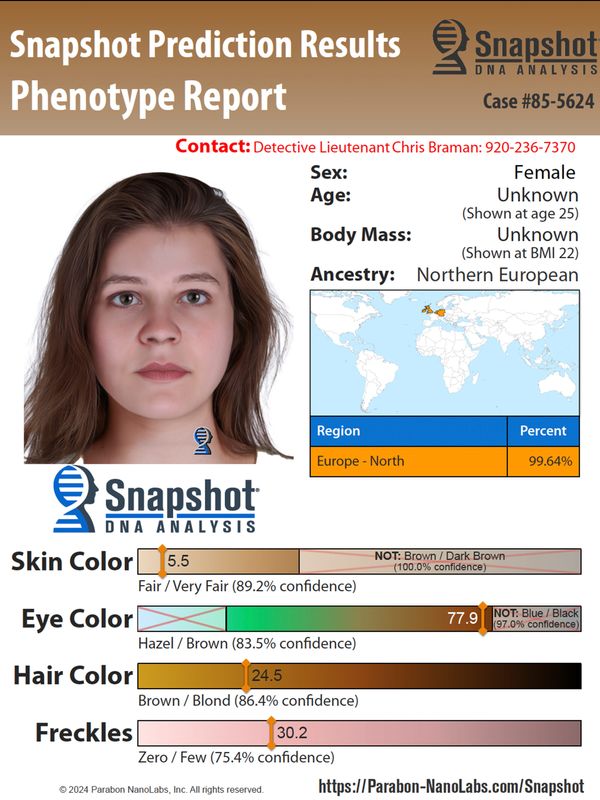
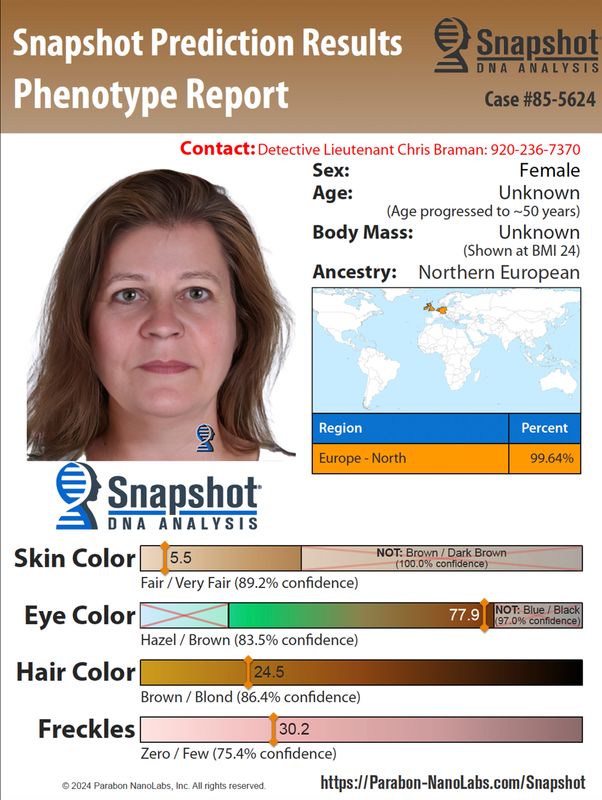
The SNP profile for “Joanne” was used by Parabon NanoLabs, a DNA technology company headquartered in Virginia, to develop images of how she might have appeared at ages 25 and 50. The SNP profile also was entered into GEDmatch PRO, a law enforcement portal that can compare a SNP profile against a database of SNP profiles from consenting participants. The comparison led to distant relatives of “Joanne” in Connecticut, Ireland and Australia.
“We asked them about their ancestry, first to see if they know of any missing people in their family history,” Braman said, “and then to find additional people who we can test so we can get closer to her. We have people in the U.S. who are helping us. We have people in Ireland who are helping us. They know she’s family.”
Family connection arrives in New York in 1907
Braman said strongest SNP match to “Joanne” thus far is a woman in Ireland who could be a second cousin, a second cousin once removed, a half first cousin once removed or a first cousin twice removed. The woman’s great-aunt emigrated from Ireland to the United States in 1907. The great-aunt landed in New York and supposedly traveled to Connecticut, married twice and had children, but the family lost track of her. Record searches have come up empty.
Investigators think “Joanne” could be the great-aunt’s daughter, granddaughter or great-granddaughter. “We just can’t find the information,” Braman said.
Two other connections, a man in Connecticut and a woman in Australia, are related to “Joanne” and to each other, but they don’t know how. If investigators can find a common relative, it could advance the case.
The key is finding additional family members who are willing to be tested.
Braman acknowledged that some people are reluctant to submit their DNA for testing for fear it could be used against them, but he said SNP profiles aren’t entered into the FBI’s Combined DNA Index System, which can be used to compare a suspect’s DNA to evidence from a crime scene. Rather, SNP profiles become part of a family tree account that investigators can check to see if they are moving closer or further from the victim.
Anyone with information about the case is encouraged to contact Braman by phone at 920-236-7341 or by email at CBraman@winnebagocountywi.gov.
Contact Duke Behnke at 920-993-7176 or dbehnke@usatodayco.com. Follow him on X at @DukeBehnke.
This article originally appeared on Appleton Post-Crescent: Investigators make progress toward identifying ‘Wolf River Joanne Doe’
Reporting by Duke Behnke, Appleton Post-Crescent / Appleton Post-Crescent
USA TODAY Network via Reuters Connect