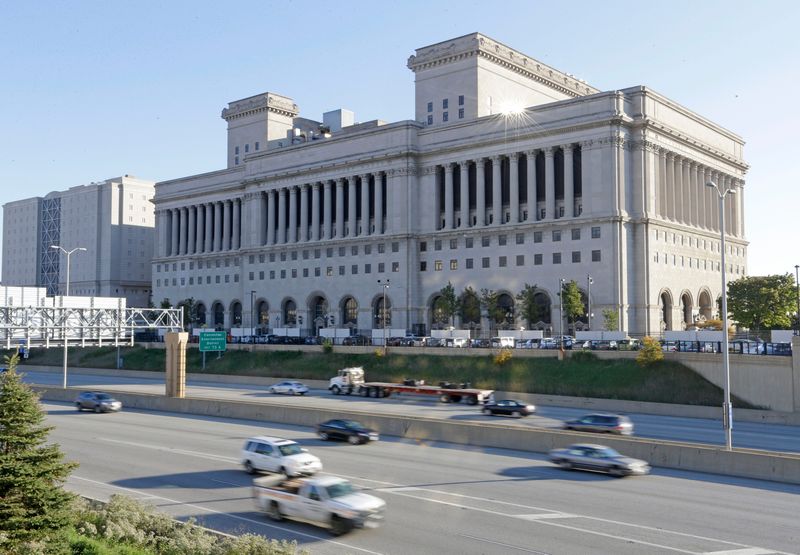
Just weeks after arrests at the Milwaukee County Courthouse sparked national attention and widespread local protests, federal immigration officials took another defendant into custody at the courthouse complex on the morning of May 7.
Milwaukee County Chief Judge Carl Ashley confirmed the arrest by the U.S. Immigration and Customs agency but provided no further details. Multiple judges also said they were aware of ICE’s action, but none could provide the name of the defendant.

“I have been informed that an ICE arrest occurred today, May 7, at the Courthouse Complex after the court hearing was completed,” Ashley said in a text message to the Journal Sentinel.
Earlier in the day, he wrote a one-sentence email to courthouse officials saying the arrest took place at 9:30 a.m. “outside of the preliminary hearing courtroom.”
Officials with the FBI and ICE weren’t immediately available for comment.
This would mark the fifth time in recent weeks that federal officials have arrested someone at the courthouse complex as part of a national crackdown by Trump officials on undocumented immigrants.
On April 18, ICE agents arrested Eduardo Flores-Ruiz, a 30-year-old undocumented Mexican immigrant, just outside the courthouse on April 18 after his court appearance on three misdemeanor domestic battery charges. He has since been indicted by a federal grand jury accusing him of re-entering the United States after being deported.
He has state and federal court appearances on May 8. He is being held at the Ozaukee County Jail.
On April 25, Milwaukee County Circuit Judge Hannah Dugan, 66, was handcuffed at the courthouse on allegations she tried to assist Flores-Ruiz avoid arrest after his hearing in her courtroom. She was charged with a felony count of obstruction and a misdemeanor of concealing a person to prevent his arrest.
The day after President Donald Trump’s inauguration, his administration rescinded a Biden-era policy that limited civil immigration arrests in or near courthouses. Unlike criminal arrests, civil immigration arrests are arrests of people who are in the U.S. without legal authorization, as opposed to those who have violated criminal law.
A CNN report on May 6 said it had confirmed a dozen cases of people being arrested by ICE on or near courthouse grounds in Virginia, New Hampshire, North Carolina, Illinois, Pennsylvania, Massachusetts and Wisconsin.
The high-profile arrest of Dugan and the federal government’s use of the courthouse to nab undocumented immigrants have sparked protests in Milwaukee County and criticism by local officials concerned that defendants may not appear for court hearings if they fear they might be deported. Ashley has also said he and his colleagues are “all concerned” about the manner in which Dugan was handcuffed at the courthouse.
“I’ve worked with administrations led by Republicans and Democrats alike, and they all made it abundantly clear that sensitive sites, including courthouses, were not to be targets of immigration detentions unless there were extreme circumstances involved,” Darryl Morin, national president of Forward Latino, said on May 7.
Morin noted that Ashley currently has a draft policy on how federal officials should be permitted to make arrests at the courthouse: “This area, with regards to jurisdiction and authority, is extremely complex, and it’s very important that he take the time to get it right.”
Trump administration officials, including U.S. Attorney Pam Bondi and FBI Director Kash Patel, have publicized Dugan’s arrest, even posting a picture of Dugan in shackles on X, formerly known as Twitter. The case has placed Dugan at the center of the nationwide dispute between the Republican president and members of the judiciary.
Some Wisconsin Republicans are talking about removing Dugan from office.
Dugan’s next court appearance is on May 15.
Records filed in the case against Dugan have offered some insight into ICE operations taking place at the courthouse.
The documents noted state and local law enforcement agencies routinely execute warrants and make arrests in public buildings, such as the courthouse, because they know where and when a person is expected to be and know that the person passed through a security checkpoint and should be unarmed.
Those factors minimize the risk of injury to law enforcement, the public and the person being sought, federal agents have said.
The ICE task force in Milwaukee has been “focusing its resources on apprehending charged defendants making appearances in criminal cases — and not arresting victims, witnesses, or individuals appearing for matters in family or civil court,” according to the criminal complaint filed against Dugan on April 25.
The task force’s policies “had been made known to courthouse officials” in Milwaukee, the complaint says.
Federal authorities have linked individuals charged with crimes locally, such as Flores-Ruiz, to their immigration files through biometric fingerprint data, records show.
Ashley Luthern and Eva Wen of the Journal Sentinel contributed to this report.
This story has been updated to add new information.
This article originally appeared on Milwaukee Journal Sentinel: ICE arrests another defendant at the Milwaukee County Courthouse Complex
Reporting by Daniel Bice, Mary Spicuzza, Chris Ramirez and John Diedrich, Milwaukee Journal Sentinel / Milwaukee Journal Sentinel
USA TODAY Network via Reuters Connect