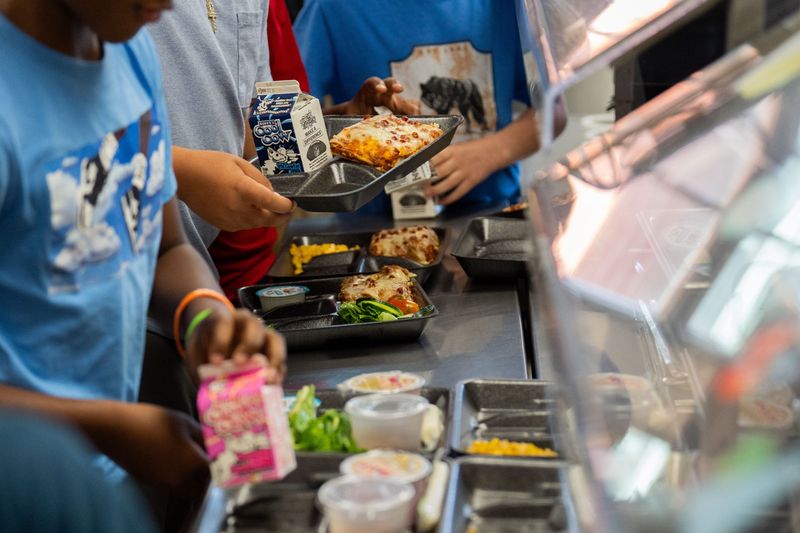
STEVENS POINT − While a slew of end-of-the-school-year events and milestones − from exams and proms to sports tournaments and music performances − occupy the time and attention of most students and their families this time of year, some families also are facing a question of how to pay student meal debt.
A regular Survey of Consumer Expectations conducted by the Federal Reserve Bank of New York recently found meaningful increases in a variety of measures that may indicate increasing food and economic insecurity. These measures included instances of dipping into savings or emergency accounts for regular expenses, missing meals, receiving food donations or receiving federal food-purchasing benefits, according to a May 27 blog post by researchers at the regional Fed bank.

“We find a remarkable increase in food insecurity, particularly among lower-educated and lower-income households and households with young children,” the researchers wrote in the post.
School meal debt exceeds $47,000 in Stevens Point Area Public School District
One way this trend is visible in the Steven Point area is with the accumulation of school meal debt. While many students and their families who lack an ability to pay for meals may be eligible for free or reduced cost meals through federal programs, many still struggle to complete an application process or still fail to pay for other reasons.
Stevens Point Area Public School District students have accumulated over multiple years $47,789.78 in meal debt as of the week of May 18, Sarah O’Donnell, the district’s director of communications, said in an email to a Stevens Point Journal reporter. About 38.6% of the 6,763 students currently in the district are eligible for free or reduced meal benefits based on family income, according to data from the Department of Public Instruction.
The district attempts to reach parents or guardians of students to ask for them to pay the outstanding debt regularly via phone calls, emails and text messages, O’Donnell said. Paper statements are mailed in April and May to accounts with negative balances and families are also informed about free and reduced-price meal programs.
Students at the district who carry meal debt will be allowed to participate in end-of-the-year events or field trips and those who are graduating participated in graduation if they chose and will receive their diplomas, according to O’Donnell. The district maintains a “Money for Meals” program, which accepts donations from community members and makes disbursements to negative accounts twice a year.
“While school meal debt is a broader issue connected to family finances and school nutrition funding, our focus is on communicating with families, connecting them with available resources when possible, and ensuring students continue to have access to meals at school,” O’Donnell said.
Most public school districts no longer deny food to students if they carry a negative meal account balance, or a practice that became known as “lunch shaming,” as it often led to worse outcomes for students, according to multiple sources. Similarly, other things that may have been withheld in the past for carrying a negative account balance, such as end-of-year celebrations or field trips, walking across the stage at graduation ceremonies, or even diplomas, are also no longer used to coerce students and their families to pay their debts.
Why has school lunch debt become such a problem?
A variety of factors have driven an increase in student meal debt across the United States’ nearly 50 million students in recent years including increasing costs to provide meals, changes to policies that allow debt to accumulate and decreases in federal school meal funding programs, according to the Education Data Initiative. Nearly 30 million students eat federally subsidized meals at school and over two-thirds receive them at free or reduced prices.
Additionally, a report by researchers at the University of North Carolina at Chapel Hill in the October 2024 issue of the Journal of Nutrition Education and Behavior highlighted the social and financial complexity of free or reduced cost meal programs contributing to unpaid meal charges nationwide.
About 42% of Wisconsin’s over 810,000 students in 2024-25 were eligible to receive free or reduced cost meals based on their family’s income and only about 75% of those eligible, or around 280,000, take advantage of the benefit, according to research presented by the Food Research and Action Center in October 2025.
Where can children find free meals during the summer?
Several groups including the U.S. Department of Agriculture in partnership with school districts or other service organizations regularly provide free meals to local youth during summer months when school is not in session. Many of these sites can be found on the USDA’s Summer Meals Site Finder website.
Here’s a list of times, dates and locations free meals are available for children and teens in the Stevens Point area this summer.
Erik Pfantz covers local government and education in central Wisconsin for USA TODAY NETWORK – Wisconsin and values his background as a rural Wisconsinite. Contact him at epfantz@usatodayco.com.
This article originally appeared on Stevens Point Journal: How Stevens Point school district addresses over $47K in meal debt
Reporting by Erik Pfantz, Stevens Point Journal / Stevens Point Journal
USA TODAY Network via Reuters Connect