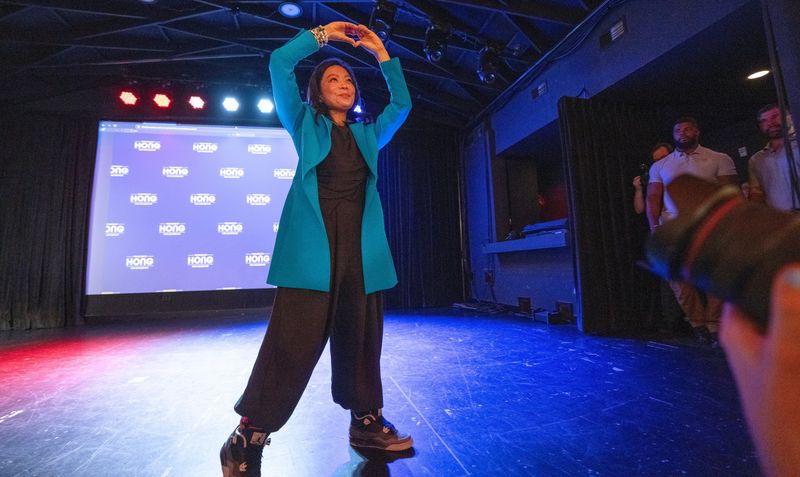
The Democratic primary in Wisconsin is over, but the flattening of Asian American identities in Wisconsin politics is not. And this will likely continue as Francesca Hong, the first Asian woman who ever ran for governor in Wisconsin, continues to serve people in the state.
Even back in early 2026, most people in Wisconsin probably have not anticipated the meteoric rise of an Asian American female candidate in the gubernatorial election. Yet Hong, a bartender, chef, community organizer, mom, and state lawmaker, surprised many voters, both on the left and on the right.

Hong and her team built a successful campaign. She attracted much public attention through her progressive policy claims for ordinary, working-class people. Free school meals. Universal childcare. Guaranteed paid leave. Improved BadgerCare for all. Protection of Wisconsinites of all immigration documentation status from secret police. A moratorium on data centers. And more.
Whether all her policy claims could be actualized, if she were elected, remains a question among many voters. But undoubtedly, Hong’s down-to-earth style and deep care for the working class has helped her build a momentous campaign, until her loss by a small margin in the Democratic primary to David Crowley on Aug. 11.
Fox News host Jesse Watters showed blatant racism
Throughout her campaign, right-wing media and social media users have showed blatant anti-Asian racism toward Hong. Fox News host Jesse Watters referred to Hong as “Wong, or what’s her name?”
On Hong’s official Facebook page, commenters often invoke “Hong is Wong” tagline under her campaign posts. Fox News constantly refer to Hong as a “socialist” candidate in their headlines. Some commenters often associated Hong with “communism” on her social media page.
There are more racist media taglines and comments that Hong and her team have to face every day during their campaign. And this will likely continue for a long time. Such anti-Asian racism in the Wisconsin governor campaign tells us a few important things about racism not just in Wisconsin but also in the United States. Hate crimes against Asian Americans remain double their pre-pandemic levels, FBI data shows.
Many racist comments that Hong receives are xenophobic and fearmongering. Douglas McLeod, a professor specialized in media framing and my colleague at UW-Madison, has done a lot of research on how media often turns to fear as a tool of mobilization to stoke voter fear.
By calling Hong as Wong or communist, a strong anti-China, xenophobic rhetoric is invoked immediately. Especially in a time when US and China are in constant tension, this easily invokes a classic “Red Scare” among voters in Wisconsin, many of whom are far away from the center of politics yet deeply influenced by such geopolitical tensions.
Ironically, this fear is misplaced, to say the least. Francesca Hong is not ethnically Chinese. She is a second-generation immigrant with parents from South Korea. Hong has been vocal and consistent in sharing her family stories and ethnic origins in public. Due to the US connection with South Korea in Asia-Pacific region, the history of Korean immigrants to the US is complicated and deserves much more attention. It is important to acknowledge Hong’s ethnic heritage as it is.
Racism works to flatten diverse Asian identities into one category
This is not to separate Asian American communities by their origins or ethnic backgrounds. Rather, this is a call to acknowledge an important fact — racism works precisely through flattening diverse Asian identities into one single category.
The racist association of Hong with Wong reveals this dangerous trend that Asian-American communities witnessed throughout American history.
One of such most prominent cases is the tragic death of Vincent Chin, a Chinese American man who died in 1982 in the Detroit area. On June 19, 1982, Vincent Chin was celebrating his upcoming wedding with friends in Highland Park, Michigan. Ronald Ebens and his stepson, Michael Nitz, two autoworkers, mistook Chin as a Japanese. They attacked Chin and beat him in the head. Chin died from the injuries four days later.
That tragedy did not happen in a vacuum. In the early 1980s, the US auto industry suffered a severe recession. Many autoworkers and factory owners blamed Japanese car manufacturers for massive layoffs and economic hardships. This blame finally drove Ebens and Nitz to commit the horrific crime in the end.
We are living in a different era now. Yet, we are not far away from the same logic of anti-Asian racism. And history rhymes, even if it does not exactly repeat itself. American audiences now are constantly receiving news headlines or watching TikTok videos about how China is outpacing US in EV or electric vehicle industry. While President Trump’s aggressive tariff and trade policies have increased some domestic output, it has not triggered a broad hiring boom in the domestic market.
What all these broad transformations will bring is still unclear. But in today’s political and economic environment, the conflation of Hong as Wong is not a simple racist punchline. It reveals a deeper history of anti-Asian racism in the US. To move forward, we need to constantly revisit that history and learn from it. Let’s start by saying: Her name is Hong.
Jing Wang is an assistant professor at School of Journalism and Mass Communication at the University of Wisconsin-Madison. She researches and teaches about communication, culture, and media technology.
This article originally appeared on Milwaukee Journal Sentinel: Hong as Wong not simple racist punchline. It’s even worse. | Opinion
Reporting by Special to Milwaukee Journal Sentinel / Milwaukee Journal Sentinel
USA TODAY Network via Reuters Connect

By Special to Milwaukee Journal Sentinel | USA TODAY Network