The new 1580 Main Townhomes look no different from the many other multifamily developments recently completed in the Green Bay area.
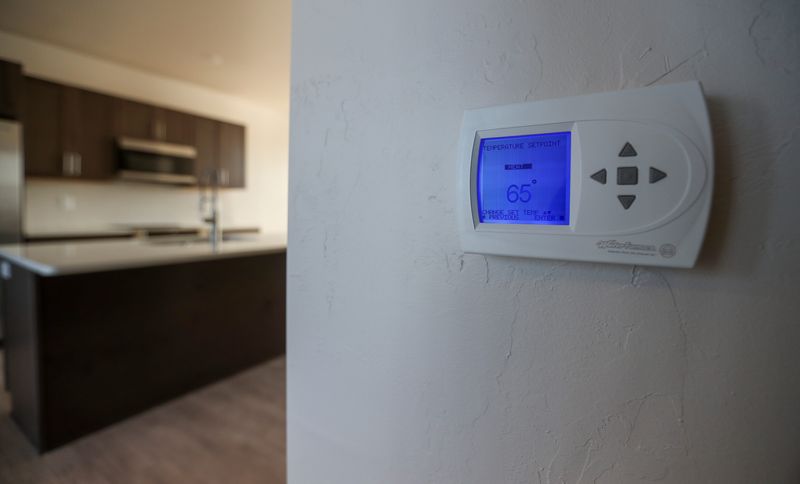
But the 84-unit development at 1580 Main Ave., on Ashwaubenon’s west side, contains a secret buried beneath its central courtyard.

And if Alliance Management CEO Erik Goerke is right, the only differences residents will notice are less noise and cleaner air.
The rental development is one of the latest Green Bay-area commercial, industrial and public buildings to use a geothermal system to heat and cool the units. It’s an energy-efficient heating and cooling system that produces cleaner air in units or workspaces and, maybe, a slightly lower utility bill.
On Dec. 31, the One Big Beautiful Bill ended federal tax credit programs that encouraged homeowners to install energy-efficient equipment like geothermal to heat and cool their residences. But commercial businesses and tax-exempt entities can still tap those tax credits to recoup up to 50% of geothermal systems’ cost, said Alex Galt, clean energy coordinator for the city’s Energize Green Bay effort.
Even with tax credits, geothermal and air-source heat pumps’ higher initial cost doesn’t always result in savings for larger building developers, but Galt said it’s limiting to only consider the value in dollars and cents.
“You’re going to attract tenants and customers who care about the planet,” Galt said. “You’re going to appeal to them based on their values as well as cost savings. And the cost savings are important if you have tenants paying their own utility bills.”
In the Green Bay area, apartment buildings, schools and a manufacturing facility have all invested in geothermal heating and cooling systems. Here’s what to know.
How do geothermal systems work?
Geothermal systems use Earth’s natural underground temperature – about 50 degrees – as a source of heat when it’s cold and for cool air when it’s hot outside.
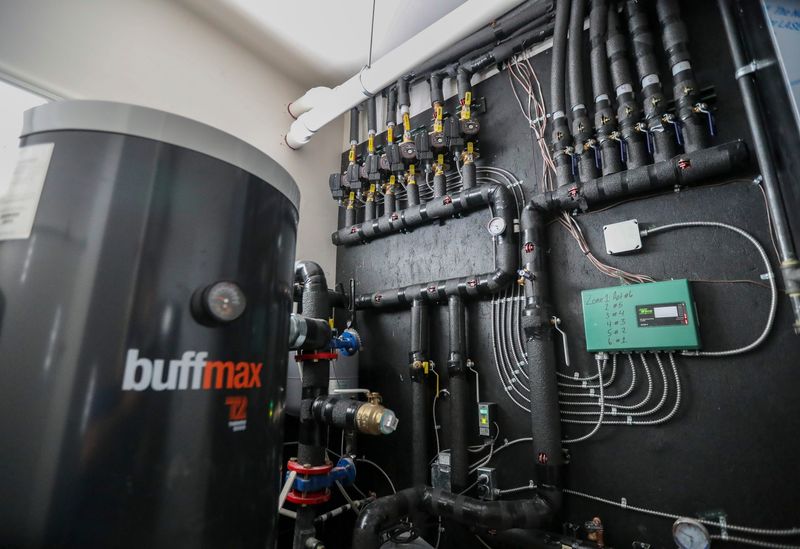
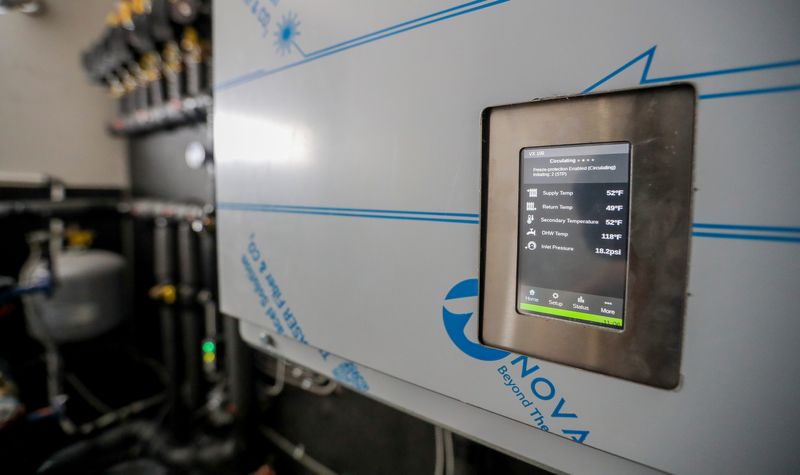
The systems sink miles of pipes deep into the ground through which water circulates. A geothermal pump in winter draws heat from the warmer water and in summer draws cooler air from the water.
Geothermal systems can handle sub-zero temperatures, but some also incorporate a small boiler system to optimize performance on the coldest of cold days. Geothermal systems may not be the right fit every development, business use or site, though.
Your winter heating bills might not see a big change. Gothermal systems eliminate natural gas costs, but the pumps consume more electricity than a furnace or boiler. But you will notice the difference in summer because geothermal requires less electricity to cool hot air.
Green Bay School District’s new Starr Elementary uses geothermal system
The Green Bay School District has been installing solar arrays at existing schools like Lombardi Middle and King Elementary schools to further its goals to reach 50% carbon neutral by 2035, 75% by 2040 and 100% by 2050. The solar system at King, for example, almost generates enough electricity to power the building, said Cale Pulczinski, the school district’s chief operations officer.
But its newest school, Starr Elementary, marks a big step forward in the district’s efforts.
“We’ll see how it comes out. We can’t say it will fully take us off the grid, but our hope is to really reduce that need for electricity from our utilities,” Pulczinski said.
Starr Elementary includes a geothermal system with a field of 120, 500-foot-deep wells that will heat and cool the building. A very large solar array of 874 panels will generate the electricity the building needs, including to run the geothermal system.
Pulczinski said the Inflation Reduction Act tax credits and availability of well-drillers made the geothermal plan viable for Starr Elementary.
“Without that IRA credit, I don’t know if we’d pursue that,” he said, estimating IRA tax credits will return $2 million to the district.
Nature’s Way invests $12 million in geothermal heating and cooling system at Green Bay factory
Vitamin and health supplement manufacturer Nature’s Way expects to turn on a new $12 million geothermal heating and cooling system at its Challenger Drive factory in 2026.
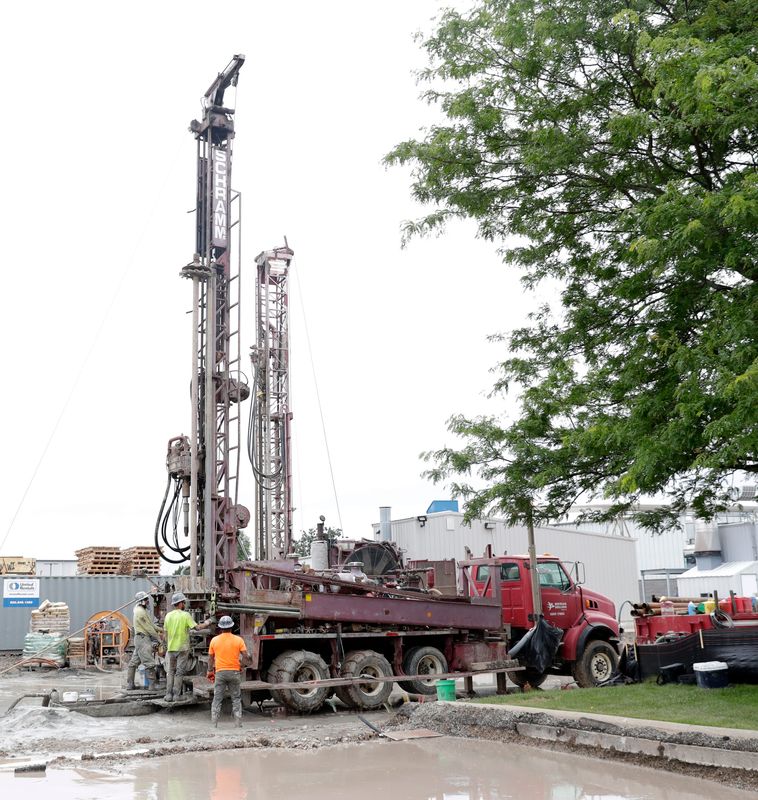
Contractors in July drilled the first of 280, 500-foot-deep wells in the facility’s parking lot that will pump a water-based solution into the earth to either heat or cool the water depending on the time of year. The water would then be pumped to heat transfer equipment to warm or cool the building.
Nature’s Way said the geothermal system equipment will last for 100 years, cut the factory’s carbon dioxide emissions by 20% and do the work of five chillers and six boilers/furnaces. And that’s not to mention the energy cost savings.
A Nature’s Way representative said the project remains on track for completion in fall 2026.
Alliance wants to prove alternative heating, cooling options have ‘gotten so much better’
Goerke said Alliance’s choice to install a geothermal system at 1580 W. Main Ave. follows its installation of air-source heat pumps two other Green Bay-area housing developments. The 1580 Main Townhomes’ geothermal system is one of those that features a back-up boiler system to support the geothermal system’s performance in cold conditions.
Goerke said the systems will significantly cut natural gas use in the buildings, which also use electric appliances. Less gas used reduces greenhouse gas emissions and the systems circulate air more regularly compared to traditional furnaces and air conditioners.
Alliance will benefit from the tax credits and Gorke expects the features will attract tenants who value sustainability. Any savings from reducing energy consumption would likely go to residents, who pay their utility bills.
Goerke added yet another reason Alliance went with energy-efficient systems: To dispel the now-outdated perception geothermal systems and air-source heat pumps won’t work in Wisconsin’s bitterly-cold winters.
“There was a time when [air-source heat pumps] didn’t work below 40 degrees, but there was also a time when the Model T couldn’t go more than 10 miles-per-hour,” Goerke said. “It’s gotten so much better.”
This story was updated because an earlier version included an inaccuracy.
Contact business reporter Jeff Bollier at (920) 431-8387 or jbollier@usatodayco.com. Follow him on X at @JeffBollier.
This article originally appeared on Green Bay Press-Gazette: Green Bay businesses, schools tap Earth’s energy for heat, cooling
Reporting by Jeff Bollier, Green Bay Press-Gazette / Green Bay Press-Gazette
USA TODAY Network via Reuters Connect