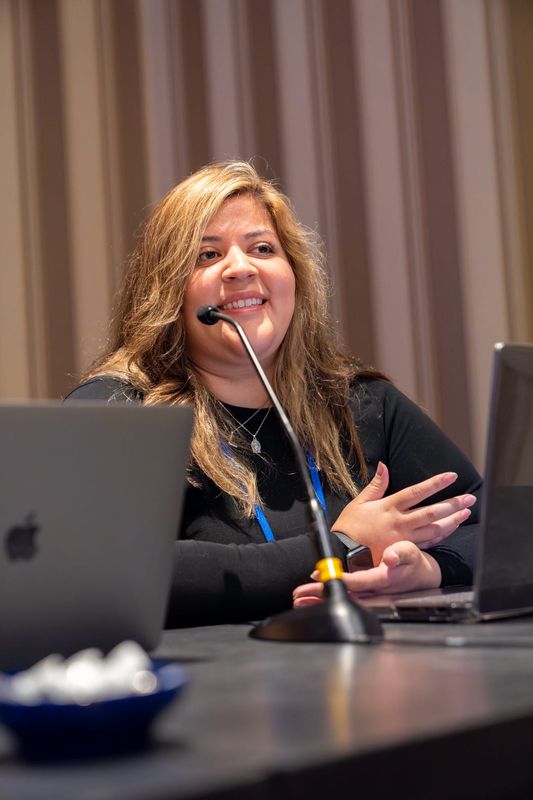
Metcalfe Park reporter April Quevedo started this year with one goal: to know everyone’s name in the neighborhood she covers.

While it may sound lofty, Quevedo has remained committed to being the kind of journalist who meets as many people in her community as possible.
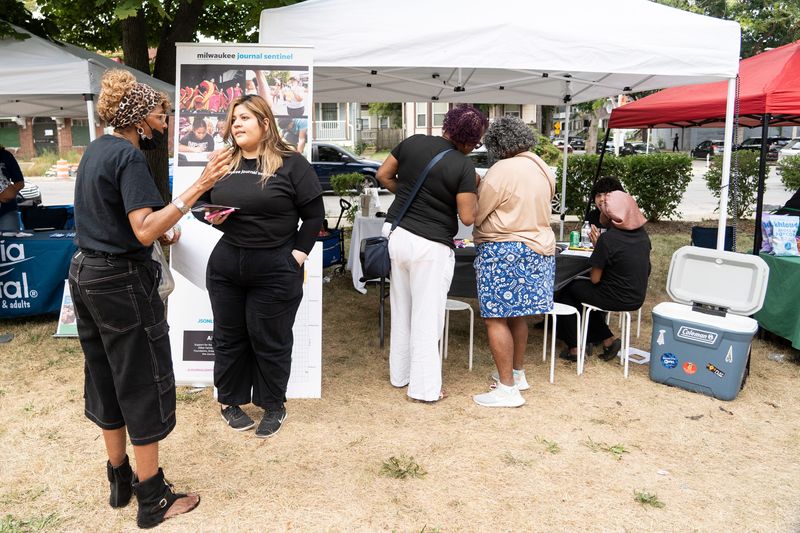
Originally from Chicago, Quevedo joined the Milwaukee Journal Sentinel’s Neighborhood Dispatch in August 2025. Each month, she volunteers and visits a host of community meetings while writing stories that elevate neighborhood voices.
She has covered everything from a woman who started a pop-up food pantry in her yard to a mother who continues to pour into her block even after her daughter was killed outside of her home.
As a recent graduate of the University of Maryland’s Philip Merrill College of Journalism, Quevedo has also used her skills as a data whiz to explore issues such as food accessibility and the impact of theft on recent store closures on Milwaukee’s north side.
Quevedo enjoys experimenting and is always looking for ways to make journalism more accessible and engaging.
Prior to joining the Journal Sentinel and earning her master’s degree from the University of Maryland, Quevedo worked in the supply chain industry for nearly a decade, supporting logistics providers like C.H. Robinson.
She received her bachelor’s degree in English from the University of Illinois-Chicago.
To learn more about Quevedo and her work, read on.
How did you get into journalism? What drew you to the Journal Sentinel’s Neighborhood Dispatch team?
My maternal grandfather was an avid reader. Every morning, he’d read “Hoy,” Chicago’s now-defunct Spanish-language newspaper (RIP). Every afternoon, he’d read a book, and every evening we watched Jorge Ramos co-anchor “Noticiero Univision.”
Grandpa respected journalists because in Mexico, where he’d lived until immigrating to the U.S. in 1969, journalists are killed every year for their work.
He viewed them as smart, brave people who work tirelessly to protect the public interest and hold power to account.
Because of him, I wanted to eventually tell my own stories.
Unfortunately, I have, like, zero imagination (not ideal for a fiction writer), but I’ve always been naturally curious and have a strong sense of justice − the recipe for a good journalist.
I grew up in a part of Chicago that the news media ignored, except when something bad happened.
In high school, I discovered DNAinfo Chicago on Twitter. It was the first news organization I saw that consistently covered people, places and issues around my neighborhood. I followed immediately, mourned when its owner shut it down, and celebrated when Block Club Chicago emerged in its place.
As my cohort at the University of Maryland’s Philip Merrill College of Journalism neared graduation last year, my friend Paul Kiefer (now at Wisconsin Watch) sent me a job posting for a reporter position at the Journal Sentinel.
I recognized the Neighborhood Dispatch initiative as my opportunity to do the community-centered journalism that had inspired me through DNAinfo and Block Club Chicago years earlier, and I jumped at it.
Before you were a journalist, you had a career in logistics and supply chain management. How has that experience influenced your work as a reporter?
I learned three things in my previous career that play a big part in how I approach reporting now.
The first is that data is perhaps the most powerful tool to effect change. In logistics, it’s not enough to say “Your less-than-truckload supply chain is being run inefficiently and it’s costing you money.” Leadership at multimillion-dollar corporations is more likely to act when you show them numbers. Turns out, the same goes for elected officials.
The second is that I derive a special kind of joy from becoming an expert on something. Knowledge has value. Part of being a reporter is knowing something well enough to be able to explain it to someone else. The more you know about the topic, the better your work gets.
The third is how to craft a narrative. It’s one thing to know your client’s supply chain so well that you can spot a breakdown in the system and then use data to prove a problem exists. It’s another to then communicate that issue in a way that compels leadership to address it. Now apply that to a neighborhood.
What does ‘community-centered journalism’ mean to you in practice?
Community-centered journalism means starting with the questions and experiences of people most affected by an issue rather than relying on institutions to decide what matters.
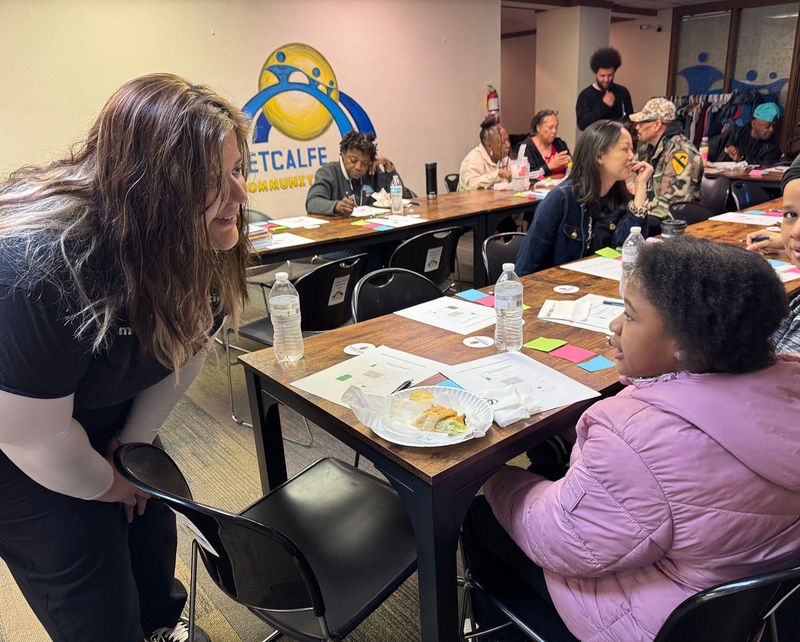
In practice, that means I prioritize spending time in my beat neighborhood, attending community events and have one-on-one conversations with residents as often as I can.
It also means bringing my own perspective to the work.
Growing up in a Chicago neighborhood that shares many of Metcalfe Park’s challenges helps me recognize stories that are overlooked by other outlets, while my background in logistics and data gives me the tools to investigate those stories with evidence.
You’ve covered food access and commercial departures from Metcalfe Park. What’s something about this subject that’s is often misunderstood?
One thing I hear a lot − especially when it comes to predominantly Black neighborhoods on Milwaukee’s north side − is that big-box stores want to stay open, but rampant theft pushes them out.
I’ve looked at police data on theft, and it is an issue throughout the greater Milwaukee area regardless of the neighborhood’s demographics. Theft is a part of the reason why stores close, but it’s not the full story.
Corporate decisions are driven by many factors, including policy, supply chain (please ask me about this) and broader business strategies.
What’s been the most challenging story you’ve worked on so far?
I can think of a couple, but my article exploring Kroger’s claims that theft was the reason for closing five stores in southeast Wisconsin was a challenge. It was hard to find sources willing to talk to me, and the list of people who could speak to the closures was short to begin with.
Getting the data back from open records requests to multiple police departments also took some time, and cleaning data for a total of eight stores before completing my analysis and writing some 1,500 words felt like it took even longer.
I pitched the idea to my editor in early September, a month after I joined the newsroom. The story was not ready for publication until the end of March, six months later. But the findings were worth the lift.
What story are you most proud of?
It changes! Right now, it’s a series of profiles called Metcalfe Park Elders.
As someone who enjoys history, it’s been great listening to the history of the country and the city unfold alongside our neighborhood elders’ lives. My hope is that their stories, as longtime residents of Metcalfe Park, are also preserved for future generations.
The series is on a hiatus, but the goal is to profile six elders in the next year for a total of 10 profiles.
You’re originally from the northwest side of Chicago. How do you like Milwaukee so far? Do the two cities feel like siblings?
Oh, this is a question that should not have been posed to me. Not siblings, no. I think they have cousin energy, with Chicago being the loud, extroverted older cousin and Milwaukee being the quieter, often underestimated cousin.
In real life, I am the oldest (and often loudest) of my cousins − and I am obnoxiously proud to be from Chicago.
Milwaukee is fine. The people I’ve met are great. My favorite part of the city is Metcalfe Park.
Outside of work, what do you do for fun?
Flee Wisconsin! Ha, that’s just my way of saying travel.
I’m a big concert-goer, so I often travel for concerts. In May, I saw System of a Down in Mexico. This month, I’ll be seeing My Chemical Romance in Minneapolis and I hope to see Underoath in Houston in December.
I also enjoy visiting museums, attending lectures and going to the theater.
Museums in the afternoon, mosh pits in the evening.
April Quevedo covers Metcalfe Park for the Journal Sentinel’s Neighborhood Dispatch. Contact: aquevedo@usatodayco.com.
Neighborhood Dispatch reporting is supported by Northwestern Mutual Foundation, Journal Foundation, Bader Philanthropies, Greater Milwaukee Foundation, and reader contributions to the Journal Sentinel Community-Funded Journalism Project. Journal Sentinel editors maintain full editorial control over all content. To support this work, visit jsonline.com/support. Checks can be addressed to Local Media Foundation (memo: “JS Community Journalism”) and mailed to P.O. Box 85015, Chicago, IL 60689.
The JS Community-Funded Journalism Project is made possible through our partnership with Local Media Foundation, tax ID #36-4427750, a Section 501(c)(3) charitable trust affiliated with Local Media Association, and EnMotive, LLC, a subsidiary of USA TODAY Co., Inc. USA TODAY Co., Inc. is the parent company of this publication.
This article originally appeared on Milwaukee Journal Sentinel: Get to know Metcalfe Park reporter April Quevedo
Reporting by Kynala Phillips and April Quevedo, Milwaukee Journal Sentinel / Milwaukee Journal Sentinel
USA TODAY Network via Reuters Connect
By Kynala Phillips and April Quevedo, Milwaukee Journal Sentinel | USA TODAY Network