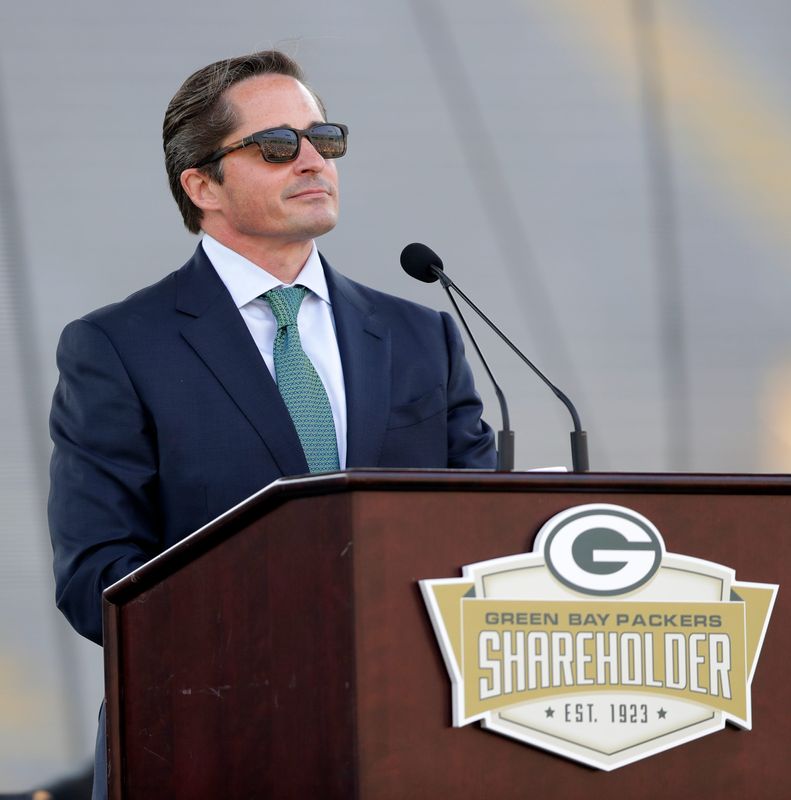
PHOENIX – No, Ed Policy does not want to change the Green Bay Packers home stadium to Kwik Trip Field. Nobody wants that.
He isn’t upset his recent quip stirred attention, though. Since joining the Packers as vice president and general counsel in 2012, Policy always has approached his job with what he calls “healthy paranoia.” It comes from his roots in Youngstown, Ohio, an hour outside Cleveland. When Policy was young, he remembers thinking it impossible the Cleveland Browns ever would leave. He said there is no connection between team and community like the Packers and Green Bay, but Policy considers the Browns and Cleveland a clear second.

He’ll never forget watching the unthinkable happen in 1995. Because the city had invested in new stadiums for the Cleveland Cavaliers and Cleveland Indians, public funding wasn’t available when it came time for the local NFL franchise to upgrade its stadium. The Browns became the Baltimore Ravens overnight, leaving a crater in Cleveland’s civic identity, and a paranoid 25-year-old attorney who one day would lead his own professional football franchise.
“It was just a lesson that I learned pretty early,” Policy said March 30 at the NFL owners meetings, “and I’ve learned that nothing is impossible. You can not take things for granted, especially with the Green Bay Packers. We are an extreme anomaly amongst NFL teams, and amongst all sports franchises.
“The worst thing you can do in my position is fail to see that, yes, we are an anomaly and that we should have a little bit of a healthy paranoia, we’re going to have to be proactive maybe more than most teams.”
Policy made the obvious clear: Green Bay is nowhere close to losing the Packers. Nobody wants that either. The idea of granting corporate sponsorship naming rights to Lambeau Field is almost as unlikely. Policy said the Packers currently are in strong financial standing, equipped to compete economically with any of the other 31 teams in the league. His paranoia is in keeping it that way.
The Packers have long benefited in football from being the only NFL team without a private owner, allowing their football operation to make decisions without meddling. It’s a potential disadvantage in business. Monitoring the league’s current economic climate, where teams are raising significant capital selling minority stakes to private-equity firms or deep-pocketed individuals, Policy fears the Packers eventually falling behind. The Miami Dolphins became the latest franchise to exploit the tactic, announcing March 31 it sold a 1% stake to Xiaomi co-founder and vice-chairman Bin Lin for $12.5 billion.
Overnight, Policy said, the Dolphins gained more money than the Packers have in their entire corporate reserve fund, which has taken roughly 20 years to build. The infusion of cash came without Dolphins owner Stephen Ross relinquishing any control in the team.
“Bin’s investment,” Ross said in a statement, “will allow us to continue prioritizing the growth of the Dolphins and our other properties – ultimately allowing us to invest further into the South Florida region.”
It’s not an option the Packers have available because they are publicly owned, which is where the business anomaly lies. Lin’s $12.5 billion investment for a 1% stake set a new standard as the highest public valuation in professional sports. Policy expects that valuation to only increase.
Which is why the Packers president and CEO has started searching for creative ways to keep his franchise financially competitive in an unequal business landscape. No, Kwik Trip Field isn’t coming anytime soon, but Policy sounded more open to granting licensing rights to the Packers’ practice facilities such as the Don Hutson Center, Ray Nitschke Field and Clarke Hinkle Field. The Packers increased ticket prices for the 2026 season between $4 and $22 per seat, depending on location. Don’t be surprised if there’s another increase in the near future.
“We are looking to be aggressive as it relates to just building our business and revenue in general,” Policy said, “because it’s just become extremely expensive to operate an NFL franchise. And we’re not going to be able to compete on the field if we don’t really begin to prepare ourselves to make smart moves off the field as a business.
“Every other team has access to – most of the teams, anyway – have access to a number of sources of capital that we don’t have access to.”
Policy stressed the economics are not a problem for now. The Packers’ current business model has flourished enough for general manager Brian Gutekunst to not only be active in free agency, but execute a blockbuster trade for All-Pro pass rusher Micah Parsons before last season. Part of that deal was an understanding Parsons would sign a landmark extension, a four-year, $188 million deal that became the richest for any non-quarterback in NFL history.
If the Packers had enough revenue to execute that contract only a year after extending Jordan Love for $220 million over four years, why worry about a lack of money? Policy said it doesn’t take long in the current arms race of professional football to fall behind.
“If we do fall behind,” Policy said, “we’re not talking about needing tens of millions. We’re talking about needing hundreds of millions to catch up, and you just can’t catch up if you fall behind by hundreds of millions in a market like ours.”
Policy said the Packers also are handling other exorbitant costs, which is where Lambeau Field re-enters the equation. The NFL’s oldest stadium remains in pristine condition, but it’s expensive to maintain. The Browns and Tennessee Titans are among teams building new stadiums. Both franchises opened their current stadiums in 1999. The last major expansion to Lambeau Field came in 2003. As Policy noted, the Atrium is considered the stadium’s “new” section.
The Packers are not changing their football principles. After years of neglecting free agency under Ted Thompson, Gutekunst has used all tools available to him in building his roster. Policy said economic viability ensures he can continue to do that.
“I’m really pleased,” Policy said, “that Brian has been pretty aggressive in recent years in terms of free agency, certainly in terms of trades, like the significant trade he pulled off last year. I think you’ll begin to see even in our finances this year, that has an impact. That has a very significant impact on us. If we want to continue to compete with other teams that are using every tool they have in their toolbox to sign players, unless we want to take some of those tools away from Brian – which I won’t do – we’re going to have to continue to act like other teams as it relates to revenue streams.”
This article originally appeared on Packers News: CEO Ed Policy has ‘healthy paranoia’ about Packers’ financial future
Reporting by Ryan Wood, Green Bay Press-Gazette / Packers News
USA TODAY Network via Reuters Connect