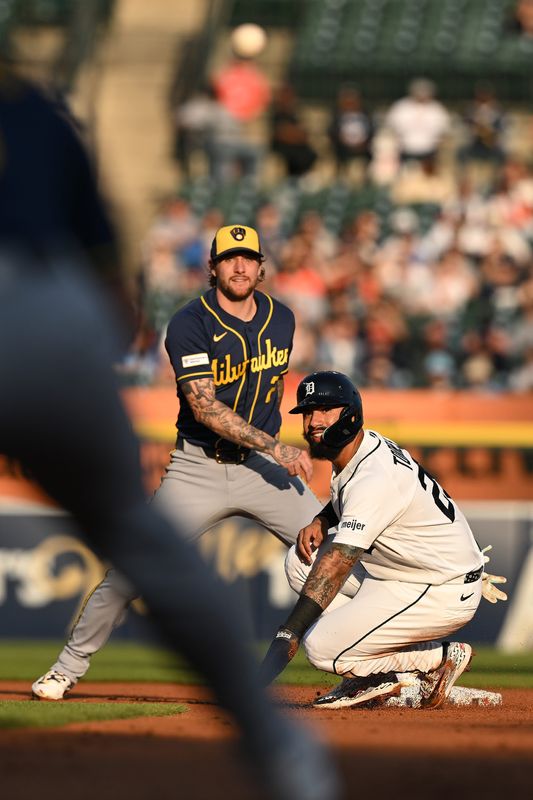
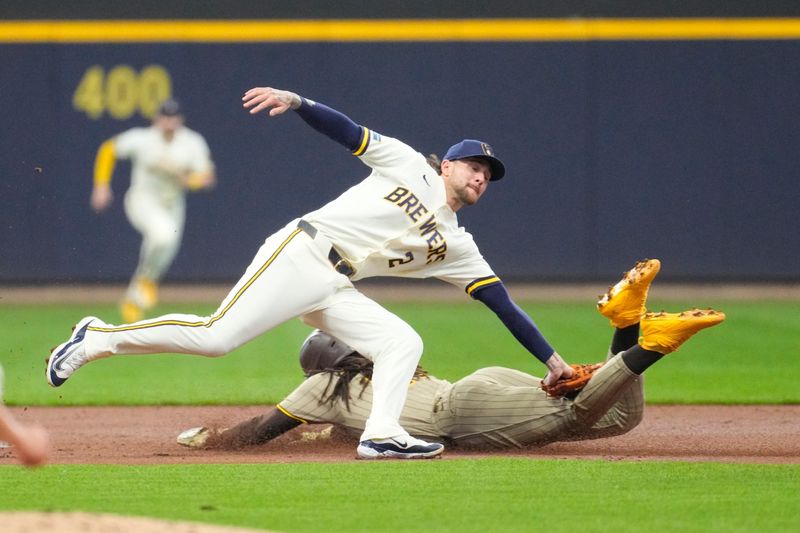
As Brice Turang has turned into one of the game’s elite-hitting second basemen, public defensive metrics say his defense has dropped off.
But has it?

Entering May 22, Statcast’s fielding run value lists the Milwaukee Brewers second basemen as tied for 17th at his position at +1 FRV. Statcast’s Outs Above Average has him ranked 23rd out of 38 second baseman at a net of zero.
This is a trend carrying over from last year, when Turang was tied for 61st among all second baseman at 0 FRV – meaning Statcast effectively believes he neither added nor subtracted value on defense.
None of this was news to Turang when he was presented with the numbers in the visiting clubhouse at Target Field last weekend.
“I’ve never been a high Outs Above Average guy,” he said. “They’ve never been that high. I don’t know how they line up the metrics, but I just never have been.”
It’s not only Statcast’s metrics, though, that are down on Turang’s defense.
Two years after being worth 22 Defensive Runs Saved during his Platinum Glove season of 2024, Turang has been worth a relatively pedestrian 1 DRS in 2026. Baseball Prospectus’ Deserved Runs Prevented puts him at -0.1.
But here’s where a conundrum is created: The Brewers don’t see it that way.
In Milwaukee’s internal defensive model, Turang still possesses all the elite traits as far as first step and range that he displayed in 2024 when he was named the National League’s best defender.
“The last 3 years, in our internal metrics, he’s the same guy,” said Brewers infield coordinator Matt Erickson.
As far as the Brewers are concerned, all that matters is what their numbers say. After all, teams’ proprietary defense measuring systems are generally more robust and comprehensive than public ones, and the Brewers have proven quite strong at evaluating and acquiring players on that side of the ball over the years.
The public, though, is never going to see those numbers. Instead, we use metrics like OAA and DRS, and those go into determining a player’s WAR. That, in turn, influences a variety of the ways that we discuss and evaluate players, from casual conversation to All-Star selections to even award voting.
“I don’t know what other people [think],” Turang said. “If other people are going strictly off the numbers out there, that’s whatever other people want to believe. But I still value myself as a very good defender. In our metric system, at least that I know of, the defense is good. I’m not so worried about it.”
Turang’s elite jumps are at the core of Brewers evaluation
To understand why the Brewers still view Turang as elite while public metrics don’t requires a greater understanding of how the team measures defense.
The Brewers, Erickson believes, have better ways of properly crediting infielders for what he calls “engagement,” which boils down to how a player takes the information from the game situation, scouting reports and PitchCom and uses it to gain an extra step toward where a batted ball is likely going.
“The public metrics aren’t giving them the credit for the additional anticipation,” Erickson said. “I want the engagement part of it measured because that tells you how guys are paying attention to swings.”
In this area, the Brewers still have Turang graded out as elite.
“He does an incredible job,” Erickson said. “He anticipates better than anybody else.”
The Brewers measure this by breaking down how quickly a fielder moves three feet in the proper direction. Their model measures Turang’s jumps as being as good as two years ago.
“There’s quite a few of his plays where they look to the eye like pretty easy plays,” Erickson said. “But the you go back and our stuff picks it up as a 47 percent out probability. It’s because he’s so explosive right as the pitch is thrown.”
Take, for instance, Turang’s first step on the line drive from Alek Thomas on April 28.
By the time the camera pans on the broadcast, it looks like he was just stationed in the proper spot to be able to leap and make the play. But Turang, the Brewers would tell you, already had a step in the direction Thomas hit the ball before contact was made.
“That, to me, is more understanding the game a little bit and trying to get the best jump you can get,” Turang said. “At contact, when the ball’s put in play, how fast can I move three feet laterally. If I’m moving really fast in 3 feet and I’m still not getting to balls, that means it might have just been a hit. The metrics we have here on our team, they might be different than some other team or they might be different than something else.
“Me and Matty talk about it, our metrics. At the end of the day, with our metrics I can go back and watch. This play, this jump, the percentage of out probability.”
Turang has had fewer opportunities…but why?
In the Brewers’ minds, Turang is still the same player with the glove, he has just gotten fewer opportunities to make the flashy play.
“Man, I feel like I haven’t gotten much opportunity,” Turang said. “I get a lot of the routine ground balls. I just haven’t had a lot of opportunities for that wide-ranging play. You got Miz (Jacob Misiorowski) punching everybody’s tickets. You got Kyle Harrison punching everybody’s tickets. For a guy to hit a groundball against Misiorowski, that’s a pretty tough thing to do.”
Turang’s perception is correct: He’s had significantly fewer chances this year. Two years ago when he won the Platinum Glove, he registered .49 chances per inning, which accounts for total assists, putouts and errors. A year ago, that dipped to .46. This year, it’s all the way down to .39 per inning.
Statcast guru Mike Petriello explained that Statcast’s most likely reason for this is Turang is getting to fewer balls, therefore not registering as many chances.
In general, that’s fairly inductive; players lose a step or two in their range all the time.
The Brewers, though, would contest that about Turang.
“Last year to his season before, he was very, very similar as far as the metrics are concerned,” Erickson said. “The only exception is 50/50 play opportunities. Two years ago, he had more 50/50 plays up the middle to his backhand. In our system those are anywhere from 30 to 70 percent. So if you’re hovering in the range between 30 and 50 percent and you’re making those, you’re getting huge credit in our system.
“Two years ago, he made 75 percent of his total chances over the course of the season, which is ridiculous. Last year, he still made quite a few but he didn’t have as many opportunities.
“But as far as his first step and his lateral range and the consistency of play, he was very, very similar. And this year, he’s still at a high level. He’s having very similar success, just not getting the opportunities.”
How then, Erickson wonders aloud, do metrics grade him as a middling glovesman?
One possibility is the scope of range on a play. Some metrics, like OAA, do account for anticipation by beginning their tracking at pitch release (DRP, though, does not have access to that data), which would seem to benefit a player like Turang, but it’s also quite possible teams have a more advanced way of doing so.
“If I have a good first step, I shouldn’t get docked for having a good first step and now that play is technically easier, if you know what I’m saying,” Turang said. “Our metric system is really focused on the jump aspect of it. Getting a good jump, which then gives you more range to do anything.”
Another is in the way defense on the whole is evaluated. While metrics like Statcast’s do measure jumps, it’s not rolled into the final number for OAA or FRV.
The Brewers are not only measuring things like jumps – and much, much more, from how well a first baseman stretches for the ball to some understanding of which plays to “throw out” – but they use them as a component of a holistic defensive evaluation.
If Turang is still grading out well in those individual components (and the Brewers say he is), then that could influence his total defensive grade even if he hasn’t had the high quantity of flashy plays.
Another possibility some around the Brewers wonder: Does Turang make more out-of-the-box plays that are difficult to account for than the average player?
Bottom line
So, is Turang’s glove still elite? Or is it merely run-of-the-mill now?
The answers, unfortunately, aren’t entirely clear. Defense is often in the eye of the beholder – or the metric.
This article originally appeared on Milwaukee Journal Sentinel: Brewers say Brice Turang’s glove is elite. Some metrics disagree. What gives?
Reporting by Curt Hogg, Milwaukee Journal Sentinel / Milwaukee Journal Sentinel
USA TODAY Network via Reuters Connect