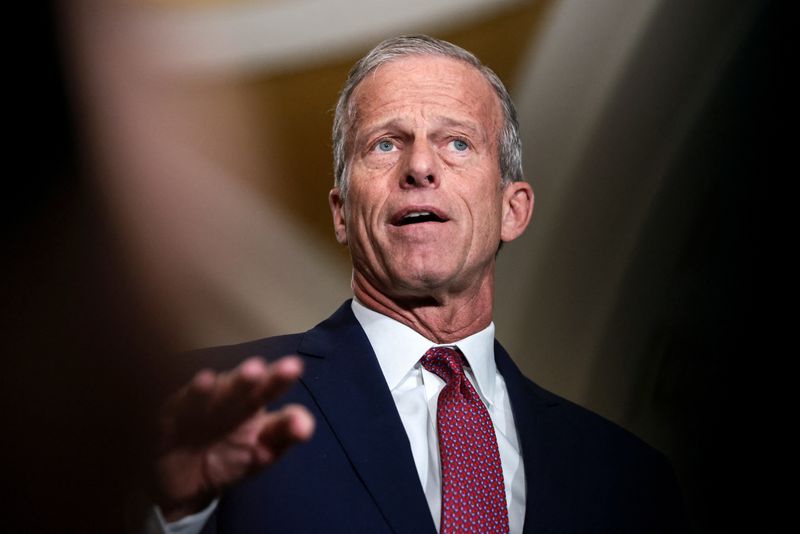
WASHINGTON, April 21 (Reuters) – U.S. Senate Republicans will move forward this week on a budget blueprint that would boost funding for the Immigration and Customs Enforcement and Border Patrol agencies for the next three years, Senate Majority Leader John Thune said on Tuesday.
Thune’s comments come as the Republican-controlled Congress aims to end a partial shutdown of the Department of Homeland Security.

“The budget resolution before us this week will unlock funding for law enforcement border security at DHS for the next three years,” Thune said in a speech to the Senate.
An additional $70 billion sketched out in the budget plan for DHS would be available at least through the end of President Donald Trump’s term in office on January 20, 2029.
Senate Democratic Leader Chuck Schumer attacked the legislation, saying it would “pour” money into “ICE and Border Patrol without putting any restraints on these rogue agencies’ rampant violence in our streets.”
Democrats have been pushing for a series of new constraints on ICE and Border Patrol, which operate under the direction of DHS, before signing off on any additional funds for them. They have argued that ICE and Border Patrol should be subject to the same operational rules as police forces across the United States, including a requirement that judicial warrants be obtained before agents can enter private homes.
Negotiations over several weeks between Republicans and Democrats on such changes did not bear fruit, causing partial shutdowns of some DHS agencies.
Now, Republicans have opted to end the deadlock and ram the new funding through the Senate using a rarely used procedure that allows some budget-related legislation to bypass Democratic opposition.
Most bills need a supermajority of at least 60 votes in the 100-member Senate to advance to passage. Republicans currently control the Senate with a 53-47 majority.
If this non-binding budget blueprint passes the Senate and House of Representatives, committees will fill in the details on how the $70 billion would be spent in separate legislation that Trump would have to sign into law before becoming effective.
(Reporting by Katharine Jackson and Richard Cowan; Editing by Doina Chiacu, Editing by William Maclean)