One of the highlights of this week’s beachcombing adventure wasn’t something washed ashore at all; it was very much alive.
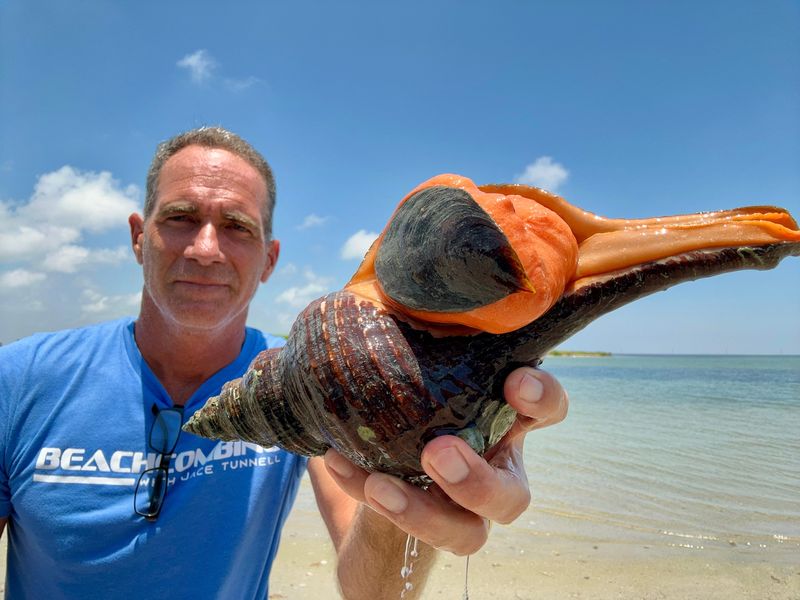
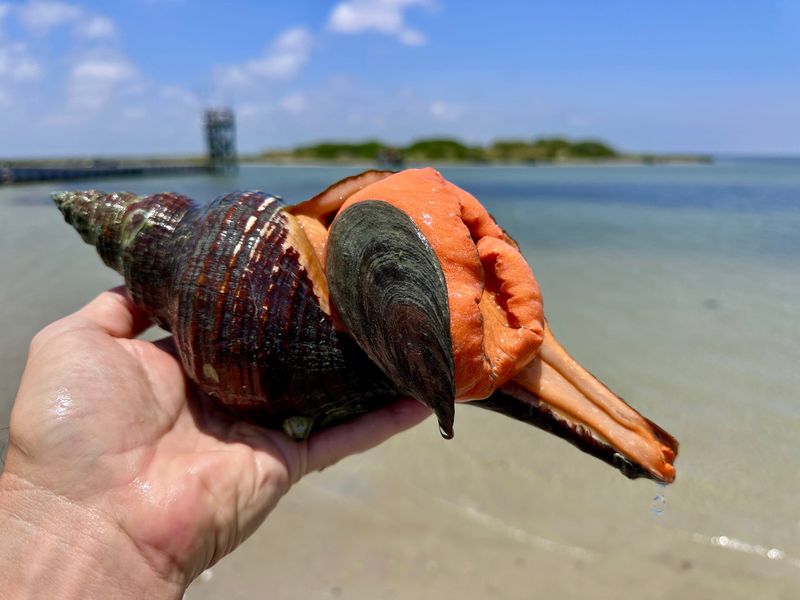
As I walked the shoreline, I spotted what looked like a large shell resting in the shallows. When I picked it up, a brilliant orange animal slowly emerged from inside. It was a living horse conch, about 12 inches long, and one of the most spectacular marine snails you’ll ever encounter.

After a few quick photos, we gently returned it to the water to continue its journey.
The horse conch (Triplofusus giganteus) is the largest snail in North America and can grow to nearly 2 feet long, although specimens that size are uncommon. Their soft body is an eye-catching orange to salmon color, creating a stunning contrast against the dark spiral shell. Seeing one alive is a completely different experience than finding an empty shell on the beach.
Despite the name, horse conchs aren’t true conchs. They belong to a different family of marine snails and are active predators. They feed on other large snails, including lightning whelks and tulip snails, using a long proboscis to reach deep inside their prey’s shell. They’re also opportunistic scavengers when the opportunity presents itself.
Horse conchs are found on sandy bottoms, seagrass meadows and shallow coastal waters throughout the Gulf and along Florida’s Atlantic coast.
Although they’re impressive predators, they pose no threat to people and play an important role in keeping marine ecosystems in balance.
While horse conchs are edible and some people do eat them, I can’t imagine harvesting such an incredible animal. I’d much rather watch one slowly crawl back into the Gulf to continue its life.
The horse conch is also the official state shell of Florida, a fitting honor for North America’s largest sea snail.
If you ever come across one alive, take a moment to admire it, snap a quick photo and gently place it back where you found it. That way, this remarkable animal can continue patrolling the Gulf’s shallow waters for years to come.
Jace Tunnell is the director of community engagement for the Harte Research Institute at Texas A&M University-Corpus Christi. His Beachcombing series appears in newspapers, as a weekly video on YouTube and KEDT PBS, and as a weekly feature on KEDT NPR. Follow Jace at harteresearch.org, Facebook (@harteresearch) and Instagram (@harteresearch).
This article originally appeared on Corpus Christi Caller Times: You can find North America’s largest sea snail in Texas coastal waters
Reporting by Jace Tunnell, Harte Research Institute / Corpus Christi Caller Times
USA TODAY Network via Reuters Connect
By Jace Tunnell, Harte Research Institute | USA TODAY Network