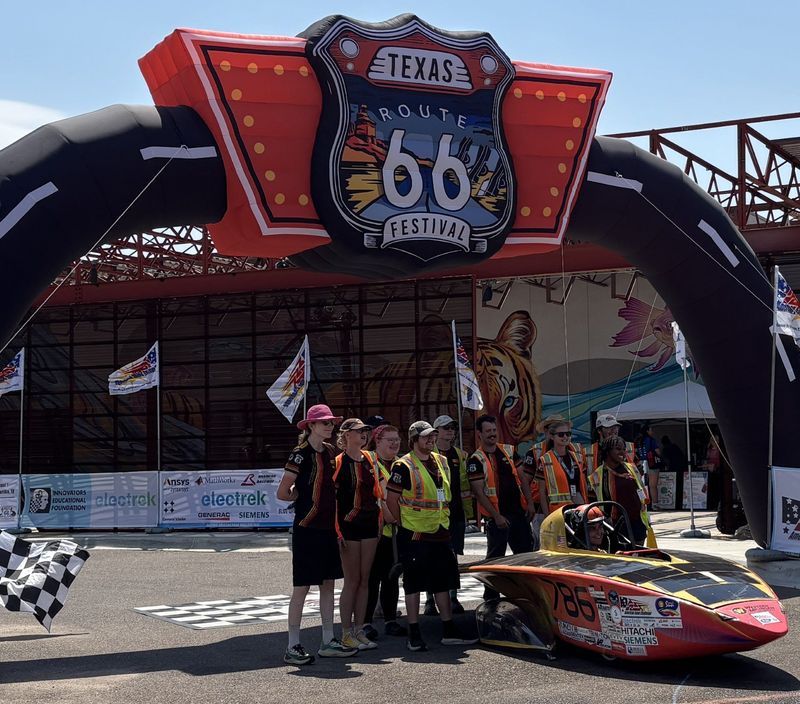
There have been many ways of traveling Route 66 during this Centennial Year of the Mother Road, which tied America together in so many ways. But one of the most unique has been the 2026 Electrek American Solar Challenge, which featured teams through eight states along the Great River Road and Historic Route 66 from Minneapolis to Amarillo.
College teams, from around the country and beyond, were challenged with completing 1,550 miles over eight days, and gaining additional miles by completing optional loops. Route 66 contains 400 miles of loops throughout the road.

The teams traveled throughout the day and charged their solar cars from the sun in the mornings and evenings in the quest of driving the most miles under solar power during the course of the event.
The main group sponsoring the first event, Electrek, is also a supporting partner of American250, a national nonpartisan organization charged by Congress to lead the commemoration of the signing of the Declaration of Independence.
The solar teams represented a variety of schools from around the world who took on the two-year challenge of designing, building and testing a solar-powered vehicle for competition.
There were two vehicle classes, the Single Occupant Vehicle Class and the Multi Occupant Vehicle Class.
Teams came from the University of Kentucky, Purdue, Massachusetts, and Berkley, along with some Canadian universities as well, including University of Calgary, Polytecnique Montreal, and University Waterloo and one from KU Leuvan.
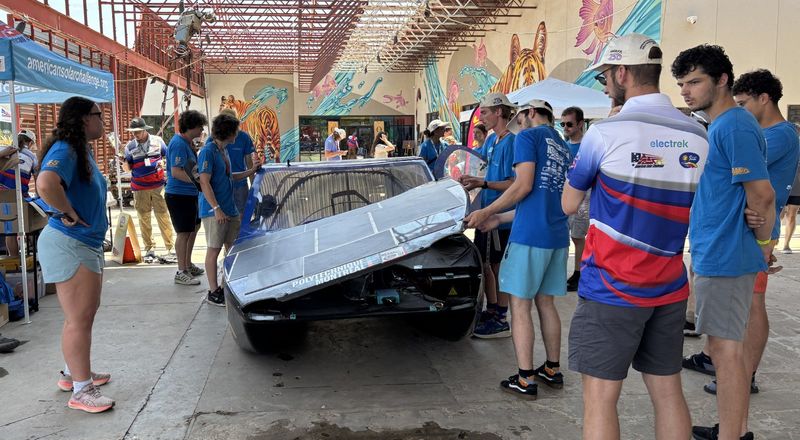
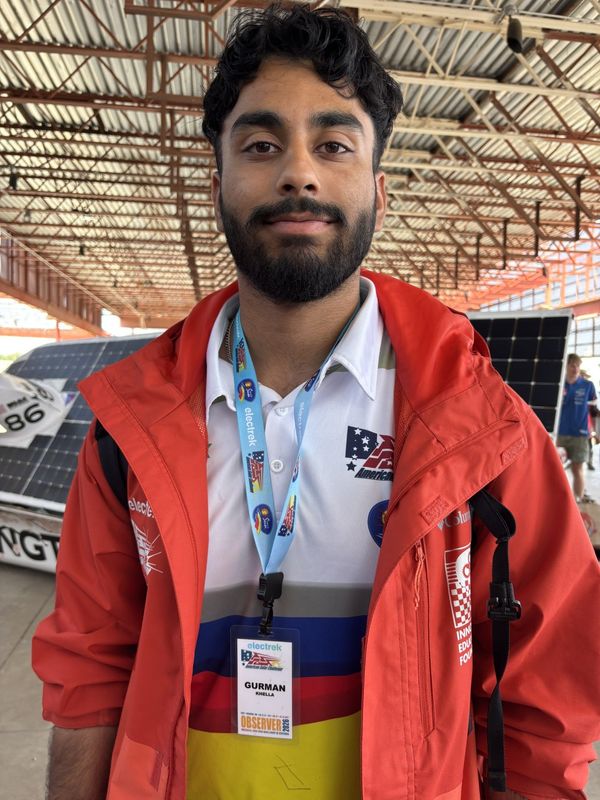
One young observer from Canada, Khella Gurman, said many of the vehicles have only one driver, who sits in the middle in a small pocket with a plastic shell above their head. He said some have fans to keep the driver from getting too hot in 100-degree weather, and many have a repellent shield they can apply to repel the sun. The “hood” or top of the cars can be pulled back and show the inside of the car, which is mostly simple. Solar panels cover the tops of the cars.
How did they decide who runs the race?
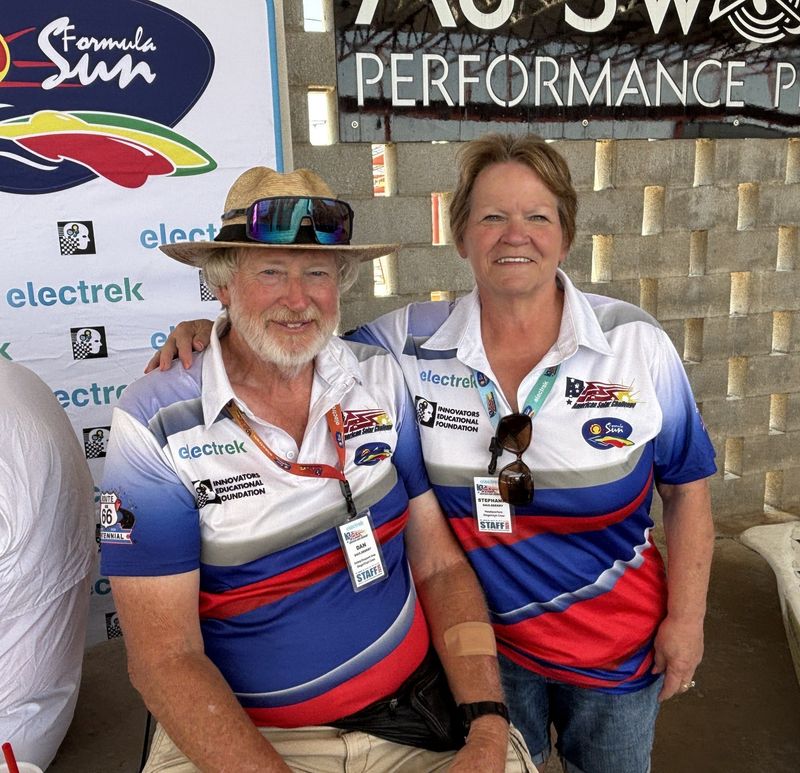
Dan Salsbury, who travels with the team and sets up their sites, said, “It’s being done by an organization of innovators, educators of a foundation started to further the enhancement of solar car racing in the U.S.”
“We’ve been going since 2009 when we took over the previous organization,” Salsbury said. “We’ve been doing this a few years and have students from all over the United States, Canada and Europe who have built these cars and have done all the work themselves.
“The universities helped them,” he added, “and then they put the car on the road. It’s a challenge to get from Minneapolis to here.”
Salsbury said that one of the challenges was to get their cars to be aerodynamic, as it can be under different conditions. He said that they had scrutiny processes where they test them and how they’re managing different kinds of weather and other conditions.
He said the cars could weigh from 800 to 1,400 pounds and include high-dollar solar panels to gather the sun power.
“If the car is working the way they want it to, there’s a certain speed they can travel by the sun itself, but it’s different for each car,” Salsbury said.
He added that if they want to build up their batteries more, they just slow down so the sun will charge up more energy. He added that if they have a certain point to reach, they have to manage their car the same way an electric car would.
Obviously, the cars don’t travel at night. Salsbury said they start at 9 a.m., and they drive until around 5 or 6 p.m. when they reach their checkpoint destination. They normally go out on loops around the community they are in to let the people see them.
“Around 49 people entered,” Salsbury said. “We had 37 that actually came to Minneapolis to do their scrutiny ring and then run a three-day track pit stop before they got on the road.”
He emphasized that through the solar car challenge, participants are getting very useful knowledge they can use for a lifetime. He said many of the previous participants had moved on to very lucrative and important jobs in aerospace and other top engineering businesses.
Georgia Tech team attempts to set record for the first time in America
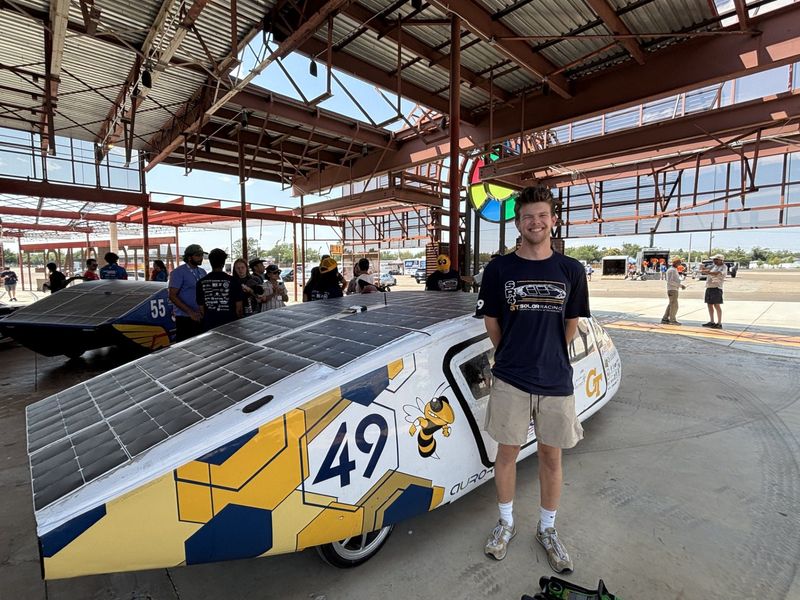
Sam Woolsey, with Georgia Tech Solar Racing, said that they felt, as a team, that they were doing something a little bit different than most the teams they saw there. Many of the team members had caps with antennae resembling bees, and their car had the design of a honeycomb on the exterior.
“Most of the cars seat one person, and some seat two people,” Woolsey said. “Our goal was to bring four people in a solar-powered car across America for the first time at this competition in over almost 10 years.” It would be the first team from North America to do this feat.
Woolsey said it was an extreme mechanical challenge, efficiency challenge and a logistical challenge to keep track of all the people. He said on the road, they would run around 35 mph as an average and traveled down as much as Route 66 as possible, avoiding the expressways.
All their team members are students at Georgia Tech, and most are up for their master’s degrees.
“I think everyone here were engineers, but their team has different majors, at least all the majors you could get at Georgia Tech. But most are electrical, mechanical, material, science, aerospace and different majors,” said Woolsey.
He said his interest is in getting energy sources, more in the generation of energy. He saw this race as a great way to get foundational mechanical engineering skills as well, and it fit the mission that he had for his career.
“Seeing all the hard work pay off” was what Woolsey enjoyed the most about his experience. He also said that the car he was in, Aurora, had entered design in 2020 when he was 14, but they had taken it to some past races and it hadn’t done as well.
“We continued to improve it over the past three years,” Woolsey said. “I’m glad to see it competing and being viable enough to race in such a competitive field.”
The top four results from teams in the SOV class who completed the base route the race were:
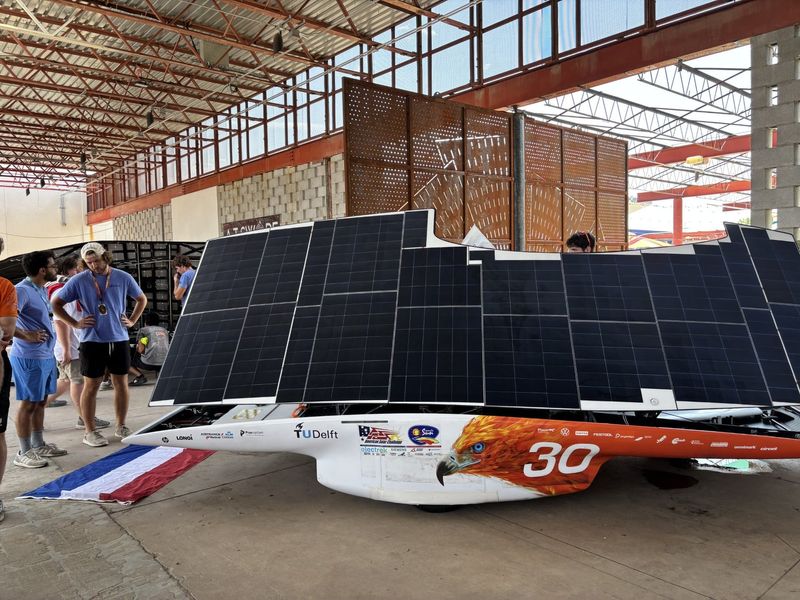
As far as the fastest teams, ETS scored first with 347 points and timing at 3:14 and Delft came in with 319 total points and 3:12 to place second.
The following teams have been granted provisional qualification to the Electrek American Solar Challenge 2026. They have to achieve their provisions during Stage 1 to be granted full qualification:
Nell Williams is a staff writer covering trends and other news for the Amarillo Globe-News. Have a story idea? Email her at nwilliams@usatodayco.com .
This article originally appeared on Amarillo Globe-News: Amarillo serves as finish line for solar car Route 66 race
Reporting by Nell Williams, Amarillo Globe-News / Amarillo Globe-News
USA TODAY Network via Reuters Connect
By Nell Williams, Amarillo Globe-News | USA TODAY Network