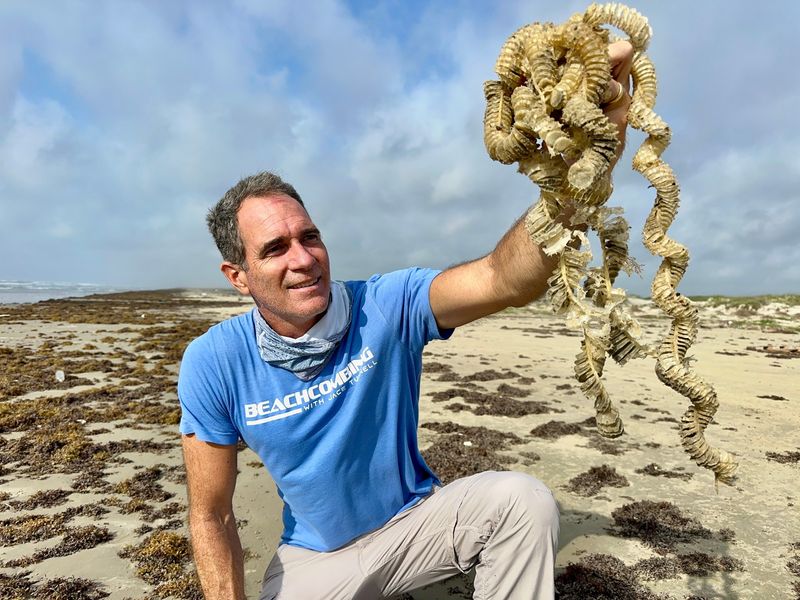
This week’s beach walk brought one of the strangest and most fascinating treasures of the spring season, long strands of lightning whelk egg casings washed ashore. Some stretched nearly 3 feet long, twisting through the wrack line like pale sea serpents.
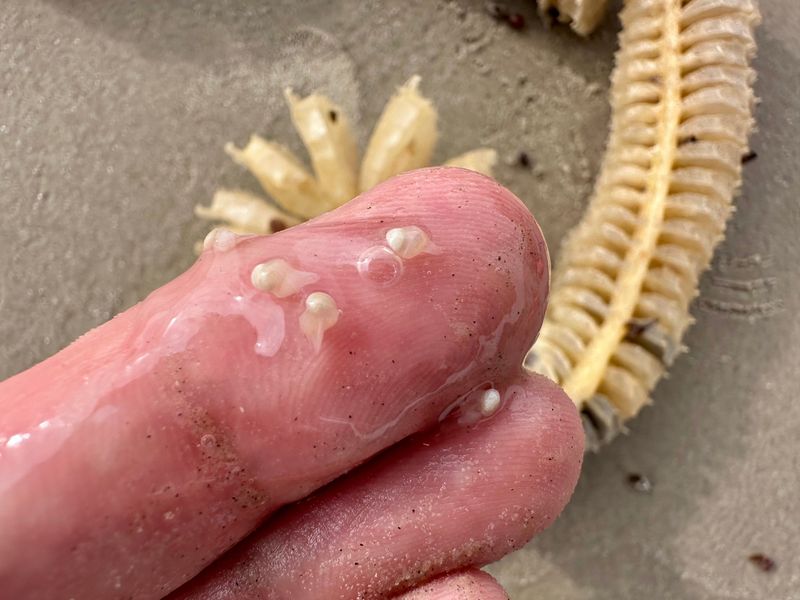
At first glance, they hardly look alive. But tucked inside many of the jelly-filled pods were tiny developing snails, each no bigger than a grain of rice. By carefully opening a few capsules, I could see miniature lightning whelks already forming their delicate spiral shells.

Lightning whelks, the official state shell of Texas, create these remarkable egg strings each spring and summer. A female whelk lays a long chain of disk-shaped capsules connected by a central cord.
Each capsule can contain dozens of eggs, though only a few babies typically survive to maturity. The stronger embryos often consume the unfertilized eggs as nourishment while developing inside the capsule, nature’s version of packed lunches for the journey ahead.
A single egg string may hold well over a hundred capsules and potentially thousands of eggs.
When the young whelks are fully developed, they cut a neat opening near the upper edge of the capsule and crawl out into the Gulf. I also found several empty casings with those tiny escape hatches still visible, evidence that this year’s hatchlings had already begun their lives beneath the waves.
Fresh egg casings feel soft and rubbery, but after drying in the sun, they become brittle and lightweight. Beachcombers often mistake them for skinned snakes or debris until they notice the repeating pattern of capsules.
Every tangled string in the tide line may represent the next generation of one of Texas’ most iconic marine snails quietly beginning its life offshore.
Jace Tunnell is the director of community engagement for the Harte Research Institute at Texas A&M University-Corpus Christi. His Beachcombing series appears on YouTube (@HarteResearch), Facebook (facebook.com/harteresearch) and Instagram (@harteresearch).
This article originally appeared on Corpus Christi Caller Times: Those objects on the beach aren’t serpents. They’re snail egg casings
Reporting by Jace Tunnell, Harte Research Institute / Corpus Christi Caller Times
USA TODAY Network via Reuters Connect