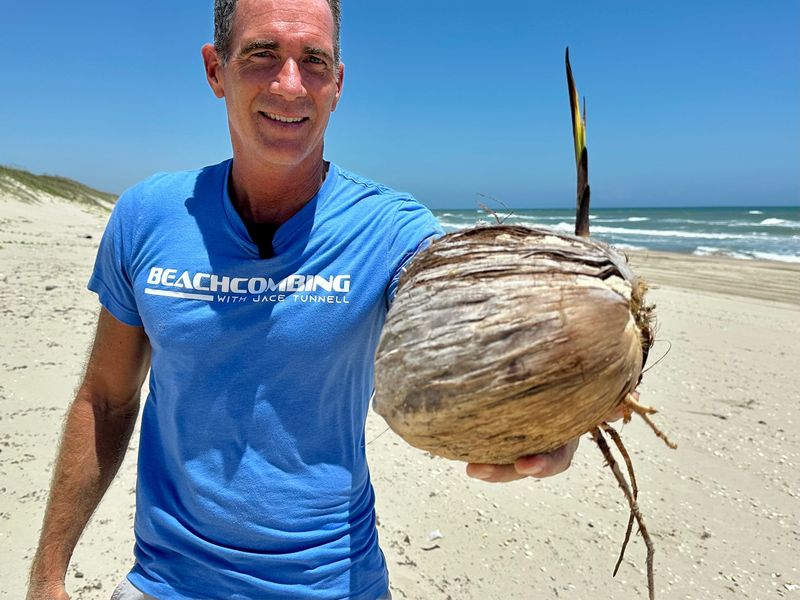
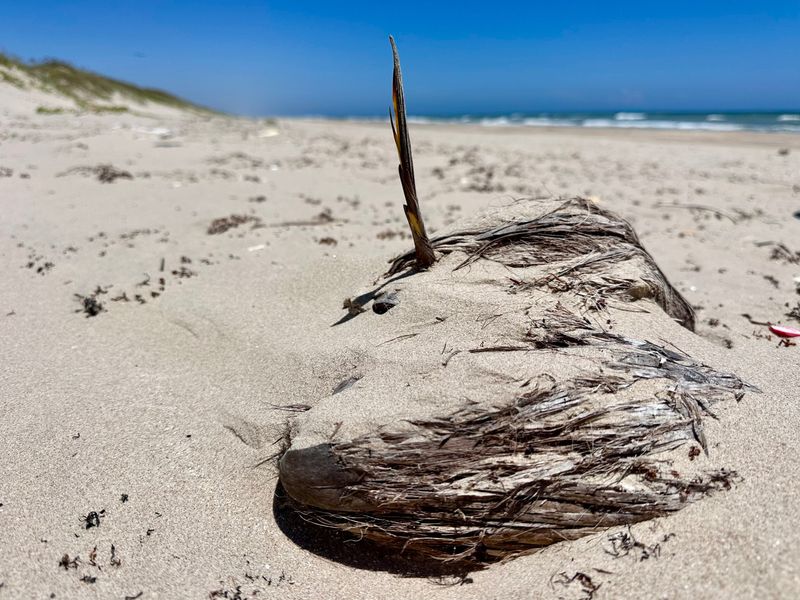
Beachcombing along the Texas coast always brings surprises, but this week I found one of the rarest: a sprouting coconut tucked at the base of the sand dunes.
Coconuts wash ashore here throughout the year, likely arriving from Mexico, Central or South America, or Caribbean islands after long journeys across the Gulf. Finding one that has actually begun to sprout, however, is extremely unusual.

The last time I encountered sprouting coconuts was during the summer and fall of 2021, when I found around 20. This year shares something with 2021: frequent coastal rain. Enough rain has fallen to keep sand moist in low areas of the beach, creating favorable conditions for a coconut to germinate.
A coconut is an impressive self-contained survival package. The water and meat inside provide stored nutrients and energy for the developing plant. Give a viable coconut warmth and moisture, and it has much of what it needs to begin growing.
So why aren’t coconut palms lining our beaches? Winter temperatures are the problem. Coconut palms are extremely sensitive to cold, and the central Texas coast regularly gets colder than they can tolerate.
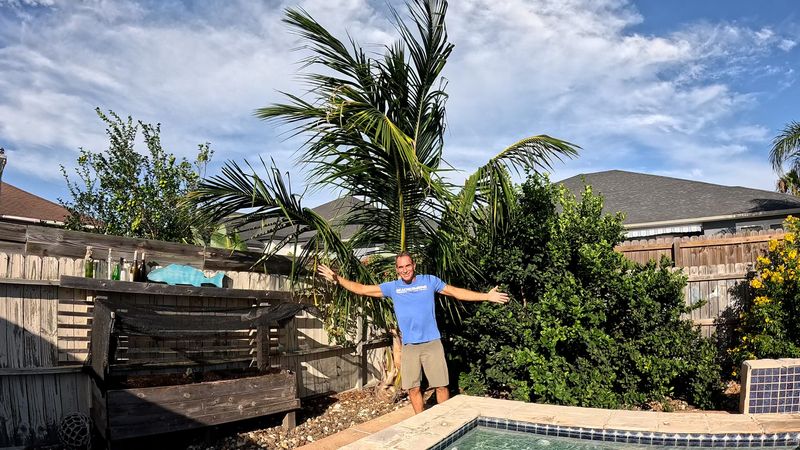
I learned that firsthand after planting two sprouted coconuts from 2021 in my backyard. Only one survived. Keeping it alive has required wrapping it with heating wire, adding heat lamps and covering it with a 20-by-30-foot tarp during freezes. Today, that palm stands about 15 feet tall.
It hasn’t produced coconuts yet, but coconut palms can take five to eight years before producing their first fruit.
As for this week’s beachcombing treasure, it already has a destination. I’ll plant it where my other 2021 coconut palm died. This time, I plan to double my efforts to protect it through our winters.
Maybe, with enough care, I’ll eventually have two Texas-grown coconut palms reaching for the Gulf Coast sun, right here in my own Corpus Christi backyard.
Jace Tunnell is the director of community engagement for the Harte Research Institute at Texas A&M University-Corpus Christi. His Beachcombing series appears in newspapers, as a weekly video on YouTube and KEDT PBS, and as a weekly feature on KEDT NPR. Follow Jace at harteresearch.org, Facebook (@harteresearch) and Instagram (@harteresearch).
This article originally appeared on Corpus Christi Caller Times: This factor contributes to sprouting coconuts washing up on beach
Reporting by Jace Tunnell, Harte Research Institute / Corpus Christi Caller Times
USA TODAY Network via Reuters Connect
By Jace Tunnell, Harte Research Institute | USA TODAY Network