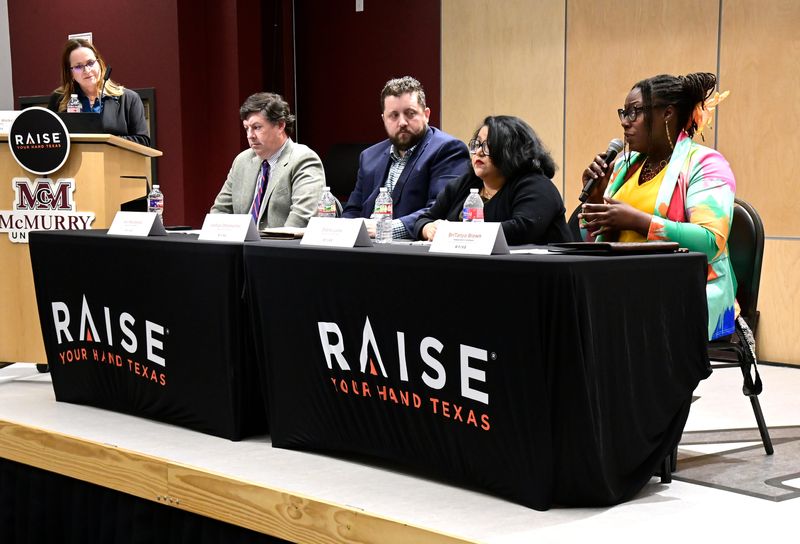
Correction: An earlier online version of this online story contained incorrect information about a group. Raise Your Hand Texas is an advocacy group funded and founded by Charles Butt and a group of community leaders.Education was the topic for state House District 71 representative candidates recently in Abilene.
The Public Education Candidate Forum was held Tuesday night at McMurry University and was sponsored by Raise Your Hand Texas, a nonpartisan public education advocacy group funded and founded by Charles Butt and a group of community leaders. Early voting in the Texas Primary begins Feb. 17 with Election Day March 3.

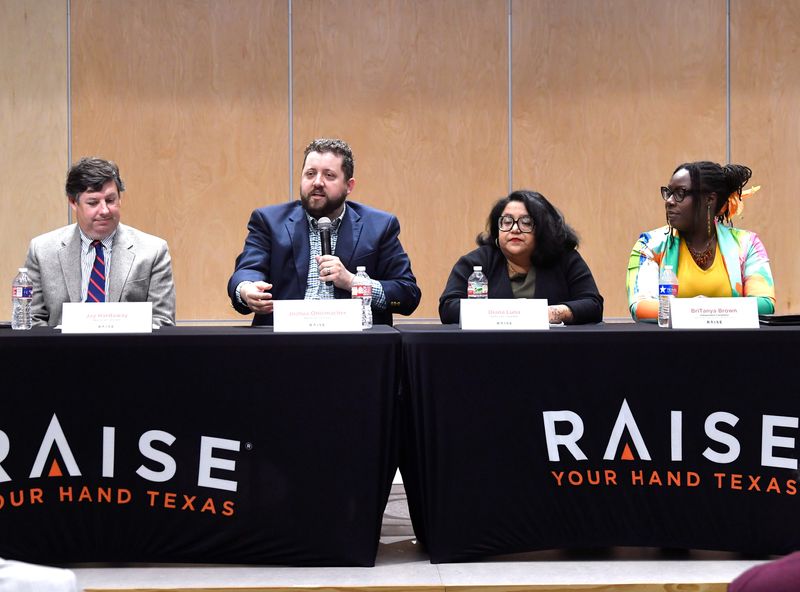
Of the six running for the seat of retiring state Rep. Stan Lambert, R-Abilene, four candidates were present Tuesday: Republicans Jay Hardaway and Joshua Ohlemacher, Democrat Diana Luna and independent BriTanya Brown. Republicans Liz Chase and Chance Ferguson were not in attendance for the first 45 minutes of the forum.
The legacy of Senate Bill 2
The first question posed by moderator Julie Welker is likely at the top of many parents and educators’ minds in Texas. The question was, for each candidate, what are the most important public education policy issues that will be addressed in the upcoming state legislative session and how would addressing them help House District 71 schools and students?
Ohlemacher started off with saying that even as “somebody who potentially receives money as a homeschool parent, I’m not a huge fan of what passed,” regarding SB2.
Gov. Greg Abbott pushed through the school choice bill in May 2025 after years of setbacks.
“By the time we get to this next legislative session, the beginning 2027, we’ll have the beginnings of data on how funding has gone,” he said. “I want to make sure that whoever ends up getting elected, that we’re keeping the feet to the fire of the folks in Austin, making sure that if that program is going to be there, it’s going to be good.
“If it’s not, then we need to get rid of it.”
Forgotten school workers
Luna countered that when something passes into law, it’s very hard to get rid of it.
“We know that this voucher bill is going to cost the state a lot of money,” she said. “As money is going out to private education and to homeschool, we need to do everything we can to make sure that the places that SB2 did not touch and are still underfunded (on our campuses), that we can shore those up.”
She added that as much as she appreciated teachers getting raises, it was campus staff who also needed to be remembered. Luna said it’s been difficult to hire secretaries, counselors and the like because the offered pay is too low.
“Our paraprofessionals did not get a raise,” she said. “Anybody that works in our schools knows that those people help that school run.”
Resource availablity
Brown called for more “wrap-around services” for families.
“We need that to be baked in, how families access the resources they need inside of school as well as outside, and how those systems talk to each other,” she said. “There are a lot of gaps being created by policies such as school vouchers, where parents are pulling their children out of school, and they don’t have those resources.”
She pointed to early learning services as an example.
“I’m a child care advocate, and I know that the foundation that early educators set in the child care setting can really help our K through 12 colleagues to understand what those diverse learning needs will look like in the classroom,” she said. “We need to understand that these policies need to reflect how public education actually works.”
Innovation is key
Jay Hardaway ended the discussion on the question by saying he agreed with much of what was already mentioned.
“Having funding based on attendance is strange to me. I would much rather see something that looks more like funding based on enrollment,” he said, adding kids have to miss school for myriad reasons that anyone there would find understandable.
“There’s this kind of catch-all policy for everything,” he said. “We’re innovative in every way. Why we wouldn’t be innovative at the local school level makes no sense to me.”
He pointed to the state’s emphasis on trade schools as an example.
“I feel like we did a moon shot in this state on technical education,” he said. “We’ve totally changed the way people talk about it now. I don’t understand why we wouldn’t apply that same innovation and dynamism to teacher recruitment and retention.”
This article originally appeared on Abilene Reporter-News: Texas House District 71 candidates discuss education, school choice
Reporting by Ronald W. Erdrich, Abilene Reporter-News / Abilene Reporter-News
USA TODAY Network via Reuters Connect