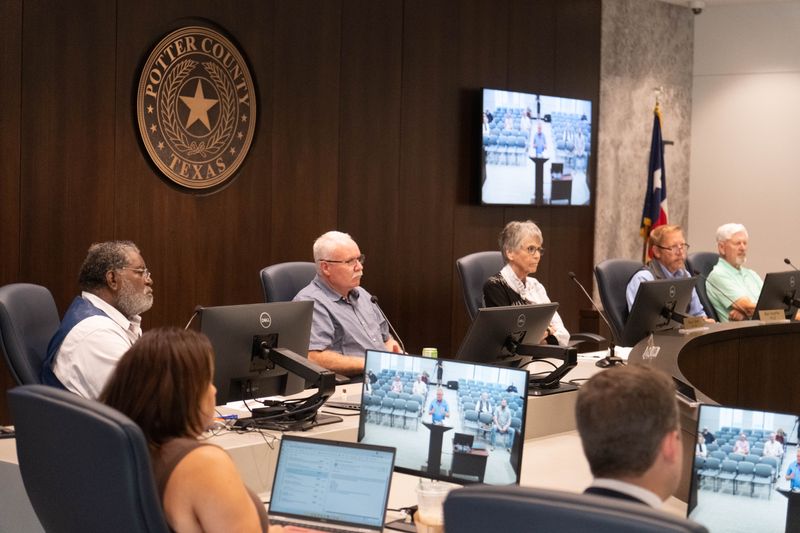
Potter County leaders are confronting a costly and long-deferred decision: whether to continue patching up a crumbling, overcrowded jail or invest in a new facility that could serve the county for decades.
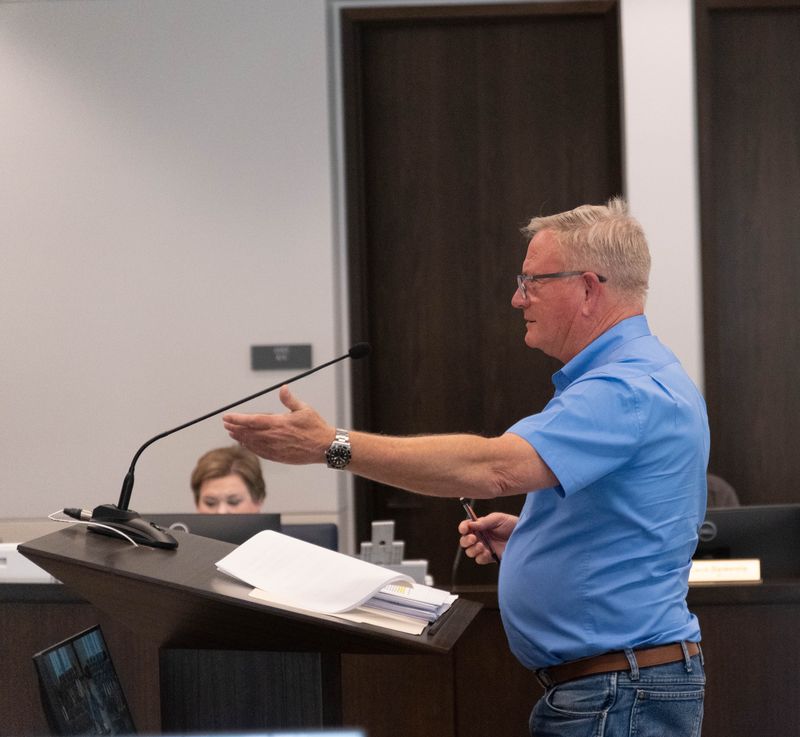
That discussion advanced Wednesday, Aug. 6, during a public workshop where commissioners heard a detailed presentation from the county’s jail consultant, Kenny Burns, CEO of Burns Architecture LLC. The firm was hired in June to assess the current jail and develop long-term recommendations.

In the days leading up to the workshop, commissioners and staff toured the Potter County Detention Center, as well as Deaf Smith County’s newer jail, to evaluate conditions firsthand. The contrast was stark, said County Judge Nancy Tanner.
“We went to Deaf Smith County first and saw what a wonderful facility they have,” Tanner said. “Then we went to our facility — and it’s not so wonderful. I’ve been out there many times, but this time I really noticed how bad it is. It needs help.”
‘End of life’ facility
Commissioners and staff walked through the jail’s mezzanine level, where infrastructure like HVAC systems, cabling, and piping are housed — much of it nearly inaccessible and dangerously outdated.
“When we walked into what we call the mezzanine, I thought I might pass out,” Tanner said. “Wires were running everywhere. One air handler was too large to even fit into the space it was supposed to go.”
Commissioner John Coffee, who has long pushed for a comprehensive assessment, said the visit left little doubt.
“There wasn’t one positive thing I heard on the tour,” Coffee said. “The building is at end of life. I do not believe it’s something we ought to be further considering.”
Sheriff Brian Thomas, whose staff of 90 operates the jail daily, said the tour helped bring officials onto the same page.
“My staff and I — we live it every day,” Thomas said. “They make it work, but we’re well beyond where we should be. I don’t think we can add on to this jail anymore.”
Thomas also added, “This isn’t just something I oversee from a distance — I work out there. I see it firsthand. I see the maintenance problems, the overcrowding, the stress it puts on our people. And I wouldn’t ask anyone to do something I’m not doing myself.”
Overcrowding, housing costs, and inmate transfer delays
Potter County’s jail has routinely operated over capacity and recently failed a state jail inspection due solely to overcrowding. On any given day, the jail may exceed its rated capacity by one to 36 inmates, triggering mandatory requirements to house inmates elsewhere.
“We’re spending nearly a million dollars just to house inmates in other counties,” Thomas said. “That doesn’t include transportation, staffing, or fuel.”
Currently, inmates are being housed in six other counties across the region.
Thomas said the jail population follows a predictable rhythm: “It starts going up Thursday, peaks through Sunday, and drops again when court resumes on Monday.”
He also outlined growing challenges in transferring inmates to the Texas Department of Criminal Justice (TDCJ). As of this week, 93 male and 29 female inmates were sentenced and awaiting transfer, with another 64 males and 21 females “paper ready.”
“TDCJ picks up weekly, but it depends on how many seats are available on the bus,” Thomas said. “Some weeks we send 10 or 12, sometimes just three. There’s no consistency.”
All 254 Texas counties are facing similar delays. Thomas said the issue has been worsened by the closure of the William P. “Bill” Clements Unit, commonly referred to locally as the Neal Unit — a state prison facility in northeast Amarillo that once routinely accepted county inmates.
“The Neal Unit isn’t taking inmates anymore because it’s closed,” Thomas said. “That’s put even more strain on the system.”
Consultant outlines cost of waiting
During Wednesday’s presentation, Burns laid out three possible paths: renovate and expand the current jail, build a new one, or do nothing — each with significant long-term cost implications.
He warned that delays would only drive prices higher. A new 776-bed facility, modeled after one under construction in Midland County, would cost about $220 million if built soon. Waiting 10 years could push that cost to $400 million, and in 25 years it could rise to $1.3 billion due to inflation.
“That’s not speculation,” Burns said. “We’ve seen construction costs rise 8% annually — and during COVID, prices spiked 35% in just one year.”
He cited a jail built in Walker County in 2012 for $17 million. Today, that same facility would cost more than $64 million to replicate.
Coffee said the message was clear.
“I wanted to consider everything,” he said. “But after seeing the facility firsthand, I don’t believe rehabilitation is a good idea. I just don’t know yet how we’re going to pay for a new jail.”
Bonds, COs, and public accountability
County officials are now exploring two financing options: a bond election, which requires voter approval, or certificates of obligation (COs), which do not.
Judge Tanner said both options would result in the same tax impact, but only a bond gives voters the final say.
“With a bond election, voters have to approve it — and there’s always a chance it won’t pass,” she said. “And if a bond fails, you can’t just pivot to COs. You’re done.”
While COs are sometimes criticized, Thomas said a functioning jail is a core responsibility of county government.
“Taxpayers don’t like it, but we have to have a jail,” he said. “I’m a taxpayer too — and I’ll pay that tax to keep Potter County safe and my employees safe.”
Next steps: Data, funding, and long-term planning
Coffee said he hopes the county will identify a path forward within six to eight months, ideally in time for public input or a ballot measure.
Fortunately, the county already owns more than 168 acres at the Law Enforcement Center, where the jail was originally built with expansion in mind.
Burns said a new facility could take up to four years to design, fund, and complete. Even expanding the existing jail — if feasible — would take more than two years.
Judge Tanner said the court is now waiting on an updated needs analysis from Burns, along with feedback from the Texas Commission on Jail Standards.
“We appreciate the public’s attention to this,” she said. “A safe, secure, and functioning jail is essential. Now we just need to find the path forward.”
Thomas agreed.
“This isn’t going to happen overnight,” he said. “But we’re moving in the right direction. The commission is engaged. And my employees, under incredibly difficult circumstances, are doing an outstanding job.”
This article originally appeared on Amarillo Globe-News: Potter County weighs future of overcrowded, aging jail
Reporting by Michael Cuviello, Amarillo Globe-News / Amarillo Globe-News
USA TODAY Network via Reuters Connect