With a high around 93 degrees and sunny skies on June 18, Odie pulled Matilda Perez left and right, trying to get his “zoomies” out.
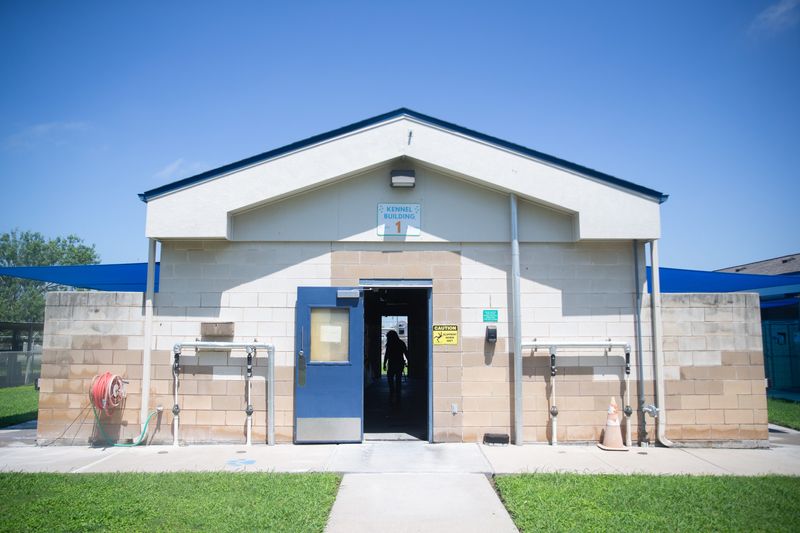
The Australian cattle dog mix normally spends his days inside his kennel like other animals at the Corpus Christi Animal Care Services department on Holly Road. Perez, the agency’s community relations specialist, said the dogs need to have some time outdoors running around to have fun.

“Odie’s a good boy,” Perez said while feeding the 1-year-old a treat. “He just needs an owner to give him a good home and life.”
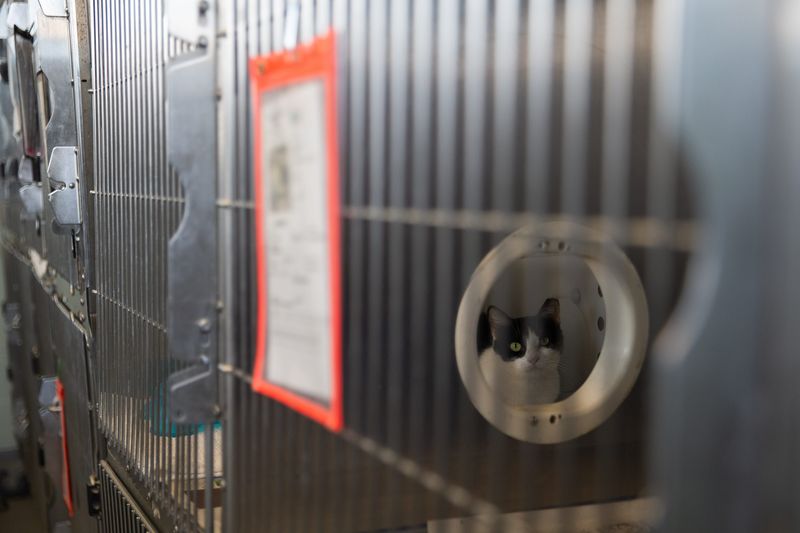
As of July 14, Odie was one of 149 animals at Animal Care Services up for adoption. The shelter houses 118 dog kennels and 39 cat kennels.
The department averages an intake of about 290 animals a month, with about 295 animals leaving the shelter due to adoption, euthanasia, returning to its owner or transferring to another pet rescue agency.
The monthly number of animals taken into the department peaked in May this year. The department began tracking monthly statistics in January 2025.
The city of Corpus Christi announced in early June that Animal Care Services was facing a “critical space shortage” and called on people to foster animals to alleviate overpopulation at the department.
Director Kathleen Chapa said overpopulation will always be an issue, but what help she needs to help combat that is volunteers.
“We need people to come in and help make treats and take dogs out of the kennels to play with,” Chapa said as 1-year-old Thumper, a rabbit, hops around her office. “They need interaction just like we do. If we can get people to come in and help get animals socialized, they will be better for adoption.”
Becoming a department
Animal Care Services was initially not designed as a comprehensive shelter operation.
The department originated as a division years ago within the public health district, where it operated primarily as a short-term holding facility for animal control. The shelter at 2626 Holly Road was built in 2004.
In 2012, it was transferred to the police department to integrate animal control efforts within broader law enforcement services. In 2021, Animal Care Services moved to the Neighborhood Services Department, a now defunct agency.
It wasn’t until June 2024 when the division became a stand-alone department.
Intakes and outcomes
Statistics on the Animal Care Services website, dating to January 2025, show the number of animals the agency takes in, the number of animals no longer in the department’s care, reasonings for euthanasia, the average length of stay, foster home reports, microchip reports, field calls and citations written.
“Intakes” are animals born at Animal Care Services, animals confiscated, victims of cruel abuse, owner surrenders, animals returned and strays. “Outcomes” are animals that were adopted; died at Animal Care Services; were euthanized; were returned to owners; were trapped, neutered and released; or were transferred to other rescue shelters.
Chapa said the department works with more than 100 rescue partners, including the Gulf Coast Pet Humane Society and The Cattery.
As soon as an animal comes into Animal Care Services, its Live Release Team tried to figure out the best way to get it out of the facility. Chapa said that could be through a foster, adoption or a rescue partner.
The highest number of intake animals was 393 in May 2026, and the lowest was 221 in November 2025. The highest number of outcomes was 390 in May 2026, and the lowest was 239 in November 2025.
In 2025, 707 animals were euthanized. From January to June 2026, 349 animals were euthanized.
The reasonings for euthanasia include behavioral issues, medical issues, court orders, positive rabies tests, serious bodily injuries, canine distemper and public safety.
Chapa said behavioral euthanasia is considered only in cases where an animal exhibits severe, unpredictable or unmanageable aggression toward people or other animals.
When it comes to euthanasia for medical reasons, a licensed veterinarian makes the call. Chapa said euthanasia is reserved for animals experiencing severe trauma, advanced terminal illness or chronic, painful conditions that cannot be treated within the department’s medical capacity or resources.
As of June 30, the department had not euthanized animals to manage overcrowding since July 2025, Assistant Director of Operations Cynthia Martinez told the Corpus Christi City Council during a presentation. She said 20 animals were euthanized for capacity in 2025.
In 2025, an evaluation of Animal Care Services by consulting firm Citygate Associates yielded 170 recommendations for improvement across a range of areas, including operations, staffing and facilities.
On June 30, Chapa told the City Council that the department had completed more than half of the recommendations in fiscal year 2025 and that it aims to complete another 50 in fiscal year 2026, which ends Sept. 30. Recommendations to be implemented in the current fiscal year encompass admission practices, data collection, response times, developing specific volunteer roles and training volunteers.
The department plans to complete the remaining recommendations by the end of fiscal year 2029.
Adopting and fostering
Since being with Animal Care Services, Chapa said the department has begun working with school districts, attending career fairs, being visible at Earth Day-Bay Day, going to ArtWalk and hosting several community events.
The department will have a Clear the Shelter event where people are able to adopt animals at no cost through July 26. The normal price for adoption is $25.
“We don’t let you come in, point at an animal and leave, though,” Chapa said. “We want you to come in, find an animal, play with them, get to know them and let them get to know you.”
Chapa said people should adopt from Animal Care Services instead of purchasing animals online or in parking lots, as the animals at the department have been vetted through their clinic, have received their first round of vaccinations and their first dose of flea and tick medication, and are microchipped and fixed.
“You know their behavior is good and we will tell you if it gets along with other animals,” Chapa said. “Our animals have been cared for here and looked after. Adopting helps us empty a kennel and address other animals in need.”
Those who want to foster can fill out an application to help free up space while temporarily taking care of animals.
Fosters are volunteer-based, and Animal Care Services provides everything for the animal, Chapa said. The length of foster depends on how long it takes for the puppy or kitten to be old enough to return.
Chapa said the smaller they are, the more likely they are to catch an illness at the department because it is a communal area.
‘They need socialization’
As Thumper the rabbit lay at Chapa’s feet under her desk in her office, she talked about how many volunteers she wished she could have at the department.
“I would love to see 100 people sign up to be volunteers with us and be active,” Chapa said. “When I say active, I mean come once or twice a week. That would help us tremendously.”
Volunteers can help give baths, clean up kennels, play with the animals, prepare treats, make toys, wash their dishes or clean their laundry. The department handles feeding and behavioral training, Chapa said.
After filling out an application and going through volunteer training, volunteers can stay for 30 minutes or the entire day if they’re able to.
“We have everything [the animals] need — food and shelter — but we don’t have the time and staff to fully socialize with them,” Chapa said. “We need people who love and care for animals to come in and show them we love and care for them. They need socialization just like we do.”
John Oliva covers entertainment and community news in South Texas. Have a story idea? Contact him at john.oliva@caller.com.
Consider supporting local journalism with a subscription to the Caller-Times.
This article originally appeared on Corpus Christi Caller Times: How to help Corpus Christi animal shelter as it’s close to capacity
Reporting by John Oliva, Corpus Christi Caller Times / Corpus Christi Caller Times
USA TODAY Network via Reuters Connect


By John Oliva, Corpus Christi Caller Times | USA TODAY Network