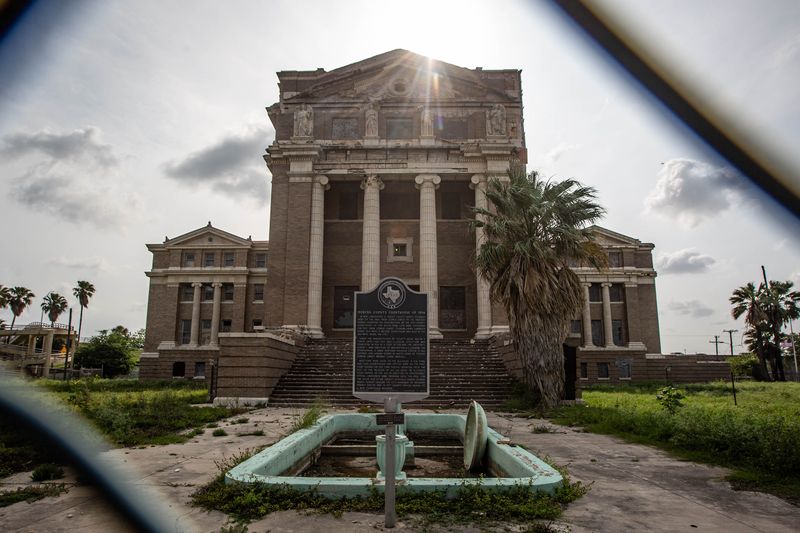
Demolition of the 1914 Nueces County Courthouse could begin this year.
Officials took another small step in the long road to demolition this month. Negotiations between Nueces County, the city of Corpus Christi and the Corpus Christi Tax Increment Reinvestment Zone No. 3 have culminated in a development agreement to provide $2 million of funding for the project.

According to the agreement, the county will begin tearing down the courthouse no later than next May, though the agreement does allow the county to request an extension of the deadline. Nueces County must complete demolition by Dec. 31, 2028. If the project isn’t finished by then, the county will have to repay funds.
However, Nueces County Commissioner Mike Pusley said the county intends to bring the old courthouse down this year.
The courthouse, once grand and now decrepit, was for years one of the first sights visitors to Corpus Christi saw after crossing the old Harbor Bridge. Today, the courthouse is near frequently visited locations such as the Hilliard Center, Whataburger Field, the Port of Corpus Christi and the Art Museum of South Texas.
The courthouse has been vacant for decades, and county officials say redevelopment isn’t feasible.
Over the course of two years, the city will reimburse the county for demolition costs of up to $2 million on behalf of Corpus Christi Tax Increment Reinvestment Zone No. 3.
Actual demolition costs are expected to be higher. The county will draw from its budget for the rest of the cost.
The TIRZ funding deal has been discussed for many months.
In December, Nueces County Judge Connie Scott stated in a letter to city leadership that the county would potentially consider leaving the tax increment reinvestment zone after lack of action on the demolition funding request.
The tax increment reinvestment zone was created by the city in 2008 to promote economic development in the downtown Corpus Christi area. The TIRZ board includes representatives from Nueces County and Del Mar College.
Tax increment financing is money that is collected through increased property taxes in a specific area. Participating government entities contribute property tax revenue that would otherwise be used for their own purposes. This money is then reinvested in the area it was collected.
The city officially adopted an amendment to the TIRZ’s project and financing plan to create a program specific to the demolition of the courthouse on May 5.
The county commissioners approved the agreement on May 13.
The decision was not unanimous. Commissioner Joe A. Gonzalez expressed disappointment with restrictions in the contract, noting that the county contributes tax revenues to the TIRZ.
“There’s too many things there that they’re asking us to do and if we don’t do it, they get the money back,” Gonzalez said. “But they forget how they got the money to begin with.”
Gonzalez voted against approving the agreement.
Scott said parts of the agreement cause her “heartburn and concern,” though she supported the agreement.
“I hope that we’re going to treat each other like partners throughout this agreement,” Scott said.
According to the agreement, the first $1 million will be paid before Sept. 30. The second payment will be made before Dec. 31.
The county is required to present a report to the TIRZ board. The county would be in default of the agreement if it is unable to comply with all requirements, if any incorrect or misleading information was submitted, if the county makes an assignment for the benefit of creditors or if the county becomes bankrupt.
The county has already completed an asbestos study of the building and is working with engineers on the project. In the coming weeks, the county intends to secure city building permits.
How did the old courthouse decline?
The courthouse was designed in the neoclassical style, with statues perched above the entrance. It also included gallows and a trap door to carry out hangings, but those were reportedly never used.
“Modern architecture is seen to abound in the new courthouse; the massive structure is a credit to the hand of man; one is dazzled as he looks at the tall columns over the doorway,” a Caller article noted around the time of the building’s completion.
During the 1919 hurricane, the courthouse was a refuge for more than 2,500 people. But in the decades afterward, the story of the courthouse was one of decline.
Voters in 1957 opposed a remodel.
By the 1970s, the facade had already begun falling off the building in chunks. In the previous decade, several children fell through false ceilings covering balconies.
In 1972, voters supported building a new courthouse, but after the old courthouse was emptied, the county abandoned it. The building wasn’t maintained.
Historical recognition prevented destruction of the building but didn’t ensure maintenance or restoration.
The Texas Historical Commission placed a deed covenant in 1978, preventing demolition of the Recorded Texas Historic Landmark until 2018. Restrictions were added in 2002 when the county accepted a courthouse restoration grant, extending the deadline for demolition to 2027.
Over the decades, many developers saw potential in the building, but all found the cost of working on the building too high. In 2018, a four-star hotel plan was pitched to the county commissioners, but like every other plan, it never came to fruition.
The deterioration continued.
Any hope of county leaders for redevelopment is long exhausted.
In 2025, Pusley said he understood consternation about tearing down a “magnificent” building, but that it couldn’t be allowed to crumble to dust on its own. Commissioner Brent Chesney said then that he had “absolutely zero” interest left in soliciting or accepting offers for revitalization after significant, failed efforts over the years. Scott said the time had come to begin the process of razing the old courthouse, though it was “unfortunate.”
That year, the county requested and received agreement from the Texas Historical Commission to terminate an easement preventing demolition until 2027.
The county intends to remove some artifacts from the courthouse before demolition to preserve them for museum display. Additionally, the county is putting together a historical book about the courthouse.
Olivia Garrett covers education and community news in South Texas. Have a story idea? Contact her at olivia.garrett@caller.com.
Consider supporting local journalism with a subscription to the Caller-Times.
This article originally appeared on Corpus Christi Caller Times: Here’s when demolition of 1914 Nueces County Courthouse may begin
Reporting by Olivia Garrett, Corpus Christi Caller Times / Corpus Christi Caller Times
USA TODAY Network via Reuters Connect