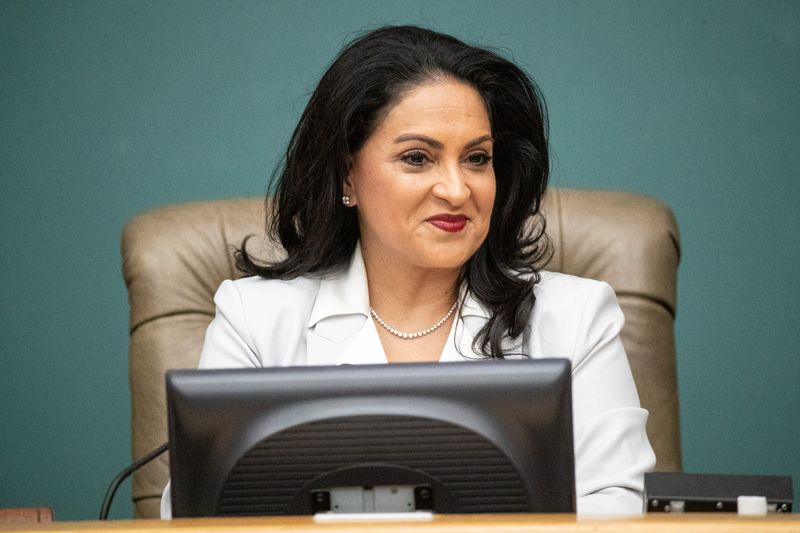
Whether Corpus Christi City Council members will be disqualified from participating in the upcoming removal proceedings of Mayor Paulette Guajardo may be decided in the next two weeks.
Guajardo’s attorney, John Flood, had raised the issue in a motion last week, arguing in documents that four council members who had participated in a 2024 vote on tax incentives should either recuse themselves or be disqualified.

The vote on tax incentives is a key piece to the allegations that were brought against Guajardo in a citizen-submitted removal petition.
The City Council, in a pretrial hearing May 19, did not discuss the motion — or any other matter in the proceedings — in detail after a more than hourlong executive session.
Attorney and former county court at law judge Terry Shamsie was announced as legal adviser to the council shortly before the closed-door meeting.
May 27 and June 2 are the dates approved by the council for further consideration of motions, including the motion on council members’ potential disqualification.
It’s expected that, before the June 2 meeting, Guajardo’s attorneys and the petitioners’ attorneys will submit lists of witnesses to be called, including the scope of expected testimony and anticipated length of testimony.
The June 2 hearing, scheduled for 9 a.m., will precede a previously scheduled special council meeting in which the marquee topic will be a vote on a contract that would advance work on the Inner Harbor desalination plant.
Council members who voted on the dates did not include Everett Roy, who abstained, or Guajardo.
While the council did not publicly discuss an ongoing federal case, there is a ruling pending from U.S. District Judge George C. Hanks Jr. on a request from Guajardo for a temporary injunction that could pause removal proceedings.
The timeline a ruling may be issued is unclear.
Hanks told attorneys in a May 18 preliminary injunction hearing that he was in the midst of a criminal case but would issue a ruling as soon as possible.
The petition
Guajardo faces removal proceedings following the submission of a citizen petition, as allowed in a process that is permitted through the City Charter.
The petition accuses Guajardo of misconduct or malfeasance as part of a controversy over the award of $2 million in tax incentives to downtown hotel developers in 2024.
Petitioners assert in the document that Guajardo had been aware of allegations against developers — specifically, an accusation that a screenshot in a presentation had been altered in a way to mislead decision-makers — but put an item on the agenda to approve the funding and voted for it.
Articles of impeachment expanded on those allegations, accusing the mayor of perjuring herself during a deposition taken in a lawsuit related to the tax incentives.
Both the developers who had requested the incentives and Guajardo have denied wrongdoing.
An investigation by law enforcement, and an administrative review by an outside attorney, did not find criminal wrongdoing.
Critics have said the inquiry in the removal proceedings is meant to address ethical questions that were not part of the earlier investigations.
The mayor has asserted that the removal effort stems from dispute over the proposed Inner Harbor desalination plant; several council members who supported moving forward with a removal hearing have denied that statement.
The court
A removal hearing as outlined in the City Charter is handled similarly to a civil court case. However, one significant difference is that council members act as both the judge and jury of the member who is the subject of the removal hearing.
Among motions filed last week for the City Council’s pretrial hearing was the one submitted by Flood contending that four council members — Roy, Gil Hernandez, Sylvia Campos and Roland Barrera — should either recuse themselves or be disqualified from the proceedings.
Each was on the City Council when the tax incentives were considered in 2024.
It’s raised questions of impartiality, Flood has asserted, as well as questions of how council members could be called as witnesses while also serving on a tribunal.
Although the motion was filed in the City Council’s pretrial hearing, it is similar to arguments Flood has made to Hanks when requesting the preliminary injunction.
The federal case, filed by Guajardo in April, names as defendants the city of Corpus Christi and, later, five individual council members: Hernandez, Campos, Carolyn Vaughn, Kaylynn Paxson and Eric Cantu.
Each had voted in favor of advancing the removal proceedings.
Guajardo’s complaint asserts, in part, that the proceedings pose due process issues — concerns that attorney Hal George, representing the city, has described in court records as speculative and premature, since the proceedings haven’t yet happened.
Guajardo’s attorneys in a filing on the temporary injunction contended that it was problematic that council members who would be on the tribunal could also be witnesses, and that the council members’ testimony was necessary to determine whether Guajardo had knowingly misled them.
City attorneys and an attorney representing the named council members have pushed back on that assertion, citing the Rule of Necessity — a rule that in this context would mean that the council is the only body that can oversee the hearing and would not be barred from participating.
Council members have immunity “from testifying at all,” contended George in response to the filing by Guajardo’s attorneys, adding later that Guajardo “should not be allowed to game the system by calling City Council Members as witnesses and thereby claim the process is spoiled.”
Stephen McMains, the attorney representing the five council members, wrote in federal court records that there wouldn’t be an “underlying reason” for the council members to be called as witnesses, other than that they had participated in the votes on the tax incentives.
“This would lead the impeachment section of the Charter essentially toothless,” he asserted in filings. “Any time a council member wanted to perpetuate a fraud, all they would have to do is say they would call the other members who went along with their fraud as witnesses and nullify the tribunal.”
Guajardo’s attorneys have argued the rule does not apply to witnesses.
There is also disagreement whether the removal process applies to the mayor, attorneys citing verbiage in different portions of the City Charter to back their contention.
Kirsten Crow covers city government and water news. Have a story idea? Contact her at kirsten.crow@caller.com.
Consider supporting local journalism with a subscription to the Caller-Times.
This article originally appeared on Corpus Christi Caller Times: Here’s what happened in Mayor Paulette Guajardo’s pretrial hearing
Reporting by Kirsten Crow, Corpus Christi Caller Times / Corpus Christi Caller Times
USA TODAY Network via Reuters Connect