As the specter of a water emergency continues to loom over the region, Corpus Christi has become largely reliant on a project from roughly 30 years ago that faced nearly as much contention as other water supply projects do now — a pipeline that traces a path of about 100 miles from Edna to the city limits.
The Mary Rhodes Pipeline, delivering a combination of water owned by right and water owed by contract, has become the bulk of Corpus Christi’s supply as the levels of Lake Corpus Christi and Choke Canyon continue descent below their lowest volumes in history.

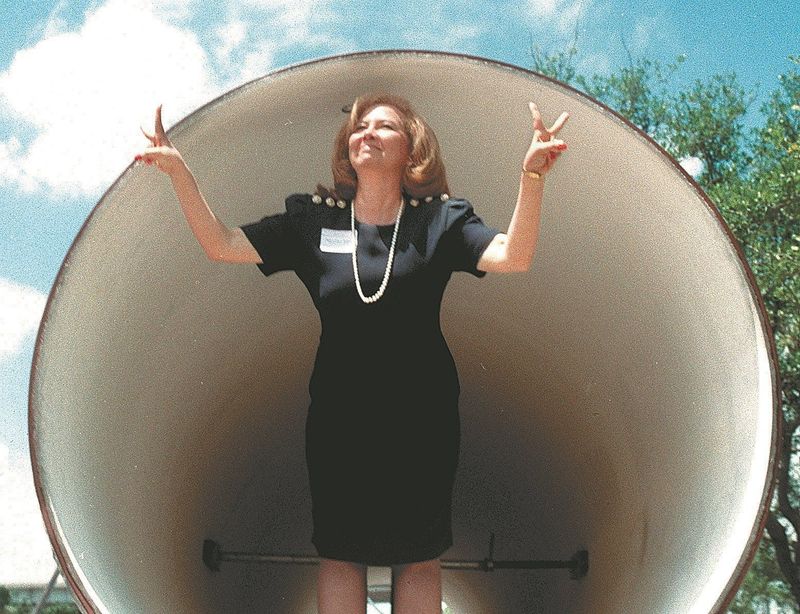
Birthed from the trials of a severe drought in the 1980s, and the onset of a new drought in the 1990s, the project was spearheaded through regional cooperation and by its namesake, the late Corpus Christi Mayor Mary Rhodes, whose iconic image is captured in an April 1997 photo.
In it, she is shown standing in a 35-foot section of a 64-inch-diameter pipe, her expression triumphant and her fingers shaped into “V’s” for victory.
Rhodes told reporters the same day that she had never seen “any project that was needed more and has taken more abuse.”
“I really had moments when I didn’t think this thing was going to happen,” Rhodes is quoted in the April 12, 1997, edition of the Caller-Times.
The pipeline, named after Rhodes posthumously, has since become the vehicle for water purchased out of Lake Texana under a contract with the Lavaca-Navidad River Authority — as much as about 43,000 acre feet per year — and, in the pipeline’s second phase, as much as 35,000 acre feet of Colorado River water, owned under water rights.
What had been a mammoth undertaking three decades ago is what the city and region are relying on today as the City Council races to put into place a series of new water supply projects.
In an April 28 email to the Caller-Times, city officials wrote that the pipeline is currently furnishing 70% of Corpus Christi’s water supply.
“As the levels of Lake Corpus Christi and Choke Canyon decline due to drought conditions, the Mary Rhodes Pipeline is a critical component of Corpus Christi’s water supply,” the message states.
John Michael, now senior vice president of engineering firm Hanson Professional Services Inc., worked on the pipeline in the 1990s and relayed a stronger position.
“It’s saving our ass, 30 years later,” he said. “If that pipeline had not been built, we would be out of water.”
The pipeline
Those living in Corpus Christi in the 1980s can recall well the drought that bore down on the region then — severe enough that it compelled water rationing, a step that the city would take again, should Corpus Christi enter into a water emergency.
A water emergency is triggered when the city is within six months of water supply falling short of meeting the demand. Projections show that reality may come to pass starting in September.
Like now, water was a centerpiece concern in the community and City Council, each seeking strategies to build resources that would make the city less vulnerable to the whims of the weather.
It generates great anxiety, Michael said, pinning it on the uncertainty of when a drought may descend and when it will lift.
“When a drought starts, you base your drought of record on the last drought of record,” said Michael, who had been a project engineer with Naismith Engineering Inc. at the time of the pipeline’s construction. “Well, you don’t know if you’re in the new drought of record, which is what we’re in the middle of right now.”
Infrastructure wasn’t the sole element of the project; the water to be delivered would be drawn from what was then an unusual source.
An interbasin transfer — in this case, meaning the transport of water from the Lavaca River Basin to the Nueces River Basin — was somewhat novel at the time, project officials said, and the practice has since become highly regulated.
James Dodson, who had served as the city’s regional water director during the project, noted that there “aren’t too many places that get their water 200 miles away.”
It was a complicated endeavor to navigate the complex legal matters associated with brokering a contract for water from Lake Texana, and purchasing rights from the Colorado River, against a backdrop of tumult between the council and some of the community’s organizations that staunchly fought against the financing — including lawsuits.
At that time, like now, how the water would be shared between traditional municipal needs and large-scale industrial operations — including limits on consumption — had arisen in community discussions.
Referencing recent debates over the city’s new proposed water supply projects, Dodson pointed to an often-cited phrase.
“There’s an old adage,” he said. “Whiskey is for drinking; water is for fighting.”
The controversy
Somewhere around 20 to 30 projects had been evaluated as part of a statewide regional planning effort around 1995, Michael said — included among them what would later become the Mary Rhodes Pipeline.
A community-based taskforce composed of representatives from a motley array of organizations had assessed the options, he said, eventually backing the pipeline as the best, most cost-effective long-term project.
There remained, however, controversy.
Caller-Times archives illustrate some similarities to current discussions — for example, one May 29, 1991, article described “the city grappling with the limits of the Nueces River basin and the often competing interests of industrial users, environmental groups, and urban and rural dwellers.”
The most consistent objections over the years were voiced by some of the members of the Corpus Christi Taxpayers Association, archives show.
City officials, seeking to finance the purchase of the water, at one time brought to voters a proposal that would have funded it through revenue generated from a new, quarter-cent sales tax — a request that soundly failed, 61% to 39%, according to earlier Caller-Times reporting.
Supporters of the pipeline and water purchases said the project was needed to prop up the economy and asserted opponents were anti-growth and short-sighted.
Opponents cast doubt on city officials’ projections of population growth and water availability, criticized raising taxes and disputed the financing mechanisms the city was employing to develop the project.
Lawsuits were filed by opponents over the contract with the Lavaca-Navidad River Authority for Lake Texana water, as well as the bond sale to construct the pipeline. Both were unsuccessful.
An April 12, 1997, Caller-Times article cites Rhodes as describing “heavy criticism directed at council members and actions such as death threats, eggs thrown at her house and car windows smashed — which she thinks are the result of her support of the pipeline.”
She had, in articles in earlier years, asserted that what was being discussed wasn’t “just talking about water that you drink.”
“Water translates directly into jobs,” she is quoted in a Feb. 16, 1994, Caller-Times article. “Our city will literally dry up, economically speaking, if we don’t move now on a new water supply.”
While the Mary Rhodes Pipeline was controversial, Michael said he didn’t recall it being as controversial as contemporary disputes over desalination.
He added that he believes there is “more community discontent than we had during the ’90s, when we made the decision to build Mary Rhodes, and it was pretty tough even back then.”
Michael believes that even Rhodes had been “taken aback by the vitriol that happened through that process.”
“It went to a vote, and it failed,” he said. “I think she was able to see through that and understand that we had to find a future water supply if the city was going to continue to see growth in the future, and she led that charge. But I think also that community involvement helped get to that decision point.”
Also integral to the process: the weight of the Port of Corpus Christi Authority.
The port
The agency became involved with the project, in part, because of the opposition it had generated, said Frank Brogan, who was then the port’s director of engineering services.
At the time, he said, “port industries was very concerned about the amount of water that the city and the region had on hand.”
“Industry had made it clear that they were not going to be able to justify any more investment in their expansions to their home offices without the community having assured water supply,” said Brogan, now retired.
He led project management on the first phase of the pipeline from its start to its conclusion — a process of about two years — including negotiation of the water rights and water contracts, Brogan said.
Materials were preordered, and three sections of the pipeline were under construction simultaneously, officials said.
The pipeline’s course ran beneath five counties, 200 landowners’ properties and at least seven rivers, according to Caller-Times archives.
It was finished in 1998, according to Caller-Times reporting.
Under a typical construction timeline, it likely would have taken around five years for the pipeline to be completed, Dodson said.
It was accomplished in about two, according to Brogan.
Rhodes, who died of breast cancer in 1997, did not see its completion but was later honored in the formal naming of the pipeline.
The City Council
Caller-Times archives show the long road city officials took to come up with solution for funding, including construction.
The city eventually landed on a partnership with the Nueces River Authority to sell the bonds needed to support the capital expenses of the project, while the city paid the bond service, Dodson said.
Caller-Times archives vary on the estimated cost of the pipeline, but at its lowest floor, it’s shown as $120 million.
Melody Cooper, who served on the Corpus Christi City Council between 1993 and 2009, with the exception of two years, can recall what she described as long, intense meetings but under a more unified council.
That’s not what she sees today, Cooper said, describing chaos, “constant bickering and changing from plan to plan.”
The “council in the ’90s had the backbone to say, ‘Look, this is what we gotta do,’ and we were able to very quickly come up with the plans and implement the plans to build a pipeline,” she said.
“We fixed it then — unfortunately, it’s not enough, and we’ve got to do more,” Cooper said. “But … what if the pipeline hadn’t been built? I mean, can you imagine the situation we would have been in?”
The future
Phase II of the pipeline, a roughly 40-mile section starting near Bay City, ultimately connects water from the Colorado River to Lake Texana, according to earlier Caller-Times reports.
It was completed around 2016 and cost about $154 million, according to an Oct. 14, 2016, article.
The Mary Rhodes Pipeline in recent years has been expanded by about 30%, now bringing in 72 million gallons to 79 million gallons per day — one of the earliest ventures in response to the current drought that has taken station over the region.
It is currently delivering 72 MGD, according to the city’s April 28 email to the Caller-Times.
It’s expected, though, that it will be called upon again to shore up new water supply — in this case, potentially carrying as much as 24 million gallons per day of groundwater pumped from a proposed well field near Sinton.
In that proposal, too, there is pursuit of water that would be transported — not between basins, but between counties.
That project, along with others, such as groundwater pumping in Nueces County and Inner Harbor desalination, has proven controversial.
Water supply projects, Brogan said, are difficult and require “a long-term view of the future.”
“You can debate all day long, or months on end, or years on end … should you do project A, should you do project B,” he said. “I think you have to move forward on several fronts and not be afraid to make bold decisions. That’s what was done back in ’96, and I think that’s what needs to be done now.”
Kirsten Crow covers city government and water news. Have a story idea? Contact her at kirsten.crow@caller.com.
Consider supporting local journalism with a subscription to the Caller-Times.
This article originally appeared on Corpus Christi Caller Times: Here’s how the Mary Rhodes Pipeline rescued the Corpus Christi region
Reporting by Kirsten Crow, Corpus Christi Caller Times / Corpus Christi Caller Times
USA TODAY Network via Reuters Connect