Editor’s Note: Jack Becker is the editor of Caprock Chronicles and is a Librarian Emeritus, Texas Tech University Libraries. He can be reached at jack.becker@ttu.edu. He is the co-author of today’s article along with David Nelson, a frequent contributor to the Caprock Chronicles.
Most people in the United States have heard of the Depression of the 1930s and the Dust Bowl years of the same decade.

West Texans have the dubious honor of suffering through both disasters simultaneously. This not only made West Texans tough but optimistic, hardworking, and resourceful – as the following story of Emma Landrum Nelson will illustrate.
Emma was born on Sept. 18, 1912, in Fluvanna, Texas, which is southeast of Lubbock between Post and Snyder.
She grew up on a small farm literally on top of the Caprock.
She came of age during the hard years of the 1930s. She graduated from Fluvanna High School in 1930 and as a bright, hardworking student she was rewarded for her hard work and academic skills with a one-year scholarship to McMurry College in Abilene.
But as the Depression deepened, her scholarship funds dried up and so after only one year of college she had to put her dream of a college degree on hold and returned to her family farm to help support her parents and her three younger siblings.
Emma was of a romantic nature, sensitive, willing to help others, and a student of literature and poetry.
She at one time, early in life, wanted to be a writer and possibly a poet, but seemingly denied of a college education and career as a writer and poet, she found solace in writing her own poetry and dreaming of the day she could continue her education.
Here is a sampling of her poetry;
The lamp is lighted and the table set,
The meal is but a simple one, and yet
It is enjoyed.
A wife sings as she cooks the evening meal;
Her husband, coming homeward from a field,
Seen afar.
Obviously these are the musings of a romantic young women wondering about her uncertain future.
Fortunately for Emma, her one year of college work qualified her to become a teacher. When a teaching position in a one-room school house opened up in the nearby community of White Flat, she applied and got the job.
The job required her to make a 20-mile commute to and from work every day, riding one her father’s horses.
But all the time she taught school she kept her dream of a college education alive. And soon another opportunity presented itself.
The opportunity did not require a college degree, and probably would mean she would have to forego her dream of becoming a poet and a writer.
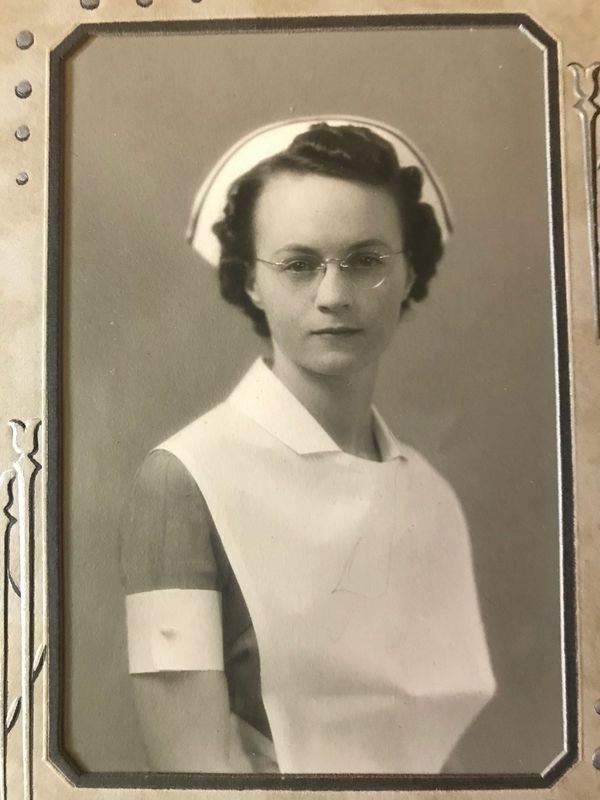
The opportunity was a chance of becoming a register nurse, one of the few careers available to women at the time.
Going to school to get a nursing degree was a fairly new idea in the 1930s. The profession of nursing began in the 1870s immediately after the Civil War.
World War I gave the nursing profession another boost when medical doctors (mostly men) needed professional medical help dealing with the with the flu epidemic of 1918.
By the early 1930’s, the nursing profession required college course work and applied training at a cooperating hospital.
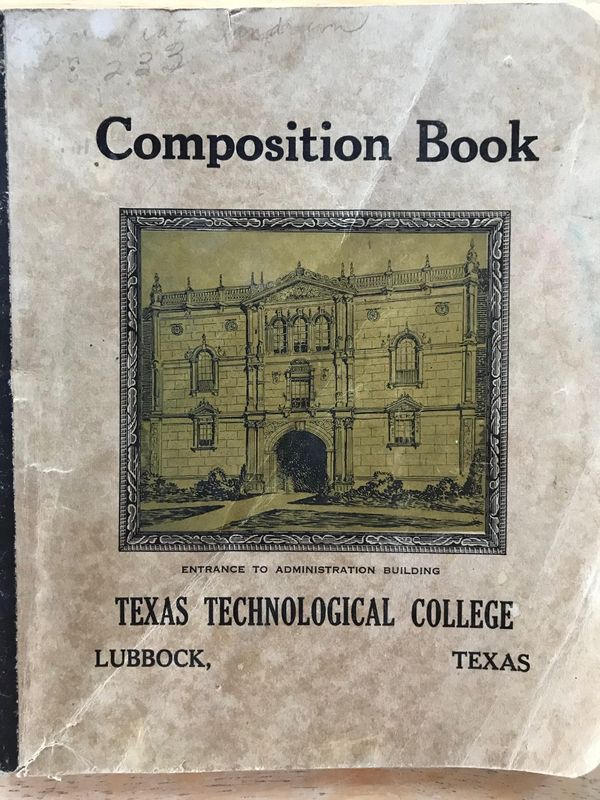
In 1932 and 1933, Emma spent her summers going to Texas Tech and staying in Lubbock with an aunt and uncle.
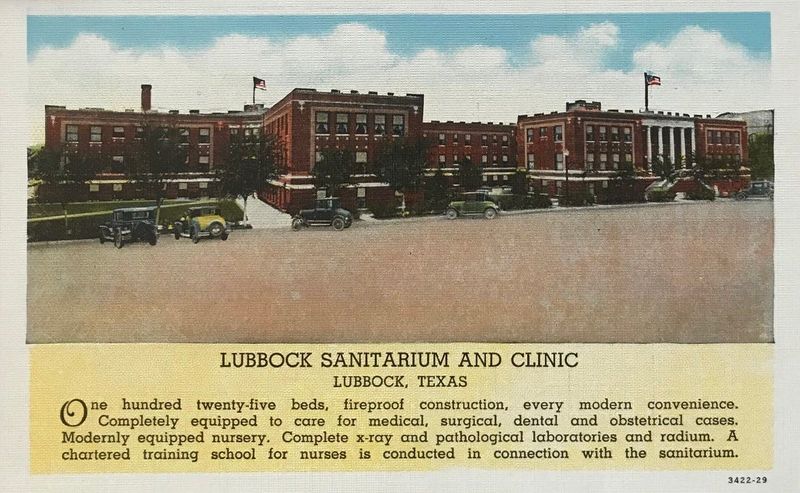
By 1935 she had accumulated enough hours to begin her hands-on training at Lubbock Sanitarium and Clinic.
By working and attending classes, she received free room, board and tuition.
She graduated from the Lubbock School of Nursing in December, 1938 as a Registered Nurse.
One of the signatures on her diploma is that of Dr. M.C. Overton.
Part of a paper she wrote, in 1936, still remains. It testifies to her pride at being a nurse.
“Among the difficulties of modern nurses[is] that of untrained or slightly trained women practicing as trained nurses,” she wrote. “A long and hard fight in England culminated in a national registration in 1919. The same was done in America… [and] has made nursing one of the most dignified and honorable professions of today.”
Emma began her nursing career soon after graduation. She did not remain a nurse for very long, for fate intervened in her life once again.
Early in her nursing career she meet her future husband, Edmond Leon Nelson, married him, and at the birth of her first baby in 1941, retired from nursing.
Another baby followed in 1944. She soon found herself a busy mother of two boys.
If she ever regretted the way her life turned out she never complained and lived the rest of her life in Lubbock, Texas, dying there on Dec. 13, 2002.
This article originally appeared on Lubbock Avalanche-Journal: Caprock Chronicles on how Emma Landrum overcame Dust Bowl, Depression
Reporting by By Jack Becker and David Nelson, special for the Avalanche-Journal / Lubbock Avalanche-Journal
USA TODAY Network via Reuters Connect