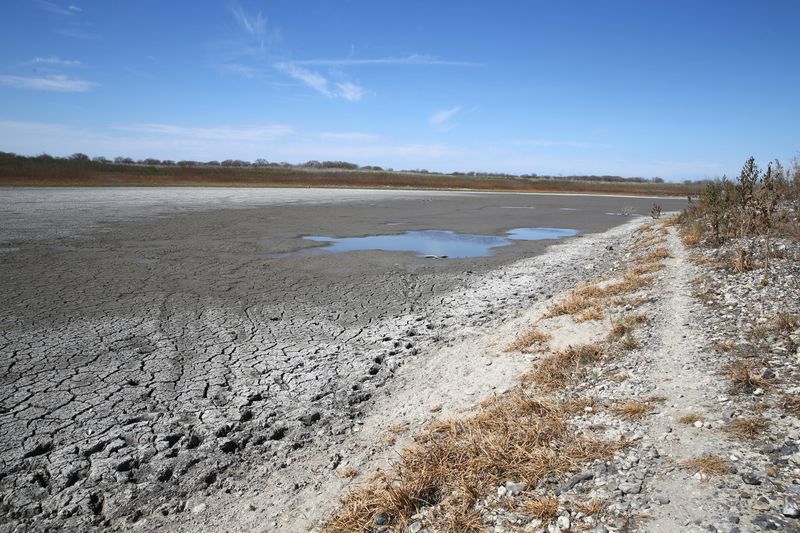
A water emergency for Corpus Christi may arrive sooner than city officials had initially forecast — and groundwater projects hoped to provide a safety net remain a question amid ongoing pushback.
November had been the month projected that the city may enter a water emergency, meaning there would be 180 days before total water supply would fall short of meeting demand. But that could depend on variables such as timelines of when new water supply projects will be in operation and the possibility the city could be curtailed by 10% of water contracted through Lake Texana.

Officials have up until now relied upon one model identifying one month for potentially calling a water emergency, said City Manager Peter Zanoni.
Consultants are now working with a new format of warning on when a water emergency would be called — something more akin to spaghetti models used by meteorologists in hurricane predictions — showing a spectrum between worst-case and optimistically-based scenarios, he said.
Those are expected to be presented to the City Council in its March 17 meeting, Zanoni added.
Curtailment — the forced reduction of water use — would be in store, should the city reach a water emergency status.
Staff is working on the framework of what that would involve, Zanoni said.
The city has not previously faced curtailment, meaning there is no real-world reference to what it may look like.
Meanwhile, the outcomes of groundwater initiatives in Nueces County and San Patricio County are uncertain — both still in regulatory and administrative processes that could dictate when, if and how the projects could go online.
The Evangeline groundwater project
The Evangeline groundwater project — planned to eventually pump as much as 24 million gallons of groundwater per day from a roughly 23,000-acre property near Sinton — is in a kind of holding pattern, after protests were lodged against two integral permits.
A preliminary hearing that would indicate the likely timeline on when there may be resolution was postponed.
Private developers are responsible for attaining requisite permits before the Corpus Christi City Council will consider a final contract for purchase of $169 million in groundwater rights.
While there is a production permit, permits for transport and drilling aren’t yet secured.
City officials had thought the San Patricio County Groundwater Conservation District would approve the permits in its Feb. 6 meeting.
Three protests were filed against the permits: one from an individual Sinton-area resident, and two from water providers, the city of Sinton and the St. Paul Water Supply Corp.
A representative of the St. Paul Water Supply Corp. declined an interview March 3.
In a March 4 message to the Caller-Times, Sinton City Manager John Hobson wrote that “the City of Sinton is prepared to go through the entire process of contesting all permits.”
Hobson has aired for several months concerns about the project potentially impacting the aquifer, the community’s sole source of water — including questions about the possibility of degradation to Sinton’s municipal water supply, such as increases to total dissolved solids.
The city of Corpus Christi extended a proposed agreement to the city of Sinton that would, in part, call for certain mitigation measures, should the well field activities have a detrimental effect on Sinton’s municipal water supply.
Staff in recent weeks received a version of the agreement from Sinton officials showing suggested revisions, Zanoni said, and it is currently under review.
There has not been response from the city of Corpus Christi, Hobson wrote in his message to the Caller-Times.
The hearing to ascertain standing of the protestants had first been expected to be held March 2 or March 3, according to city officials.
However, it has not been held. The judge who had been selected recused themselves because of a conflict of interest, Zanoni said.
Selection of a new judge to oversee the preliminary hearing is underway, he said.
That will delay resolution further.
It could amount to years, should protestants be determined to have standing and the matter deferred to a contested case hearing, city officials have said.
Expedited work to develop the well field is continuing, Zanoni said.
The aim is to begin delivering an initial production of 4 million gallons of groundwater per day in November, he said.
About $196 million of a $400 million funding package, recently approved by the City Council for groundwater projects, is dedicated to services and material purchases for the Evangeline initiative.
“It’s a calculated financial risk because we don’t want to lose time,” Zanoni said. “So while the administrative process works its way through the system, there’s still a lot of work that is being done and can be done, and that’s what we’re doing.”
A “decision point” will come after the results of the preliminary hearing, he said. The options will then be to either maintain at an accelerated pace, proceed at a slower pace or end pursuit of the project entirely.
Contracts in effect have a termination option, he said, and there may be an option for some of the materials to be returned with a fee.
Nueces County Western Well Field
A timeline for permitting needed to begin operations in the Western Well Field, located in Nueces County, is unclear — particularly in light of more than 100 comments submitted to the state’s environmental agency about the endeavor, the majority in opposition.
The well field is now about 2,700 acres, when combining city-owned property and property owned by the nonprofit Ed Rachal Foundation.
The two were joined after the purchase of as much as $28 million in groundwater rights from the foundation’s property.
City officials filed with the Texas Commission on Environmental Quality in January an application for a bed and banks permit for the original, 250-acre city-owned property.
A bed and banks permit allows the pumped groundwater to be conveyed to the Nueces River.
Comments submitted to the TCEQ related to the permit include requests for public meetings or a contested case hearing.
Hearing requests made during the public comment period will mean that the application would be put before the TCEQ board, according to state agency representatives.
Whether TCEQ would hold a public meeting is “determined by several factors, including the level of public interest in the application, the request from a legislator in the area of the proposed project, and any other legal requirements,” wrote spokesman Richard Richter in an email to the Caller-Times on March 4.
The permit application lists wells on the city’s property as producing as much as 25 million gallons of water per day, with a request for conveyance of as much as 29,000 acre feet of groundwater.
The application had been filed prior to the most recent hydrogeology reports, Zanoni said. Now it’s believed that the entirety of the 2,700-acre well field could produce as much as 26 million gallons of water per day.
The city is considering an amendment to the current application that would take into account the Ed Rachal Foundation property, he said.
In comments, multiple Nueces County residents named among their concerns water quality, aquifer health and general impacts to private wells used for household, livestock, irrigation and property needs.
Several comments objecting to the permits reference city production levels as 28 million gallons of groundwater per day. It was not immediately clear where the number had been cited.
Among those who has electronically requested a contested case hearing is Drew Molly, the former chief operating officer of Corpus Christi Water who stepped down from his post last year.
In his message, he identified himself as the owner of a property in the Sinton area, near the prospective well field, stating that he was “deeply concerned about the potential impacts on my property, livelihood, and ability to remain on my land.”
He encouraged “TCEQ to deny this permit and require the City to pursue sustainable, well-planned solutions rather than short-term fixes that jeopardize landowners and long-term water security.”
Molly also referenced the Inner Harbor desalination plant, writing that he and earlier City Councils had supported its development.
“Unfortunately, the City’s failure to deliver on this long-standing solution undermines confidence in its ability to manage water resources responsibly,” he wrote. “The current permit request appears to be a desperate measure, and when decisions are made under desperation, they often lead to poor outcomes for residents and the environment.”
Design work with then-contractor Kiewit Infrastructure Co. was halted in a split council vote in September. Since then, a new firm, Corpus Christi Desal Partners, has picked up the torch, embarking on early steps of a proposal.
It is expected that a new design-build contract for the Inner Harbor desalination plant will be considered by the City Council in April.
Kirsten Crow covers city government and water news. Have a story idea? Contact her at kirsten.crow@caller.com.
Consider supporting local journalism with a subscription to the Caller-Times.
This article originally appeared on Corpus Christi Caller Times: A water emergency for Corpus Christi may arrive sooner than thought
Reporting by Kirsten Crow, Corpus Christi Caller Times / Corpus Christi Caller Times
USA TODAY Network via Reuters Connect