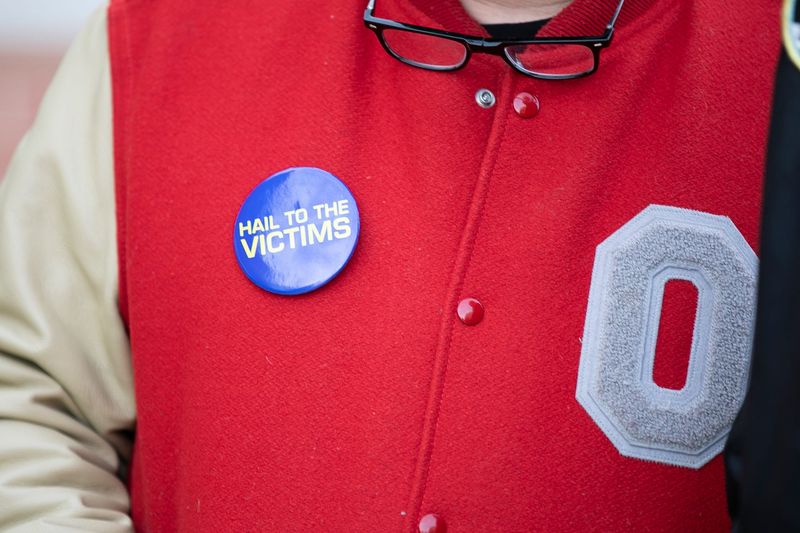
A new HBO documentary accuses Ohio State of trying to cover up a now well-known sexual abuse scandal and of underpaying survivors with whom the university has settled.
The documentary, called “Surviving Ohio State,” chronicles abuse by Dr. Richard Strauss at the university. After premiering at the Tribeca Film Festival in early June, the documentary aired June 17 on HBO and is streaming on MAX.

Produced by George Clooney, the film includes interviews with survivors of sexual abuse by Strauss, who worked at the university from 1978 to 1998. The documentary also alleges multiple coaches knew about Strauss’ abuse, including former Buckeyes wrestling coach Russ Hellickson and Rep. Jim Jordan, who wrestled at the University of Wisconsin and previously served as an Ohio State assistant coach.
Both Hellickson and Jordan declined to be interviewed for the documentary, as did Ohio State Board of Trustees members, the film states in its closing moments.
The abuse scandal first came to light in 2018 after a new complaint was filed with the university, which hired the law firm Perkins Coie to investigate.
“We express our deep regret and apologies to all who experienced Strauss’ abuse,” Ohio State spokesman Ben Johnson said via email June 3. “We are forever grateful to the survivors who participated in the independent investigation, which could not have been completed without their strength and courage.”
Colleen Marshall, an anchor for NBC4 (WCMH-TV) in Columbus who is featured early on in the documentary, said once a few students came forward, it was as if they “opened the floodgates” of accusations against Strauss.
Strauss, who died by suicide in 2005, was accused of abusing hundreds of former Ohio State athletes and other students. The State Medical Board of Ohio first became aware of alleged misconduct by Strauss in 1996.
But after taking initial steps to gather patient records and take action against Strauss’ medical license, the investigation sat inactive for months. It was eventually closed in 2002, with no action ever taken.
Here are three major takeaways from the documentary:
Ohio State is accused of trying to cover up the Strauss sexual abuse scandal from the beginning
Throughout the film, student athletes say that coaches and staff knew and did nothing or lied to them about Strauss’ history of abuse.
Steve Snyder-Hill, for example, said that he was told by former Ohio State director of student health services Dr. Ted Grace that Strauss had never faced abuse accusations.
But just a few days before Snyder-Hill reported Strauss, another student had done the same. In a deposition obtained by the documentary crew, Grace claimed he might not have known about the other complaint at that point.
Grace was stripped of his medical license by the State Medical Board of Ohio in 2021 for failing to report Strauss to the board.
The documentary also accuses Ohio State’s athletics department of doing nothing about Strauss despite multiple complaints from a former fencing coach.
Charlotte Remenyik, who served as the men’s fencing coach from 1978 to 1999, once sent a student with a bleeding ear after practice to see Strauss for treatment. That student reported back to the coach that Strauss required a genital exam to treat the bleeding ear, according to the documentary.
After the incident, Remenyik reported Strauss to her superiors. She said she was told that the report amounted to rumors and hearsay and that unless a student came forward, the university would not take action.
No students from the fencing team came forward despite Remenyik offering to stand by them, her daughter states in the film.
The documentary also portrays Strauss as an expert on steroids. Clips of Strauss on the news program “Nightline” in the documentary show him discussing steroid use by athletes.
Some interview subjects suggested that Ohio State might have been reluctant to discipline Strauss if he was providing steroids to student athletes. At least one wrestler in the documentary recalled how Strauss would give them shots of something before major matches.
Wrestlers recounted detailed conversations with Jim Jordan about Strauss sex abuse at Ohio State
Multiple wrestlers and a referee told filmmakers that Jordan was aware of Strauss’ abuse.
Dan Ritchie, who wrestled at Ohio State from 1988 to 1992, said that Strauss would conduct unnecessary genital exams with ungloved hands.
Multiple wrestlers said Strauss would turn off the lights and use a flashlight to examine their genitals, and some said he would get so close to them that they could feel his breath on them. Wrestlers told the documentary filmmakers that people had nicknames for Strauss, such as “Dr. Fun Boy” and “Dr. Jelly Fingers.”
Ritchie recalled a conversation where Jordan said he wouldn’t allow Strauss to abuse him like others had.
Ritchie claimed Jordan, an assistant coach at the time, told wrestlers, “If he ever did that to me, I’d snap his neck like a stick of dry balsa wood.”
Frederick Feeney, a wrestling referee from 1988 to 2024, said that he once was showering after a match and Strauss began to shower right next to him. Feeney said that he saw Strauss begin to masturbate and when he turned away, Strauss grabbed his butt.
Feeney told filmmakers that he told both Jordan and Hellickson about the encounter. But Feeney said Jordan shrugged off the incident and said: “It’s Strauss, you know what he does.”
In interview footage with local and national news stations included in the documentary, Jordan denied that he knew about Strauss’ sexual abuse.
“Chairman Jordan never saw or heard of any abuse, and if he had, he would have dealt with it,” Russell Dye, a spokesman for Jordan, told The Dispatch in a statement June 18.
Hellickson, who served as the wrestling team’s head coach from 1986 to 2006, said in interview footage from 2018 that he wasn’t aware of abuse at the time it occurred. In the 2018 interview, Hellickson said he once approached Strauss about how he thought the doctor touched student athletes in a way that was “too invasive” and “too physical.”
Average settlements between Ohio State and sex abuse survivors pale in comparison to those at other universities
In the documentary’s waning minutes, former Ohio State leaders are seen apologizing to survivors at a board of trustees meeting.
Behind closed doors though, former athletes and an attorney contend the university has not been as friendly.
Ohio State has reached settlement agreements worth more than a combined $60 million with 296 other survivors of Strauss’ abuse, which amounts to more than half of the plaintiffs, Johnson previously said via email. The university has offered settlements to each of the male students who have filed a lawsuit, he said.
However, the film states that those settlement amounts have been far lower per survivor when compared with sex abuse scandals at other universities.
Ohio State has paid out around $250,000 on average to each survivor it has settled with, the film states. By comparison, Penn State University paid out roughly $1.5 million per survivor following the Jerry Sandusky sexual abuse scandal, and Michigan State University paid out $1.2 million per settlement to survivors of Dr. Larry Nassar’s abuse, according to the film.
At the same time, the documentary accuses Ohio State of trying to get lawsuits thrown out of court because of the statute of limitations.
Ohio State took its case to the U.S. Supreme Court in 2023 when the university asked justices to review a divided decision by the 6th U.S. Circuit Court of Appeals on the statute of limitations of sexual abuse claims and the scope of federal education protections under Title IX. The Supreme Court declined, meaning more than 230 men in two related cases were allowed to proceed with their lawsuit against Ohio State for Strauss’ abuse.
A trial date could come as early as 2026, an attorney has told The Dispatch.
Near the end of the film Snyder-Hill —who is one of the plaintiffs in the lawsuit— criticized the university for how it continues to handle the Strauss abuse scandal.
“Somebody asked me one time, they said, ‘Are you a survivor or are you a victim?'” Snyder-Hill said. “I had to think about that, and I thought, you know what? I’m a survivor of sexual assault, but I’m a victim of OSU.”
How to get help and report sexual abuse by a medical professional
Dispatch investigative reporter Max Filby can be reached by email at mfilby@dispatch.com. Find him on X at the handle @MaxFilby or on Facebook at @ReporterMaxFilby.
(This story was updated to add resources for survivors of sexual abuse.)
This article originally appeared on The Columbus Dispatch: We watched HBO’s Surviving Ohio State documentary: Here’s what you need to know
Reporting by Max Filby, Columbus Dispatch / The Columbus Dispatch
USA TODAY Network via Reuters Connect