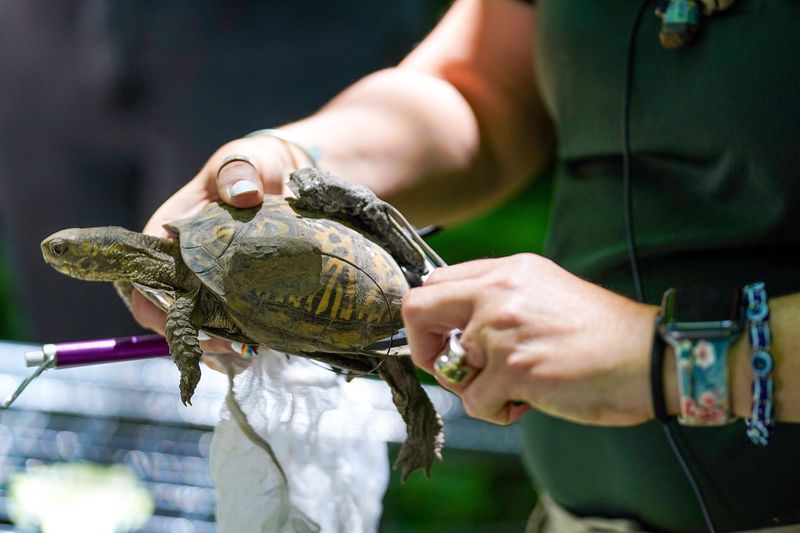
Ten Eastern box turtles are on their way to finding a new home in Southwest Ohio, after researchers opened the gates to their enclosure at Bowyer Farm on Wednesday afternoon, giving them a taste of freedom.
They aren’t alone. The Cincinnati Zoo & Botanical Garden is taking part in a statewide Division of Wildlife research effort to find new homes for turtles.

With a beaming sun and a crowd of around 40 watching, several turtles took one small step at a time, inching past the starting line. Cheers from their enthusiasts followed as the creatures disappeared into the green and brown landscape. Some hid in their shells, perhaps waiting for privacy before exploring their new landscape. They had spent a month acclimating to the wetlands before heading off on their latest adventure,.
The Ohio Division of Wildlife partnered with many conservation organizations, including the Cincinnati Zoo, to return turtles to the wild. Eastern box turtles are native to Ohio, but populations are declining. Many of them ended up with rescuers because they were illegally collected.
“The sort of dominant thought was that you can’t really rehome a box turtle because they have such a wonderful homing device or internal homing instinct that they’ll just walk forever to try to get back to their original home site,” said Mollie O’Neill, the Cincinnati Zoo’s director of partnerships in local conservation.
Researchers hope to learn whether box turtles will thrive after being rehomed.
Slow and steady takes the turtles home
Cincinnati Zoo’s involvement began in September, when the Division of Wildlife asked them to collect and care for a group of turtles that were living in a courtyard at a middle school near Dayton, Ohio. The group had settled there around 30 years ago, when staff who were unaware of state regulations moved a few to the courtyard. Decades later, the school was going to be knocked down, and 24 turtles had nowhere to go.
“A lot of people in this region have memories of finding box turtles as kids, and we’d love for that amazing sort of awe and wonder experience to continue on for everyone around here,” O’Neill said.
The zoo removed the turtles, and the reptile team cared for them through the fall and winter, their brumation – or hibernation for reptiles – period.
Four weeks before the release, 10 turtles – a mix of those from the school and other places – were taken to Bowyer Farm for a “period of soft release.” They were split into two enclosures to acclimate to the new environment before full release.
This is the zoo’s first rehabilitation project to take place at Bowyer Farm, a secure plant nursery where the zoo uses trail cams to monitor local species activity.
Eileen Wyza, a wildlife biologist and the project’s field research logistical lead, said the team is optimistic that the turtles will stick to their new habitat.
“There’s been a couple studies of turtles that have been put in soft release enclosures and then released, and the time spent in soft release enclosures seems to help a lot,” Wyza said. “It helps them reorient themselves.”
Microchipped and fitted with tracking devices, the turtles’ movements will be monitored. Wyza said the soft release enclosures will stay in place with their gates open, so that if the turtles stray too far from the farm, they will be returned there and try again.
What dangers do Eastern box turtles face in Ohio?
The Eastern box turtle is not classified as threatened or endangered, but that doesn’t mean the creatures can’t face trouble. In Ohio, the population is declining due to factors such as habitat loss, road mortality, inbreeding and poaching, O’Neill said.
Since box turtles are omnivores, the Cincinnati Zoo & Botanical Garden advocates for using less chemicals in landscapes and yards. While “less disturbance is always best,” and turtles on trails should be left alone, O’Neill encourages people to move turtles out of dangerous locations, like roads or lawns being mowed.
Researchers at the University of Toledo recently discovered high levels of inbreeding in box turtles, which will cause generations to be less likely to reproduce over time. Since the 24 turtles collected from the middle school were closely related, only some were moved to Bowyer farm. The rest are a mix of turtles seized at JFK and LAX airports – genetically linked to the Midwest – as well as turtles surrendered or confiscated throughout Ohio.
The other turtles found at the middle school are being released at other Ohio sites, including Columbus Zoo’s safari park The Wilds on June 24.
“There are 24 kind of spread across the state now and ideally will be finding mates and enriching the genetic diversity of turtle populations much, much wider than just our little Southwest region,” O’Neill said.
How box turtles are monitored
The turtles were fitted with VHF antennas and GPS tracking devices, allowing researchers to monitor them throughout the summer. The GPS, which pings on location every three hours, will give a general idea of where the turtles are. The antennas will allow them to pinpoint the exact location.
Starting 14 days after the turtles’ release, the team will perform body condition checks every two weeks, looking for signs of dramatic weight loss and predation.
Near the end of fall, as turtles enter brumation, researchers will change the devices’ batteries so when the turtles emerge in the spring, their movements will continue to be tracked. By fall of 2027, O’Neill said, they will be able to share their findings and give recommendations for future rehoming.
After both groups of turtles were released, the observers and researchers took a trail back to the farm’s shelter house, passing a snapping turtle’s nesting site and several snakes – the box turtles’ new neighbors. With various groups including the Warren County Park District, Ohio Department of Natural Resources, Cincinnati Zoo and Bowyer Farm all together, the members shared their love for box turtles over turtle-shaped boxes of candy assembled by the zoo’s summer campers.
This article originally appeared on Cincinnati Enquirer: Tiny steps, big journey as turtles return to Ohio wild
Reporting by Carly Gist, Cincinnati Enquirer / Cincinnati Enquirer
USA TODAY Network via Reuters Connect
By Carly Gist, Cincinnati Enquirer | USA TODAY Network