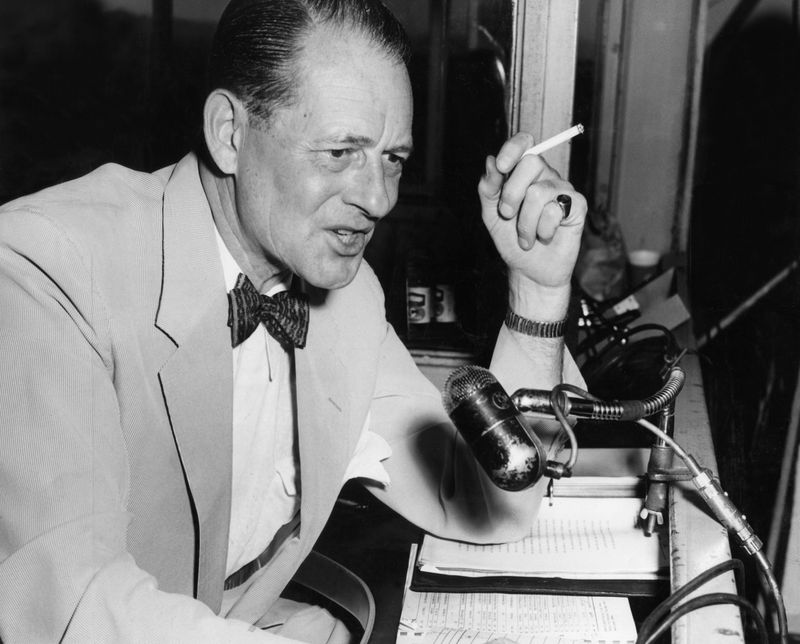
Summer in Cincinnati in the 1950s. Folks tuned to WSAI radio to hear Waite Hoyt announce Redlegs slugger Ted Kluszewski had hammered a “hit into Burgerville!”
That’s Hoyt-speak for Crosley Field’s Sun Deck bleachers – and a reference to Burger Beer, sponsors of the Reds broadcasts from 1942 to 1965.

Baseball and Burger Beer. The regional brand stayed loyal to Hoyt as pitchman even after the Hall of Fame pitcher not-so-anonymously joined Alcoholics Anonymous.
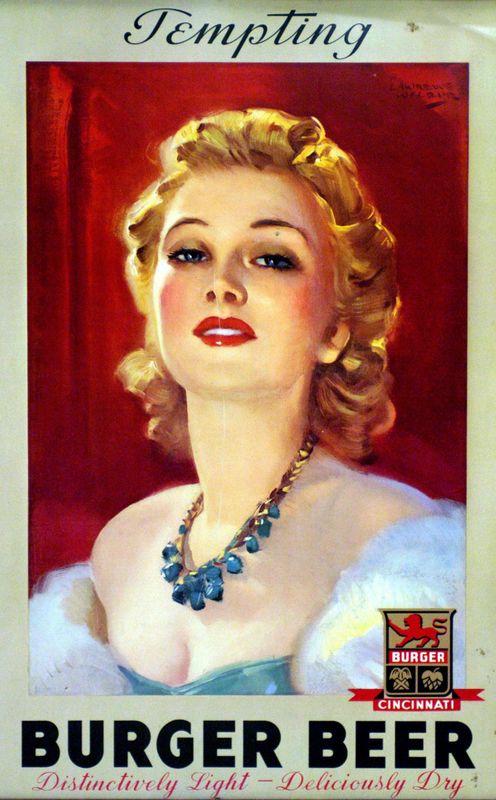
The association with sports – Burger also sponsored the Bengals’ team MVP the first few seasons – helped make Burger the second-best-seller in town behind Hudepohl in those days. Burger Beer was an everyman beer, affordable and brewed in Cincinnati.
‘Vas you efer in Zinzinnati?’
The company dated to 1874 when German immigrant Louis Burger went into business with Albert Schwill & Co., seed merchant. The partnership dissolved about 1881, and Louis teamed with his younger brother Charles as the Burger Bros. Co., selling malt extract, hops and brewers’ supplies.
The Burger family sold the company to William J. Huster in 1925, while Prohibition killed most of the city’s German breweries. As soon as Prohibition ended, Huster filled the void by reconfiguring the company as a brewery business.
The Burger Brewing Co. released Bürger Beer on Aug. 15, 1934. The company dropped the umlaut in the name during World War II, but in the beginning it was proudly German.
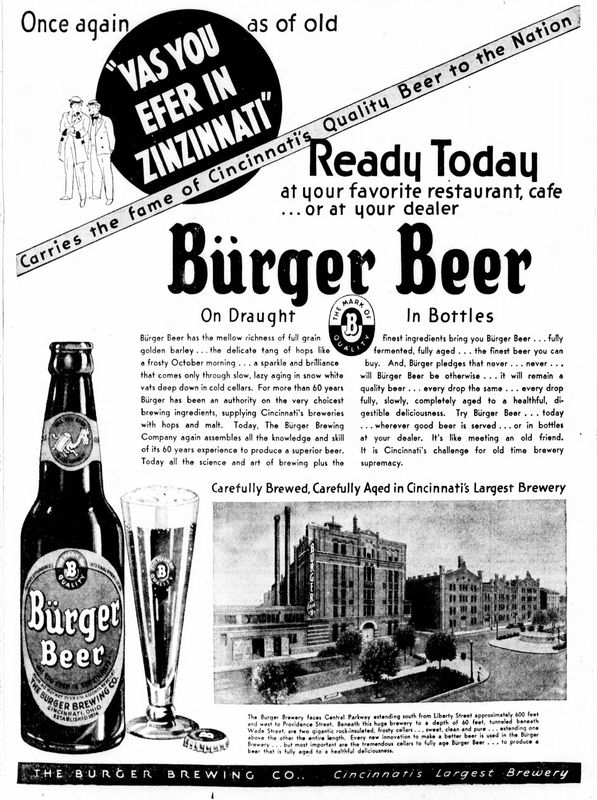
An ad in The Enquirer the first day featured its slogan, “Vas you efer in Zinzinnati?” – playing on memories of Over-the-Rhine’s pre-Prohibition brewery district.
“Bürger Beer has the mellow richness of full grain golden barley … the delicate tang of hops like a frosty October morning … a sparkle and brilliance that comes only through slow, lazy aging in snow white vats deep in cold cellars,” the ad read.
Burger reopened the old Lion Brewery at Central Parkway and Liberty Street, where the Windisch-Mulhauser Brewing Co. brewed Lion Beer until 1922. Two concrete lions were perched atop the gables of the brewery.
“Beneath this huge brewery to a depth of 60 feet, tunneled beneath Wade Street, are two gigantic rock-insulated, frosty cellars” where the beer was “carefully aged,” the ad said.
Burger also produced Buckeye Beer and Red Lion Ale, as a nod to its brewery predecessor.
Made with ‘pure artesian water’
In 1969, Burger made a big to-do about switching back from city water to using water from artesian wells that years earlier had long been drilled underground.
“Water is the basic ingredient used in brewing beer and we are most fortunate to have this wonderful water source right below our brewery,” said J.F. Koons Jr., then-president of Burger Brewing Co.
During the devastating 1937 flood, Burger’s artesian wells helped supply millions of gallons of clean water to Cincinnatians, distributed by fleets of Enquirer and Burger trucks to hospitals and emergency stations.
Despite an aggressive ad campaign touting Burger as “brewed with pure artesian water,” sales sharply declined.
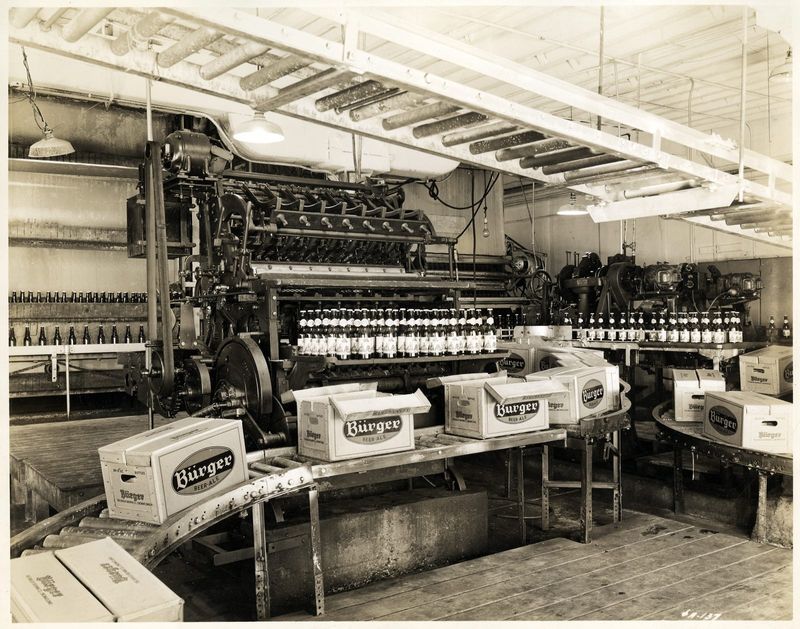
With little warning, Burger ceased its beer-making operation March 15, 1973 – putting 225 brewery workers out of a job – to focus on its Pepsi bottling plants.
The company sold its beer formulas, labels and trademarks to rival Hudepohl, which immediately began brewing Burger Beer at its Queensgate plant and added Burger Light in 1980.
The Burger plant (Lion Brewery) buildings were all gone by 1993. The Cincinnati Ballet built its headquarters on the site and used the beer vaults to store costumes. Both the ballet building and vaults were demolished for future developments around TQL Stadium.
When Greg Hardman relaunched Christian Moerlein Brewing Co. in 2004, he started buying up many of the favorite but defunct local beer brands, including Hudepohl and Burger.
Christian Moerlein relaunched Bürger Classic and Bürger Light (the umlaut restored) in 2009. Cincinnati Beverage Co. took over Moerlein in 2020 and many brands disappeared. Burger now offers its one special Muskie Lager, with proceeds going to help Xavier University student athletes.
This article originally appeared on Cincinnati Enquirer: The rise and fall (and resurrection) of Burger Beer in Cincinnati
Reporting by Jeff Suess, Cincinnati Enquirer / Cincinnati Enquirer
USA TODAY Network via Reuters Connect
By Jeff Suess, Cincinnati Enquirer | USA TODAY Network