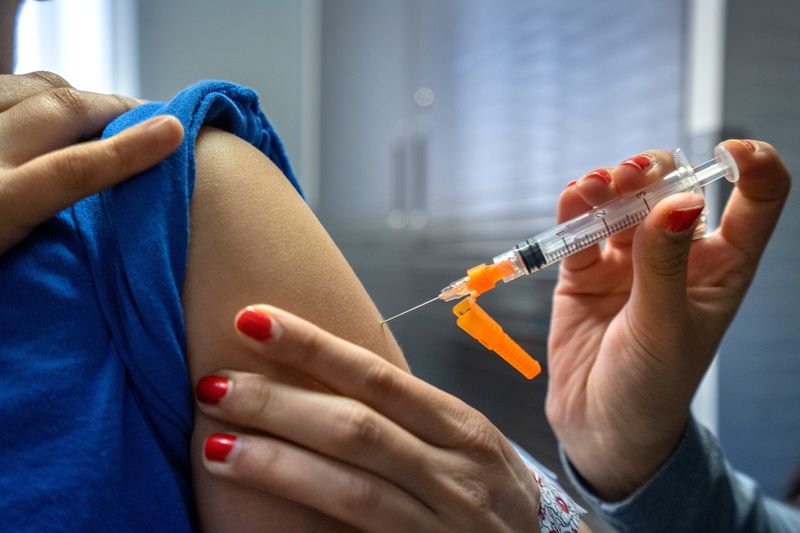
Ohio officials recently launched a public dashboard displaying kindergarten vaccination rates statewide to increase transparency around childhood immunizations in public and private schools.
But for Cincinnati Public Schools, the Ohio Department of Health dashboard has instead raised concerns about vaccination documentation.

According to the state dashboard, only about 1 in 4 CPS kindergartners appear to be fully vaccinated – a figure health officials say likely reflects missing documentation rather than actual vaccination status.
Despite what the state data shows, the district told The Enquirer it believes “most CPS students are vaccinated or actively working to complete required immunizations.”
The Cincinnati numbers could signal a lack of compliance with several Ohio laws, including requirements for kindergartners to be vaccinated against diphtheria, tetanus, and pertussis, measles, mumps, rubella, Hepatitis B, chicken pox and polio.
State law also says unvaccinated students cannot attend school for more than 14 days without written proof of a medical or nonmedical exemption or documentation that shows they’re in the process of being immunized. Health officials say no agency actively enforces that rule – leaving compliance largely up to individual districts.
Some districts, like Columbus City Schools, strictly enforce that rule. But Cincinnati Public Schools does not, citing a continued effort to curb chronic absenteeism.
A school board’s responsibility to require vaccines rests in a gray area, too. State law requires boards of education to keep records of students’ vaccines, but it’s up to each board’s discretion whether or not to make additional policies requiring those vaccines in order to enroll in school.
There’s no formal enforcement of vaccinations in CPS – the only district policy that exists is one adopted in 2021 that requires employees be vaccinated against COVID-19. Immunization records are listed among the documents needed to enroll in school, but there’s no explicit mandate that those records reflect a complete slate of vaccinations.
CPS officials say the low vaccination rates on the dashboard can be explained by outdated data. Hamilton County and Cincinnati’s public health leaders aren’t so sure.
Cincinnati’s reported vaccination rates trail Columbus and other large districts
In an Enquirer analysis of Ohio Department of Health data, the abnormality in Cincinnati schools’ kindergarten vaccination rates compared to other large districts is clearly documented.
In central Ohio, Columbus City Schools reports that 89% of its students are completely vaccinated, on average. In all of Franklin County, 87% of students reported a complete vaccination status during the 2025-26 academic year.
For the most part, the rest of the state’s largest districts dubbed the “Urban 8” follow the same trend as Columbus, with 70% to 90% of their student bodies logged as fully vaccinated.
The state health department is aware of the inflated incomplete numbers in Cincinnati, said press secretary Ken Gordon. But questions as to how and why the numbers appear that way should be directed to districts themselves, he said.
Dr. Stephen Feagins, medical director of Hamilton County Public Health, said CPS’s numbers have “always been a puzzlement to us as well.”
It’s Feagins’ belief that the anomaly in Cincinnati is “more of a reporting issue than a vaccination issue,” he said.
Errors in reporting may pile up particularly in large, urban schools, Feagins said, when more acute issues like student attendance or budget planning may take precedence.
Plus, small details like a name or address change of a parent, he said, can complicate the documentation process for large districts like CPS. Thus, the actual rates of vaccinated students may be higher than how they appear on the state’s dashboard.
That’s the same sentiment held by board president Brandon Craig, who says the high numbers of missing vaccination documentation in the dashboard aren’t truly representative of the schools’ current status of vaccinated students.
What if there’s a disease outbreak in Cincinnati Public Schools?
The lack of documented immunization could pose complications should measles or another antigen appear and the majority of students’ vaccine status can’t be confirmed, Feagins said.
In the case of an outbreak, the health agency has to assume every child without documentation is unvaccinated, Feagins said. That means pulling more students out of school for 21 days, the required quarantine period.
The Cincinnati health department has for years worked with the district on boosting immunizations through its full-service health centers located in 24 schools, offering low or no-cost medical care to students regardless of insurance status.
Dr. Grant Mussman, the city’s health commissioner, said he had no comment on the vaccination numbers reported in the state’s database.
The district maintains that it’s providing ample support in getting students vaccinated through the school-based health centers.
What is Columbus City Schools doing that Cincinnati Public Schools isn’t?
A key difference between Cincinnati and Columbus schools’ rates lies in enforcement. In Columbus, unvaccinated students are kept home after a set number of days under Ohio law until their vaccination status is complete. In Cincinnati, that provision is not enforced.
“We have traditionally not tried to dissuade you from attending school because that also puts you in the chronically absent category,” Craig said, adding that the district offers leniency for students who may be in the process of finishing their vaccines.
Columbus City Schools has embraced a proactive approach to student vaccinations, including early clinics and strict enforcement of state law, said district health director Carole Sullivan.
The district hosts vaccination clinics months before back-to-school season and the Oct. 15 deadline to report vaccination rates to the state. Last summer, the district partnered with Columbus Public Health to host summer vaccination clinics for families.
The roughly 130 registered nurses employed across Columbus’s 113 schools also actively track student immunizations through partnerships with Nationwide Children’s Hospital and Columbus’ health department, Sullivan said.
Cincinnati schools have similar partnerships in place with local agencies, such as the school-based health centers hosted through partners like the Cincinnati Health Department and Cincinnati Children’s, Craig, the board president, said. But nurse staffing levels have declined in recent years.
At the height of the COVID-19 pandemic, Craig said, the district aimed to place a nurse at each of its 66 schools under a contract with the city.
But as pandemic relief funds ran out, that goal became infeasible and the district made the decision to end the contract with the city at the end of the 2024-25 academic year. It pivoted to employing fewer nurses and more school health aides, a position with less certification that still provides basic medical services.
CPS did not answer The Enquirer’s questions about whether it hosts vaccination clinics to promote immunizations ahead of Oct. 15.
Dashboard reflects issues in how state collects data, CPS says
If the goal of the Ohio Department of Health’s dashboard is to provide more accurate information around student vaccines, Craig said, schools should have the chance to update vaccine records year-round.
Under state law, schools are required to report immunization status of students entering kindergarten, seventh grade and 12th grade by Oct. 15. So any additions to a student’s vaccination status after that day is not reflected in state records.
District officials echoed the same critique, asserting that the numbers in the dashboard simply aren’t accurate and “lag behind the documentation our schools receive every day.”
“Cincinnati Public Schools works year-round with families to keep student immunization records accurate and up to date,” the district said in a statement. “As always, CPS’s mission is to educate all children who wish to come to our schools.”
To see your child’s school’s vaccination rates, you can visit the state dashboard here.
This article originally appeared on Cincinnati Enquirer: State website says 1 in 4 Cincinnati kindergartners vaccinated. Is it wrong?
Reporting by Grace Tucker, Cincinnati Enquirer / Cincinnati Enquirer
USA TODAY Network via Reuters Connect