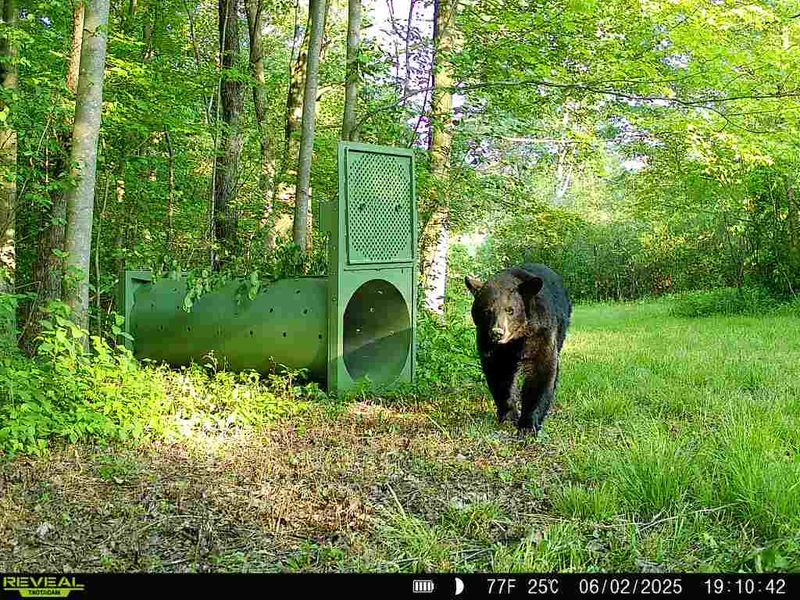
Scientists are studying the expansion of black bears throughout Ohio.
For the first time in state history, they put a GPS collar on a female black bear in Ashtabula County, according to the Ohio Department of Natural Resources.

The partnership between ODNR and the University of Dayton’s Gantchoff Lab aims to learn more about how black bears expand their range throughout the Buckeye State.
“Black bears are rare in Ohio and are considered a state-endangered species,” ODNR noted.
Humans drove black bears out of Ohio in the mid-1800s, but the species has been naturally recolonizing the state from healthy populations nearby.
Most of Ohio’s new black bears are reported in the northeast and southeast portions of the state.
Collar will fall off bear before its battery dies
The female black bear captured June 3 is 5-10 years old and 198 pounds.
The bear was captured on private land in northeast Ohio with landowner permission and released unharmed in the same location after a GPS collar was attached.
The GPS collars remotely transmit location data to help researchers learn about habitat use and preferences of individual bears.
“Researchers using the location information can also learn about a bear’s home range size and space requirements, survival rates and their reproductive status, including litter size and frequency of reproduction,” ODNR noted. “The collar is programmed to fall off the bear before its battery dies, typically after about 18 months.”
Most Ohio bears are males on hunt for companion
The goal for the collaboration between ODNR and the University of Dayton is to put GPS collars on 10-20 Ohio resident black bears in the coming years to monitor their movement and reproduction.
Another objective is to estimate Ohio’s black bear population trajectories, habitat suitability and factors impacting human-bear conflicts.
“In addition to the female bear collared this month, the project is monitoring the movements of a male bear collared in northeast Ohio in July 2024,” ODNR noted.
Scientists believe most bears seen in Ohio are young male bears coming from Pennsylvania and West Virginia.
“These male bears wander widely in search of a mate and territory, and they are unlikely to stay in an area long-term unless a resident female bear is present,” ODNR noted. “Female bears that establish a home range are more likely to remain in Ohio. In recent years, the Division of Wildlife has confirmed the presence of female black bears with cubs in northeast Ohio.”
ztuggle@gannett.com
419-564-3508
This article originally appeared on Mansfield News Journal: Scientists tracking Ohio’s black bears to learn about state’s population
Reporting by Zach Tuggle, Mansfield News Journal / Mansfield News Journal
USA TODAY Network via Reuters Connect