RANDOLPH TWP. − As the small group of children trooped single file to their seats, their teacher Nikki Miller admonished them with a smile.
“Try not to walk on the crime scene, please. You will contaminate it,” said Miller, preschool teacher at St. Joseph School in Randolph Township.

But the youngsters there on a mid-June afternoon weren’t preschoolers, and this clearly was not a normal school day for Miller. The roughly 20 kindergarteners and first graders were taking Fur-ensics, a course about forensic investigations during the week-long Camp Invention.
The camp is a program of the National Inventors Hall of Fame in Lake Township.
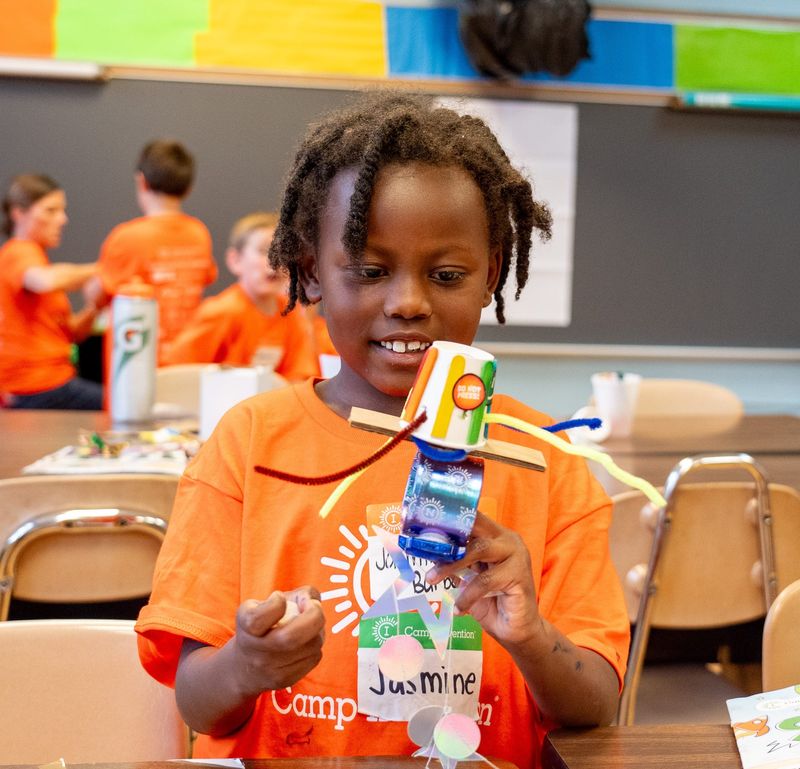
“Camp Invention challenges children in grades K-6 to tap into their natural curiosity and use their creativity to solve problems,” says a National Inventors Hall of Fame media release. “Through hands-on activities, Camp Invention promotes STEM learning; builds confidence, leadership, perseverance and resourcefulness; and encourages entrepreneurship — all in a fun and engaging environment.”
The curriculum, inspired by the work of Hall of Fame inductees, changes every year and is taught yearly to about 140,000 students at more than 2,600 schools across the nation.
Lindsay Leiby, director of the St. Joseph’s Camp Invention, said most of the campers campers are from schools in the area, such as St. Joseph, Brimfield and Suffield elementary schools, Biomed Academy in Shalersville and Lake Center Christian School in Stark County. One camper came from Tennessee.
Other classes during the five-day event included:
On June 16, campers were busy with Fur-ensics, where Miller went over the various aspects of forensic investigations, including answering the questions of who, what, where, when, why and how of a crime.
“Detectives must determine why the suspect committed the crime,” she said.
Students then went to work creating a “gadget,” using various provided materials with tweezers.
Exploring the “crime scene” was for another day. On the floor up against a wall was a piece of irregularly shaped blue paper representing a river with a larger piece of brown paper that doubled as the river’s bank. On top of the blue paper were images of vegetables, such as broccoli and onions.
Leiby said the crime was that someone “pilfered” the vegetables and threw them into the river. The student detectives must search for clues and gather evidence, such as bits of fur and feathers, bring it back to the “lab” and examine it to identify the culprit.
In another classroom, students in second to sixth grades were taking part in Make Waves. St. Joseph preschool teacher Brad Walker, who led the class, said students figure out a solution to a problem that has something to do with water, the beach or surfing. The students decide for themselves what problem each will solve.
“They come up with their own problems,” said Walker.
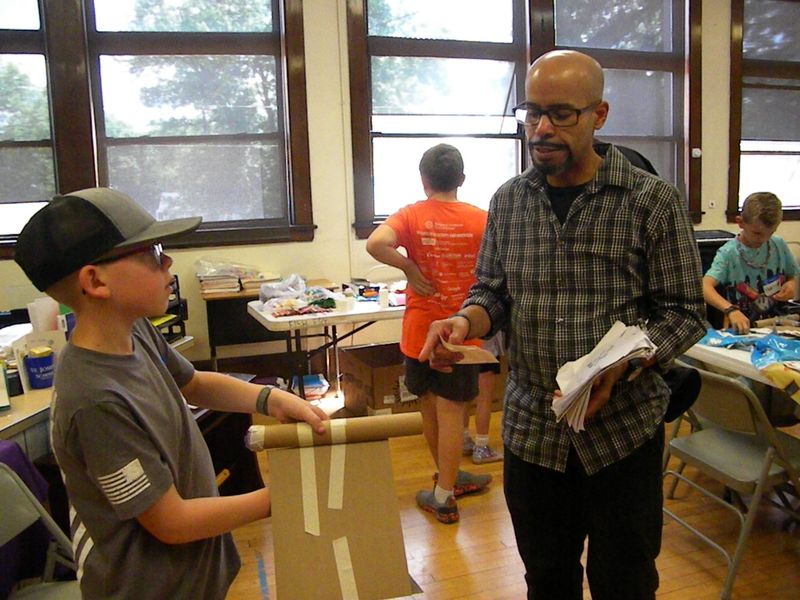
St. Joseph fourth grader Weston Kuzma showed off his Beach Blaster model, a cardboard tube cannon resting on a cardboard base.
“The problem this is going to solve is when people forget their beach stuff,” said Weston.
The idea, he explained, is that when people leave things behind, such as blankets, towels and umbrellas, they can be put into the Beach Blaster and fired to their location at the beach.
Creativity and problem-solving were not the only purpose of the course. As Weston held his invention, seminarian Donald Bailey quizzed him about the Beach Blaster to prepare him for the kinds of questions investors might ask.
“It’s going to move around,” Weston said in answer to Bailey’s question about whether the Beach Blaster would be mobile.
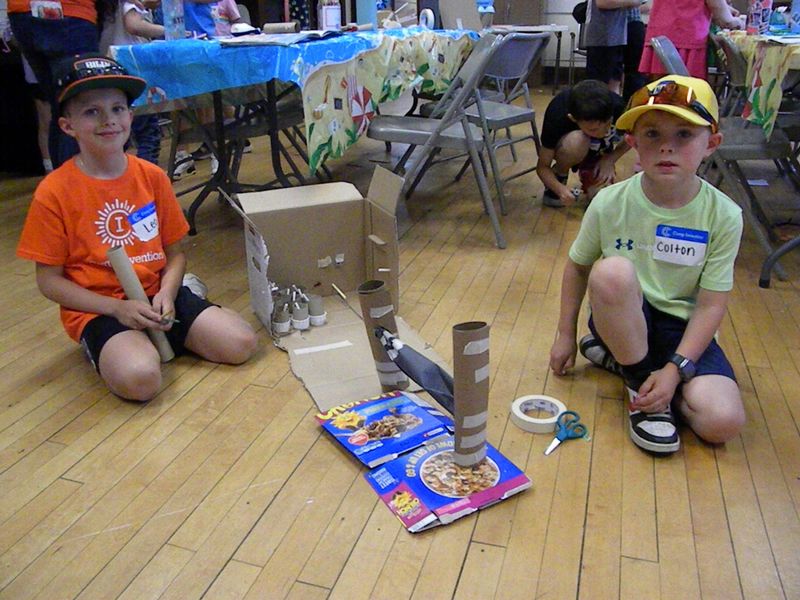
On the other side of the room, St. Joseph third graders Colton Frame and Leo Mudd were working on their model for a device that would filter ocean water to make it drinkable.
“This is the ocean and it comes up this tube,” said Leo, pointing to a flattened cereal box on the floor with a cardboard tube perpendicular to it.
The boys were working on attaching another tube to simulate a pipe to carry the water away to an outlet cut in a box.
“It tastes like it comes out of the faucet,” said Leo.
With Bailey, Father Kevin Bertleff, pastor of St. John Neumann Parish, was present playing the part of an investor questioning students about their inventions.
“We wanted them to see how they can improve it to get to the next level,” he said.
As the session was coming to a close, Walker asked if any of the kids had changed their plans in response to the questions. He pointed out that one girl had gone from a design for a surfboard to a robot surfboard and finally to a robot surfboard that picks up trash in the water.
Walker told the students he wanted them to start considering advertising to sell their inventions and starting a company.
“I want you to start thinking about a name for your company,” he said as the class was coming to an end for the day.
Bertleff said he sees practical benefits in the activities.
“To get the kids to think creatively, about problem-solving,” he said. “To get kids to think about a real-life problem.”
Go to www.invent.org for learn more about the National Inventors Hall of Fame and Camp Invention.
Reporter Jeff Saunders can be reached at jsaunders@recordpub.com.
This article originally appeared on Record-Courier: Randolph youngsters get creative during invention camp
Reporting by Jeff Saunders, Ravenna Record-Courier / Record-Courier
USA TODAY Network via Reuters Connect
By Jeff Saunders, Ravenna Record-Courier | USA TODAY Network