Three years ago, Rebecca Tien had what she called a “little farm” in the backyard of her home in Columbus’ Clintonville neighborhood.
With seven garden beds measuring 8 feet by 3 feet each, Tien’s plot blossomed with everything from strawberries to potatoes to summer squash and watermelon.

Now, all that remains in her backyard are three tomato plants. The rest, she said, have been eaten, almost entirely by rabbits.
“We’ve been planting for 15 years,” Tien said. “Last year, they decimated our garden. This year I gave up.”
Tien, who said she now sees at least 10 rabbits in her backyard at any given time, is far from the only central Ohioan noticing an uptick in the rabbit population this year.
The Dispatch asked users on Reddit’s Columbus thread if they’ve noticed a rise in rabbits from years past. While a few said they hadn’t observed an increase, the overwhelming consensus among more than 300 replies — from users across New Albany, Merion Village, Hilliard and beyond — was clear: They’re everywhere.
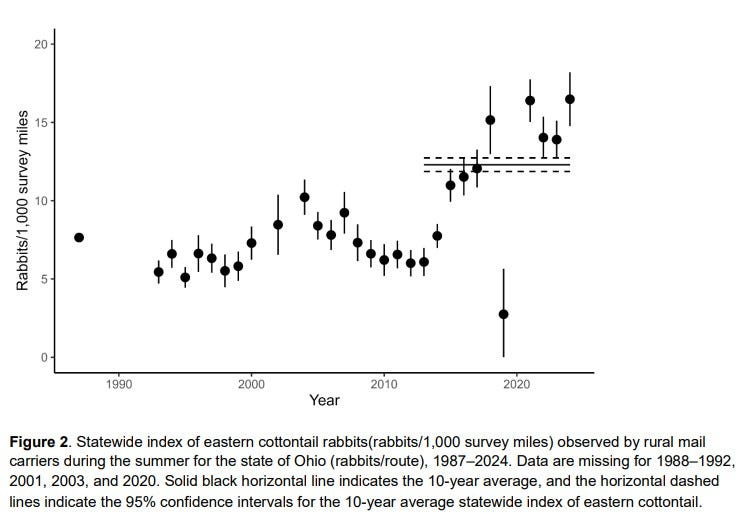
These anecdotal reports are more than just a series of coincidences; they’re supported by data. According to Joseph Lautenbach, a wildlife biologist with the Ohio Department of Natural Resources, the state has seen a mostly steady increase in its native rabbit species, the eastern cottontail, over the past 10 years.
Not only that, but ODNR data shows that the summer of 2024 saw the highest number of rabbits recorded across the state since 1990 — roughly triple the counts from the early 1990s.
Lautenbach said the sudden dip in rabbit population around the summer of 2019 was likely due to the weather being especially cold and wet that year.
Why are there so many rabbits in central Ohio?
ODNR research biologist Mark Wiley said it’s hard to say exactly what’s contributing to an increase in rabbit activity during a given year.
However, he said it’s common to see “dramatic fluctuations” in rabbit population year to year, largely due to changing conditions in habitat availability, weather and predation levels.
Lautenbach added that hare and rabbit populations usually follow a 10-year cycle. But according to data collected from the mail carrier surveys, he said there’s been no indication of this cycle for rabbits in central Ohio — just steady population growth.
What about 2025? Has the Ohio Department of Natural Resources seen more rabbits this year?
It’s too early to know whether the Eastern cottontail has officially increased in population size this year, Wiley said.
The department uses a Rural Mail Carrier Survey to track Ohio’s rabbit population, which involves distributing survey cards to all postmasters across the state, who then give the cards to the carriers who deliver mail on rural routes. The carriers can choose to participate in the survey by keeping track of how many rabbits they notice on their routes, but it is not required, Wiley said.
The survey — conducted twice a year, once in the spring and summer — has been used by ODNR for rabbit-counting since the 1950s and is a common practice for many other state wildlife agencies that are tracking the population of various species, Wiley said.
He added that ODNR mailed its survey cards to postmasters July 9, and the two-week survey period will take place over mail carriers’ 12 working days from July 21 to Aug. 2. The data for 2025 should be posted around September, Wiley said.
“Without the 2025 data, I can’t tell you that we know anything more than a few reports,” Wiley said. “But it seems like it was a good year for rabbits.”
Can I get sick from rabbits?
Tularemia is a rare disease that can affect animals and humans, with rabbits and hares especially susceptible. If you make physical contact with an infected rabbit, it’s possible that you could become sick, according to the CDC.
Though most infections can be treated with antibiotics, the CDC reports tularemia can be life-threatening.
Symptoms vary greatly depending on how the bacteria enter one’s body, and they can be mistaken for more common illnesses. The CDC advises letting your health care provider know of any exposure to sick or dead animals.
To protect yourself, be sure to wear gloves if handling sick or dead animals, and avoid mowing over them.
What do I do to keep rabbits out of my yard?
Wiley’s biggest piece of advice for central Ohioans dealing with large numbers of rabbits on their properties is physical barriers. Especially for locals with gardens, Wiley said low-level fences are the best deterrents.
Tien, who hopes to get her garden up and running as soon as possible, said she recently invested $170 into “rabbit-proof” fencing. She said she’s already tried plastic fencing and chicken wire, but to no avail.
“It feels like a losing battle,” Tien said. “I’ve never had a problem growing a garden like this.”
More information about the Eastern cottontail rabbit can be found on ODNR’s website.
Reporter Emma Wozniak can be reached at ewozniak@dispatch.com, or @emma_wozniak_ on X, formerly known as Twitter.
This article originally appeared on The Columbus Dispatch: Rabbit sightings in Columbus area hopping up from steady population growth; what we know
Reporting by Emma Wozniak, Columbus Dispatch / The Columbus Dispatch
USA TODAY Network via Reuters Connect