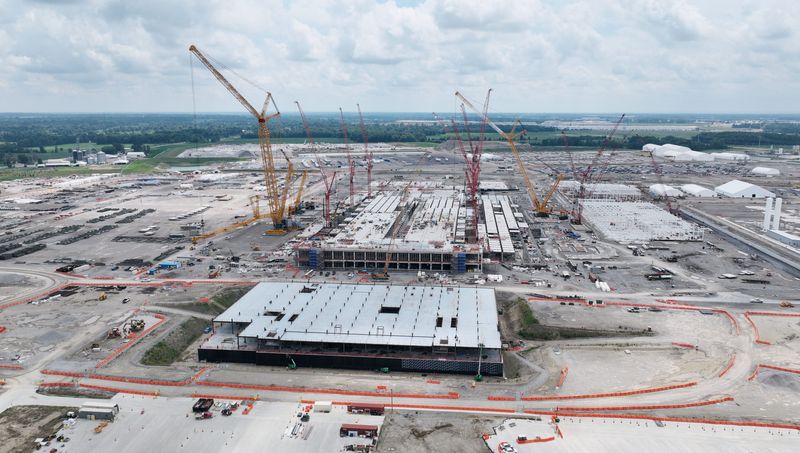
Construction equipment kept rolling just steps away from a temporary stage where some of the nation’s top political and tech leaders heralded Intel’s 2022 arrival in Ohio as what would turn the Rust Belt into the “Silicon Heartland.”
Not even a visit from the President of the United States for the groundbreaking ceremony could pause work on Intel’s Ohio factories that were set to open in 2025. In fact, momentum was so strong that Intel’s then-chief executive officer Pat Gelsinger boasted the company’s proposed $28 billion investment could grow to $100 billon and that as many as 10 factories could be built locally.

But three years since the 2022 groundbreaking, Intel is still in search of a customer for the chips it intends to make in Ohio and not a single factory has opened as financial turmoil has forced the chipmaker to repeatedly delay its New Albany fabs.
“Things are very much up in the air,” said Zach Schiller, research director at Policy Matters Ohio, a left-leaning think tank with offices in Columbus and Cleveland. “There are some people who think it might not happen at all, and that’s quite possible.”
Semiconductors were to begin rolling off factory lines this year at Intel’s Ohio One campus. Now, chips may not be produced locally until at least 2030 or 2031 as the company announced in July that it would “further slow” construction.
Despite the delays and financial troubles, Intel’s leaders have maintained they’re committed to building out the Ohio fabs and have reassured state and local leaders that the project will keep moving forward.
“With approximately $7 billion invested in Ohio through its fabrication plants project, Intel’s Ohio One facility is on track to produce chips made here in Ohio,” Dan Tierney, spokesman for Gov. Mike DeWine, told The Dispatch.
Intel expects to spend more than $1 billion on the project in 2025 alone. Among the construction expected to continue is pouring concrete for the fabs and support buildings, steel work and groundworks for support structures. Intel has already started hiring Ohioans and training them at pre-existing company facilities in Arizona, New Mexico and Oregon.
The shift in strategy is part of what Intel CEO Lip-Bu Tan in July described as a “systematic approach” to growing its foundry business in Ohio. Intel needs to find a “meaningful external customer” and demonstrate that “we can deliver” the products they need when they need them, he said during a July 24 earnings call.
“Intel is committed to advancing U.S. technology and manufacturing leadership, and Ohio One remains an important part of our long-term plans to expand leading-edge manufacturing on U.S. soil,” an Intel spokesperson told The Dispatch. “Based on the progress we have made in Ohio, we continue to have flexibility to adjust timelines based on customer demand.”
In an attempt to bolster Intel, President Donald Trump announced last month that the federal government would be taking a nearly 10% stake in the company.
The government will purchase the 433.3 million shares with funding from $5.7 billion in unpaid CHIPS Act grants and $3.2 billion awarded to Intel for the Secure Enclave program. At least $1.5 billion of that funding was set to go toward the New Albany project, according to the U.S. Department of Commerce.
Ohio is providing a $600 million reshoring grant for the factories, $691 million in infrastructure improvements and $650 million over 30 years in state income tax incentives based on the number of workers Intel hires. JobsOhio, the state’s private nonprofit economic development corporation has also provided $150 million to Intel.
The administration’s stake comes as semiconductors have become increasingly important to national security, with most made overseas.
While the government’s investment may look like a good endorsement, it may not be enough to convince customers that Intel can meet their needs, said Ryuta Makino, an analyst focused on semiconductors and software at Connecticut-based Gabelli Funds, which holds Intel stock. But, Makino said Intel’s future remains “very uncertain” and the next two years will prove critical as to whether the chipmaker can pull off a turnaround.
“It doesn’t really solve the overarching problem,” Makino said. “If Intel doesn’t find a customer in 2026 or 2027, then I could see the Ohio fabs being canceled outright.”
Is Intel’s government stake a ringing endorsement or ‘life support?’
How the government’s stake will be perceived by the semiconductor market and potential customers is yet to be seen. But Ohio’s senators have both expressed optimism over what the investment could mean.
Republican Sen. Bernie Moreno, who has repeatedly sounded the alarm on Intel’s unfinished factories, said the Trump administration’s investment will ensure New Albany isn’t left with an unfinished factory.
“It means it’s going to happen,” he told reporters during an Aug. 29 stop in Columbus. “It means that we can rally the troops to get them customers.”
Before joining Moreno in Congress, Republican Sen. Jon Husted helped bring Intel to Ohio as the state’s then-lieutenant governor.
When taking questions from reporters in Columbus on Aug. 29, Husted said Intel has assured him that “the Ohio fabs are still full steam ahead” despite the delays. While Husted previously said a government stake in Intel might make sense, he said that doesn’t change the fact that the chipmaker will still need to compete with other major semiconductor companies for customers.
“The element of competition does not go away just because the president took a stake in Intel,” Husted said. “They still have to innovate. They still have to prove that they can outcompete the other chip fab manufacturers across the globe.”
While Ohio’s senators may be bullish on what the government stake means for Intel’s prospects, policy experts told The Dispatch they’re concerned about what it might mean for the company and its future here.
Greg Lawson, research fellow at right-leaning think tank The Buckeye Institute, said he believes the federal stake makes it more likely that Intel will be able to complete its Ohio fabs.
But, Lawson fears Intel still won’t live up to its initial promise to hire 3,000 workers. And he worries that the government’s direct involvement may stifle what the chipmaker can do for the U.S. and Ohio in the long run.
“When the government gets involved, does the company make decisions because they’re being innovative or are they making political decisions?” Lawson said. “The thing that keeps America at the tip top of innovation is that we don’t do that… when you start blurring those lines, you run the risk of that ending.”
While some like Moreno or Lawson think the government stake makes Intel’s Ohio factories more likely to move forward, potential customers and Ohio taxpayers may see it as a sign that the company is dying, said Bailey Sandin, a work and wages fellow at Policy Matters Ohio and a leader of Chips Communities United, a coalition pressuring Intel to make good on its promises across the U.S.
Sandin and the group began speaking out several months ago, when Intel’s troubles began to look more and more problematic. Ever since, the “writing on the wall has been pretty evident” and Sandin said that more people are simply coming to terms with Intel’s reality.
“Ultimately it just shows that the company is on life support,” Sandin said of the government stake. “The future that Intel has promised… It’s increasingly starting to look like not a great deal.”
Local leaders let down but still hopeful about Intel’s future in Ohio
When Intel first announced its plans, local communities moved quickly to prepare for the chipmaker’s first plants.
Local governments poured money into improving infrastructure around the factory site. And local schools and universities have begun revamping programs to better train the workforce Intel will need in New Albany.
Now, massively widened roads and roundabouts remain largely unused and an AEP substation completed earlier this year has nothing to power, for now at least.
While the Intel site was annexed into the city of New Albany, it’s just outside the neighboring Licking County city of Johnstown. Since seeing one delay after another, Johnstown Mayor Donald Barnard said he’s no longer optimistic the company will build more fabs beyond the original two Intel promised.
“There’s just a lot of unknown and I feel like Johnstown is left having to answer all the questions,” he said. “The state has literally forgot about us and what they’ve done to us, and yet we get asked all the questions about Intel.”
New Albany Mayor Sloan Spalding is hopeful the factories will come to fruition. While he acknowledged the original 2025 timeline was ambitious, he said projects of this scale are complicated and don’t always go according to plan.
Still, Spalding said he’s confident a chip plant will open in New Albany in the not-so-distant future.
“I can’t wait to have the ribbon cutting at that facility, and know that through all the blood, sweat, and tears, if you will, that we were able to bring this manufacturing back to the United States,” he said.
As former farm fields turned into concrete slabs and shells of buildings were erected, local officials like Licking County Commissioner Tim Bubb were excited to see the factories come to life. Three years later though, Bubb said he’s frustrated that Intel has yet to fulfill its promises as the construction work that once seemed unstoppable has dramatically slowed.
While Bubb acknowledged the delays may be necessary to ensure Intel’s financial health and future in Ohio, the commissioner said he and others are eager for the day the factories are finished.
But, Bubb could be waiting at least five or six more years for that day to come.
“The brakes have been tapped,” he said. “We’re all waiting with bated breath to see what happens.”
USA TODAY Ohio Bureau Reporter Haley BeMiller contributed to this story.
Dispatch investigative reporter Max Filby can be reached by email at mfilby@dispatch.com. Find him on X at the handle @MaxFilby or on Facebook at @ReporterMaxFilby.
Eastern Columbus suburbs reporter Maria DeVito can be reached at mdevito@dispatch.com and @mariadevito13.dispatch.com on Bluesky and @MariaDeVito13 on X.
This article originally appeared on The Columbus Dispatch: ‘On life support’: 3 years after groundbreaking, Intel’s Ohio factories still unfinished
Reporting by Max Filby and Maria DeVito, Columbus Dispatch / The Columbus Dispatch
USA TODAY Network via Reuters Connect